





How to Verify Kosher Xanthan Gum for Label Claims and Supplier Compliance
For quality control and safety managers, verifying kosher xanthan gum is no longer just a paperwork exercise. It affects whether a label claim can stand up during customer review, whether an audit trail is complete, and whether a supplier can be trusted when production schedules tighten. In practice, the challenge is rarely the word “kosher” itself. The real issue is whether the certificate, product identity, manufacturing controls, and supply chain records all point to the same conclusion.
That matters even more for hydrocolloids. Xanthan gum sits in a part of formulation where small input changes can influence texture, suspension, process stability, and finished product consistency. FFAI, which closely tracks food preservation systems, rheological thickeners, flavors, fragrances, and other high-sensitivity ingredients across global FMCG markets, often approaches this category from a practical angle: compliance claims only work when they remain aligned with formulation reality, supplier controls, and market-specific documentation.
Why kosher verification goes beyond the certificate
A valid kosher certificate is the starting point, not the full verification package. Many internal teams discover this only when a customer questionnaire asks for more than a certificate copy. Buyers may want to know whether the exact grade used in a beverage stabilizer blend is covered. Auditors may ask whether the manufacturing site is the same site listed on the approval. Regulatory and label review teams may need evidence that the claim on the packaging matches the product sold and the ingredient received.
Kosher xanthan gum is typically derived through fermentation, and that often leads some teams to assume the product is automatically low-risk. It is lower-risk than some animal-derived ingredients, but “usually acceptable” is not the same as “verified.” Fermentation media, processing aids, shared equipment, plant controls, repacking activities, and private-label distribution can all create gaps between assumption and documentation.
Start with product identity, not branding
Before reviewing kosher documents, confirm that the product itself is clearly identified. This sounds basic, but it is where many mismatches begin. The certificate should be checked against the exact commercial product name, grade designation, internal item code if available, manufacturer name, and production site. If the supplier is a distributor, the chain from original manufacturer to distributor to your receiving site should be traceable.
For xanthan gum, grade differences may relate to mesh, viscosity profile, application use, or dispersion characteristics. If your formulation approval references one grade but the kosher certificate covers a broader family description, do not assume that every item inside that family is included. Ask for confirmation tied to the exact product sold.
Also compare the specification sheet, certificate of analysis format, and commercial invoice description. If one document refers to food-grade xanthan gum, another to industrial xanthan, and the kosher certificate uses a third naming format, the discrepancy needs to be resolved before a label claim is relied on.
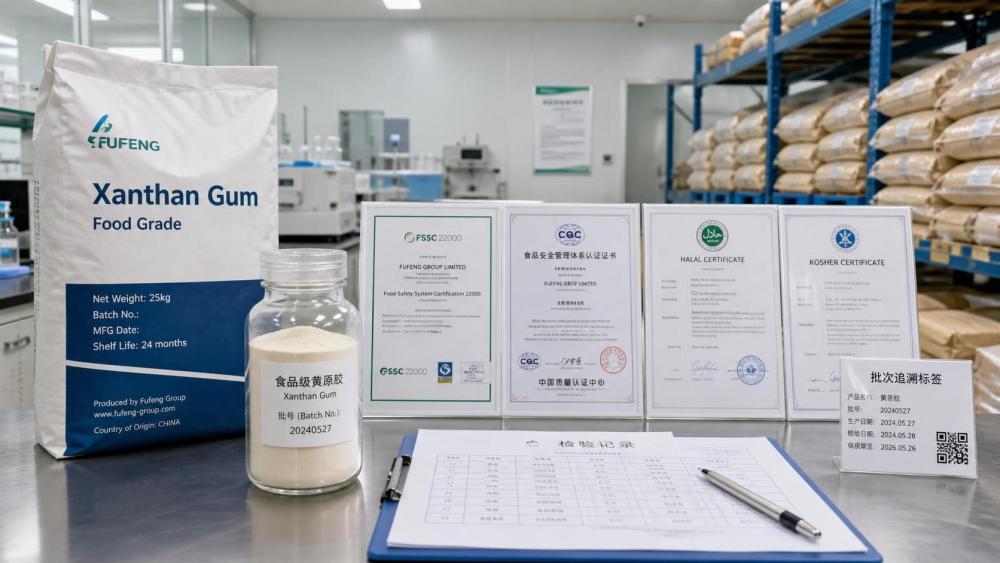
What to review on the kosher certificate itself
A proper review of the certificate should cover more than the presence of a recognizable symbol. Teams usually need to check:
- Issuing kosher certification body
- Certified company name and, where shown, manufacturing site
- Exact product listing or annex reference
- Certificate validity dates
- Relevant designation, such as Passover status if your market or customer specifically requires it
- Any restrictions, remarks, or product category notes
Validity dates deserve more attention than they often get. A certificate may be current today, while the lot you received was manufactured months earlier under a previous certification period. In many cases, that can still be acceptable if traceability is intact, but your file should show how the lot date, certificate period, and supplier confirmation fit together.
If the certificate is generic and does not list products clearly, ask for the official product schedule or manufacturer attestation referencing the exact grade. A marketing PDF is not a substitute for controlled certification records.
Supplier compliance records that should support the claim
The stronger approach is to build a layered file. For kosher xanthan gum, that file often includes the kosher certificate, product specification, COA template, allergen statement, non-GMO statement where relevant, process flow summary if available, and a supplier questionnaire covering site controls and change management. Not every project needs the same level of depth, but relying on one document alone leaves too much room for ambiguity.
Quality teams should pay particular attention to change notification. A supplier may keep the same product name while changing the manufacturing site, fermentation input sourcing, drying subcontractor, or repacking arrangement. None of those automatically cancel kosher status, but they can change what evidence is needed. If your approval system does not capture these shifts, the label claim may remain unchanged while the underlying compliance basis has moved.
This is where FFAI’s intelligence-driven view is useful. Ingredient compliance is rarely isolated. A thickener used in a clean-label dairy dessert may sit alongside preservatives, flavors, pigments, or active systems that each bring their own certification and market-entry conditions. The better managed the documentation architecture, the less friction appears later in audits, export checks, or retailer reviews.
Common sourcing risks that can weaken a kosher claim
Some risks appear again and again, especially in multi-country sourcing.
Another practical risk is overreliance on historic approvals. If a supplier has been used for years, teams sometimes stop rechecking certificates with the same discipline they apply to new vendors. That is understandable, but it is also how obsolete records survive in approved supplier files.
How label claims should be tied to internal controls
A kosher ingredient does not automatically justify every type of kosher claim on finished packaging. The internal review should connect ingredient status with the finished product standard used by the company or customer. For some businesses, the claim depends on all ingredients, plant conditions, line clearance, and third-party oversight of the finished goods. In that context, verified kosher xanthan gum is necessary but not sufficient.
What quality managers can control is the integrity of ingredient-level evidence. That means approved supplier lists should indicate certification status, expiration tracking, and any conditional notes. Incoming goods procedures should confirm the product name and supplier match approved records. Label approval teams should be able to see whether the claim basis is current, partial, or pending further review.
If your business ships into multiple markets, be careful with the assumption that one kosher document set satisfies every customer. Some customers accept a standard certificate and specification package. Others want direct confirmation from the certifying body, or require additional statements covering processing, transport, or contract packing arrangements. This usually needs to be checked case by case.
Questions worth asking suppliers before approval
A few targeted questions often reveal more than a stack of generic declarations:
- Is the certificate issued for the manufacturer, the packer, or only the seller?
- Does the certified scope cover the exact xanthan gum grade and production site supplied to us?
- Have there been recent changes in raw material sourcing, fermentation media, subcontract processing, or repacking?
- Can lot numbers be traced back to the certified plant and production date?
- What is the process for notifying customers of certification changes or suspension?
These are not aggressive questions. They are basic safeguards, especially for ingredients that move through global distribution channels where the commercial seller is not always the original producer.
A workable verification routine
In day-to-day operations, the most reliable routine is fairly simple: verify the product identity, validate the kosher certificate, map the document to the manufacturing source, review supporting compliance records, and monitor change control. If a gap appears, resolve it before the ingredient is linked to a label claim. That approach is less glamorous than chasing broad “clean label” positioning, but it prevents costly contradictions later.
For a category like xanthan gum, where rheology, customer specs, and global sourcing often intersect, disciplined verification is not a bureaucratic burden. It is part of good formulation governance. FFAI’s broader work across thickeners, preservatives, sensory systems, and compliance intelligence reflects the same principle: ingredient performance and ingredient claims should never be managed in separate silos.
If your current file on kosher xanthan gum consists of a certificate saved years ago and a specification sheet from a distributor, that is usually a sign to rebuild the approval package. Not because the claim is necessarily wrong, but because it may not be defensible enough when someone finally asks the harder questions.
Related News
- How to verify a cosmetic nanotechnology supplier's safety documentationOct 04, 2026Dr. Chloe Vance
- How to set a control sensory flavour standard for panel consistencySep 27, 2026Dr. Chloe Vance
- How to verify compliance documents for cosmetic active compoundsSep 19, 2026Dr. Chloe Vance
- How to verify food grade flavor formulation ingredients for safetySep 18, 2026Dr. Chloe Vance
Related News
- 00
0000-00
Verifying halal status of hydrocolloid ingredients in the Middle East - 00
0000-00
How to interpret active matter on a surfactant specification sheet - 00
0000-00
What Quality Checks Should You Run on Fragrance Ingredient Suppliers? - 00
0000-00
How to assess a flavor chemistry manufacturer's batch consistency - 00
0000-00
What drives fragrance ingredients price changes in bulk orders?
Dr. Chloe Vance
Weekly Insights
Stay ahead with our curated technology reports delivered every Monday.