





A GRAS ingredient compliance audit rarely becomes stressful because of one missing file. More often, it turns into a problem when small gaps appear across the whole record set: a formulation change was not logged clearly, a supplier statement is outdated, or the safety rationale is spread across too many folders. By the time the audit date gets close, the team is no longer checking compliance—they are trying to reconstruct it.
If you work in quality control or safety management, that pressure will sound familiar. A GRAS ingredient compliance audit is not only about showing that an ingredient is generally recognized as safe; it is about proving that the documentation, controls, and internal decisions still match the way the ingredient is actually used. When that alignment is weak, the risk is not just a difficult audit conversation. It can affect release decisions, supplier approval, and how quickly a product moves through review.
Start with the question auditors will ask first
The most useful preparation step is simple: can you explain, in plain language, why this ingredient is considered GRAS in your specific use? Many teams keep a folder full of papers, but the file set does not always tell a clear story. An auditor will usually want to see the ingredient identity, intended use level, food category, manufacturing process, and the safety basis behind the conclusion. If those points are scattered, preparation becomes harder than it needs to be.
That is why the first pass should be a narrative review, not a document dump. Read through the ingredient record as if you were a newcomer to the project. Ask whether someone outside the original team could follow the logic from source material to current use. If the answer is no, the record needs restructuring before the audit begins.
Separate “supporting evidence” from “working evidence”
A common mistake is to assume every internal note has equal value. It does not. Some items belong in the formal audit package; others are useful only as background during internal review. Mixing them together can create confusion, especially when versions do not match.
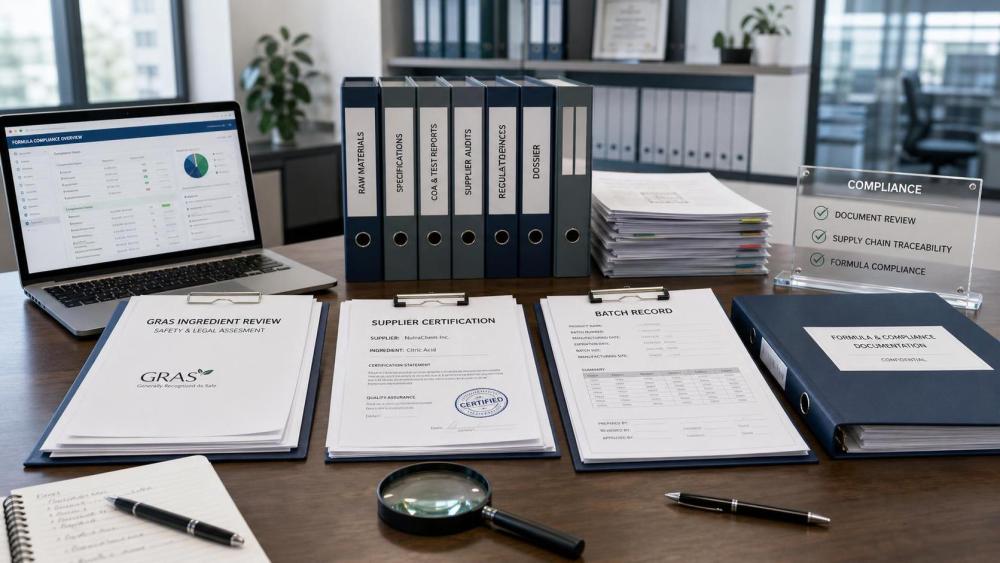
For a GRAS ingredient compliance audit, it helps to divide materials into three groups:
- Core documents: identity, composition, specification, intended conditions of use, and the basis for the GRAS determination.
- Control records: supplier qualification, incoming inspection, change control, batch records, and deviation handling.
- Reference materials: technical literature, internal research notes, and correspondence that explain how the decision was formed.
This separation makes it easier to see where the real gaps are. If the core package is complete but control records are weak, the issue is usually operational. If the safety rationale itself is thin or outdated, the issue is more fundamental.
Check where most audits usually slow down
In practice, delays often happen in the same places: ingredient identity, supplier consistency, use-level justification, and change management. These are the points where a file can look complete on the surface but still fail a close review.
Ingredient identity should be precise enough to avoid confusion with similar materials. Supplier documentation should match the exact ingredient used in production, not a broader family description. Use levels should be traceable to formula records and actual product applications. And if the ingredient has been reformulated, re-sourced, or processed differently, the change must be reflected in the safety file.
One overlooked issue is silence in the record. If a supplier changed a subcomponent, or if the manufacturing process shifted in a way that could affect impurity profiles, the absence of a note can create more concern than the change itself. Auditors do not just read what is present; they also notice what is missing.
Build the file the way you would defend it
When teams prepare only for document collection, they often miss the chance to strengthen the logic behind the file. A better approach is to build the package in the same order you would use to answer questions under review.
Begin with a one-page internal summary. It does not need to be polished, but it should state the ingredient name, function, intended food use, and the basic safety position. Then attach the supporting sections in a sequence that follows that summary. If an auditor asks why the ingredient is safe at the intended level, the path from claim to evidence should be easy to trace.
For many teams, this is also the point where a structured review tool or controlled document system becomes useful. It is not about adding complexity; it is about keeping the latest approved version visible, recording ownership, and reducing the chance that someone sends an outdated file during audit prep.
Use a short internal review before the audit date
An internal review works best when it is practical, not ceremonial. Instead of asking, “Is this compliant?” ask, “Could we explain this ingredient to an auditor without opening another five files?” That question usually exposes the real weaknesses.
Look for the following pressure points:
- Does the ingredient description match what is used in production?
- Are supplier documents current and tied to the right material?
- Is the intended use consistent across technical, quality, and regulatory records?
- Have any changes been reviewed and closed properly?
- Can the safety rationale still be followed without specialist interpretation?
If a section relies on one person’s memory, it is not ready. If the file needs side explanations to make sense, it is not ready either. The goal is not perfection; it is a record that can survive scrutiny without constant repair.
Where teams should be careful with GRAS records
Two problems appear often. The first is treating the GRAS position as a one-time event. The second is assuming that ingredient use is unchanged simply because the label looks the same. Both habits create trouble.
A GRAS file should stay connected to real-world operations. That means review after supplier changes, formulation adjustments, process updates, or new applications. It also means not relying on old approval language when the ingredient’s role in the formula has shifted. Even a modest change in use level or product type may require fresh internal evaluation.
For teams managing multiple ingredients, a central review list helps. It does not need to be complicated. A simple register that tracks status, last review date, responsible owner, open questions, and linked supporting files can prevent most last-minute surprises.
When to bring in outside regulatory support
Some issues are best handled internally, but not all. If the safety rationale is difficult to trace, if the documentation trail crosses several legacy systems, or if the ingredient has an unusual use pattern, outside regulatory support can help test the file before the audit does. The value is not in replacing the internal team. It is in spotting weak points early enough to fix them calmly.
For organizations that handle complex ingredient portfolios, a focused compliance review can also help clean up terminology, align file ownership, and confirm whether the current dossier still matches the intended use. That kind of support is especially useful when the audit calendar is close and the team needs a practical reading of what will likely attract questions.
In the end, preparing for a GRAS ingredient compliance audit is less about collecting more documents and more about making the existing record usable. If the story is clear, the controls are current, and the change history is visible, the audit becomes much easier to manage. If not, the best time to fix it is before anyone asks.
Related News
- How to verify a cosmetic nanotechnology supplier's safety documentationOct 04, 2026Dr. Chloe Vance
- How to set a control sensory flavour standard for panel consistencySep 27, 2026Dr. Chloe Vance
- How to verify compliance documents for cosmetic active compoundsSep 19, 2026Dr. Chloe Vance
- How to verify food grade flavor formulation ingredients for safetySep 18, 2026Dr. Chloe Vance
Related News
- 00
0000-00
Verifying halal status of hydrocolloid ingredients in the Middle East - 00
0000-00
How to interpret active matter on a surfactant specification sheet - 00
0000-00
What Quality Checks Should You Run on Fragrance Ingredient Suppliers? - 00
0000-00
How to assess a flavor chemistry manufacturer's batch consistency - 00
0000-00
What drives fragrance ingredients price changes in bulk orders?
Dr. Chloe Vance
Weekly Insights
Stay ahead with our curated technology reports delivered every Monday.