





How to screen personal care flavor and fragrance ingredients for allergens
A fragrance blend can meet sensory specifications yet still introduce allergens that complicate product safety and labeling. Screening flavors and fragrances ingredients for personal care requires more than checking a supplier’s allergen declaration. It means verifying ingredient identities, reviewing composition and oxidation risks, and assessing exposure against applicable market requirements. A useful screening workflow connects these tasks so that missing information becomes an approval decision—not an overlooked attachment.
The central distinction is simple: identifying a sensitizing substance, deciding whether it needs individual labeling, and establishing safe use are different exercises. Passing one does not automatically satisfy the others.
Define the exposure before requesting an allergen panel
Start with the finished product, not the fragrance bottle. A rinse-off shampoo, leave-on body lotion, lip balm, and toothpaste can use related aroma materials but create different exposure conditions. Record the intended market, product classification, application site, maximum use concentration, frequency of use, and whether foreseeable use includes oral exposure.
For lip and oral-care products, “food grade” is not enough. Suitability for ingestion does not establish suitability for repeated skin or mucosal contact. Likewise, a cosmetic ingredient assessment does not automatically resolve food-allergen questions where protein-containing materials or cross-contact could be relevant. Keep fragrance contact sensitization and food-protein allergy as separate screening tracks.
Distinguish allergic contact dermatitis from irritation as well. Stinging from an oral-care flavor or redness after a strongly fragranced wash does not, by itself, establish allergy. Both deserve investigation, but the evidence needed and corrective actions may differ.
Build a supplier dossier that supports an actual decision
A safety data sheet is useful for handling hazards, but it is not a complete cosmetic allergen assessment. Disclosure rules and concentration cutoffs can leave relevant constituents outside its composition section. Request documents tied to the exact material code and current formulation revision.
- Identity: INCI name, chemical names, CAS identifiers where applicable, and botanical species, plant part, and extraction method for natural materials.
- Composition: quantitative allergen information, including constituents contributed by essential oils, extracts, carriers, and other blend components.
- Regulatory scope: the market requirements and allergen list covered, document date, and any exclusions or reporting limits.
- Use restrictions: an IFRA Certificate of Conformity where applicable, identifying the intended product category and relevant Standards amendment.
- Quality controls: specifications, representative analytical results, shelf life, storage conditions, and supplier change-notification commitments.
Ask what a reported zero means. It may mean “not intentionally added,” “not detected,” or “below the reporting threshold.” These are not interchangeable. Where commercial confidentiality prevents full disclosure, arrange confidential access for the qualified safety assessor rather than accepting an unsupported assurance.
Natural origin deserves particular attention. Botanical composition can vary with source, harvest, and processing. A generic declaration for an essential oil may not adequately represent the supplied grade. Compare its specification with batch evidence and determine whether upper-bound concentrations are needed for exposure and labeling calculations.
Separate legal labeling rules from safe-use limits
For EU cosmetics, Regulation (EC) No 1223/2009 and its current annexes are the starting point. Commission Regulation (EU) 2023/1545 expanded individual fragrance-allergen labeling requirements. For the relevant Annex III entries, declaration thresholds are generally above 0.001% in leave-on products and 0.01% in rinse-off products, measured in the finished cosmetic. Check each applicable entry for its exact substance scope, naming rules, and conditions.
The amendment provides transition arrangements allowing qualifying products that comply with the previous requirements to be placed on the EU market until 31 July 2026 and made available until 31 July 2028. These are different supply-chain events. Launch planning should use the actual legal text and product circumstances, not treat either date as a universal labeling deadline.
An allergen declaration threshold is not a safe-use limit. A concentration below that threshold does not establish absence of sensitization risk, particularly for already sensitized consumers. Conversely, a required label declaration does not automatically make an otherwise compliant product unacceptable.
IFRA Standards provide a separate framework for restrictions, prohibitions, and specifications. A supplier’s conformity certificate should match the intended end-use category; it is not an IFRA-issued product approval or a replacement for the finished-product safety assessment. Other markets require separate checks. Food-use status, EU CPNP notification, and cosmetic safety substantiation are also distinct matters: none should be presented as interchangeable approvals.
Calculate contributions across the whole formula
The relevant concentration is not necessarily the amount supplied by the main perfume compound. The same allergen can enter through a flavor blend, botanical extract, masking fragrance, or another multifunctional ingredient. Build a contribution calculation using consistent units and add all identified sources.
Finished-product allergen concentration (%) = raw-material use level (%) × allergen concentration in that material (%) ÷ 100.
As a hypothetical calculation, a fragrance used at 0.8% containing 2% of a particular allergen contributes 0.016% of that substance to the finished product. Any contribution from other ingredients must then be added. This arithmetic supports labeling review; it does not establish a safe exposure level.
Where suppliers report ranges, use a justified upper bound for screening. Avoid rounding down near a declaration threshold, and account for manufacturing tolerances and analytical uncertainty. If the decision changes within the plausible concentration range, obtain better evidence or reformulate rather than approving on the most favorable number.
Use targeted testing to close specific evidence gaps
Testing is most useful when it answers a defined question: does a higher-risk botanical meet its specification, does a supplier declaration cover the required substances, or is the finished-product concentration close to a labeling threshold? Ordering a generic “allergen screen” without an analyte list can produce an impressive report that misses the actual concern.
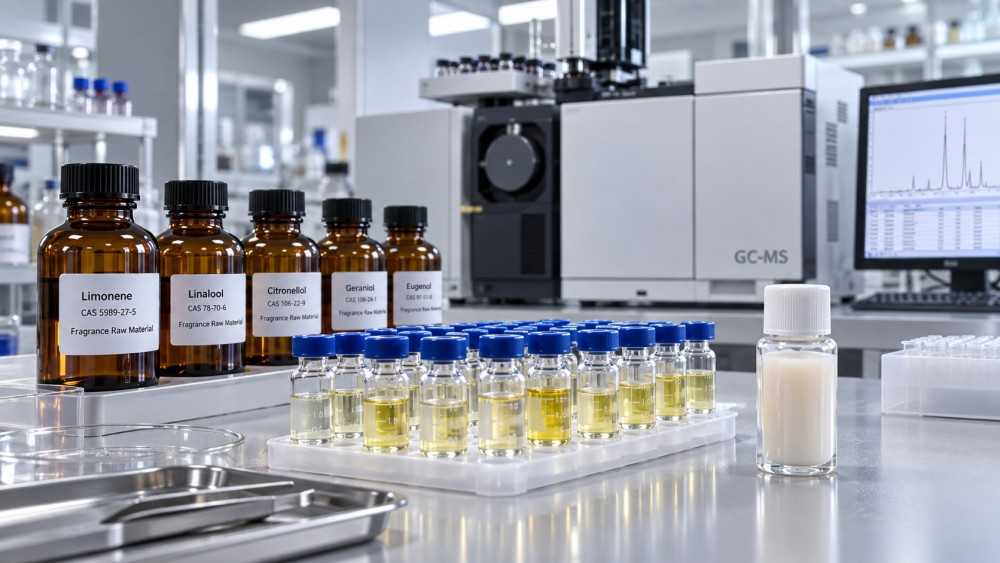
GC-MS is widely used for many volatile fragrance constituents. Quantitative work requires suitable calibration, reference standards, and demonstrated separation—not just a library match. Some substances or degradation products need other approaches, including validated liquid-chromatography methods. The laboratory should justify method suitability for the analytes and sample matrix.
Before commissioning analysis, agree on:
- The exact substances, isomers, or grouped entries being assessed.
- Whether the sample is a neat ingredient, fragrance concentrate, or finished product.
- Limits of detection and quantification appropriate to the decision threshold.
- Recovery, selectivity, matrix interference, and measurement uncertainty.
- How non-detects, unresolved peaks, and results near specification limits will be reported.
A non-detect means the method did not detect the target above its detection capability. It does not prove absence, and a targeted panel cannot rule out every possible sensitizer. ISO/IEC 17025 accreditation can support confidence in laboratory competence, but verify that the relevant method and matrix fall within the laboratory’s accredited scope.
Screen what develops during storage, not only what arrives
Limonene and linalool illustrate why fresh-material results can be incomplete. Exposure to air can generate oxidation products, including hydroperoxides associated with contact allergy. Measuring only the parent molecules does not fully characterize this risk.
Review container headspace, repeated opening, light exposure, temperature, and storage duration. For susceptible materials, consider justified oxidation specifications and targeted analytical methods. A peroxide value may help monitor oxidation in an appropriate material, but it is not a universal measurement of individual allergenic hydroperoxides.
The finished product also matters. Packaging, antioxidants, and the formulation environment can influence stability, so raw-material data alone may not represent exposure throughout use. Stability studies should reflect the intended pack and reasonably foreseeable storage conditions. Accelerated testing can reveal problems, but it does not automatically predict every chemical change over shelf life.
Turn the evidence into controlled approval
An approval record should identify the material revision, permitted product categories, maximum assessed use level, markets covered, required labeling, and unresolved conditions. Missing quantitative data, an unsuitable analytical limit, or a category mismatch should trigger a hold or a clearly restricted decision—not an unconditional release.
Do not use a routine patch test as a shortcut around incomplete composition or exposure evidence. Human testing requires appropriate scientific and ethical oversight, and a negative result cannot guarantee that no consumer will develop an allergy.
After approval, re-screen when the supplier changes composition, botanical sourcing, extraction, manufacturing, or specifications. Regulatory updates, packaging changes, higher fragrance loading, and relevant complaint patterns can also invalidate earlier assumptions. Link purchasing controls to the approved material revision so that a replacement grade cannot silently bypass review.
For an intelligence portal such as The Global Food, Fragrance & Active Ingredients (FFAI), the useful connection is between molecular behavior, regulatory requirements, and practical formulation decisions. Tracking a rule change is only part of the work; teams also need to understand which supplier declarations, analytical panels, and formula calculations must change with it.
Before releasing the next ingredient, check three things together: whether its composition is sufficiently known, whether the evidence represents intended use and storage, and whether the finished-product calculation supports the proposed label. If one remains unresolved, make that gap visible in the approval record.
Related News
- How to check a fragrance raw material specification for IFRA complianceNov 12, 2026Dr. Chloe Vance
- Are synthetic flavors in food required to be FDA approved?Nov 10, 2026Dr. Chloe Vance
- How to review a supplier's GRAS claim for an intended food useNov 09, 2026Dr. Chloe Vance
- Cosmetic compliance guide to IFRA fragrance limitsOct 31, 2026Dr. Chloe Vance
Related News
- 00
0000-00
Wissen Research: Global Cosmetics Market to Reach $497.2 Billion by 2031 - 00
0000-00
Can biomimetic peptides improve skin firmness? - 00
0000-00
China Records 543 New Cosmetic Ingredients, Including 167 in 2026 - 00
0000-00
How to check a fragrance raw material specification for IFRA compliance - 00
0000-00
Australia and New Zealand Weigh Wider Steviol Glycoside Use in Griddle Products
Dr. Chloe Vance
Weekly Insights
Stay ahead with our curated technology reports delivered every Monday.