





How to Verify FDA Compliance for Rheological Thickeners
For quality-control and safety professionals, verifying that rheological thickeners are FDA compliant is not simply a paperwork exercise. It protects product safety, label credibility, and access to the U.S. market.
A defensible review connects ingredient identity, intended use, regulatory status, supplier evidence, specifications, manufacturing controls, and traceability. The central question is not whether a supplier says “FDA approved,” but whether the documented use is legally supported.
Start With the Correct Regulatory Question
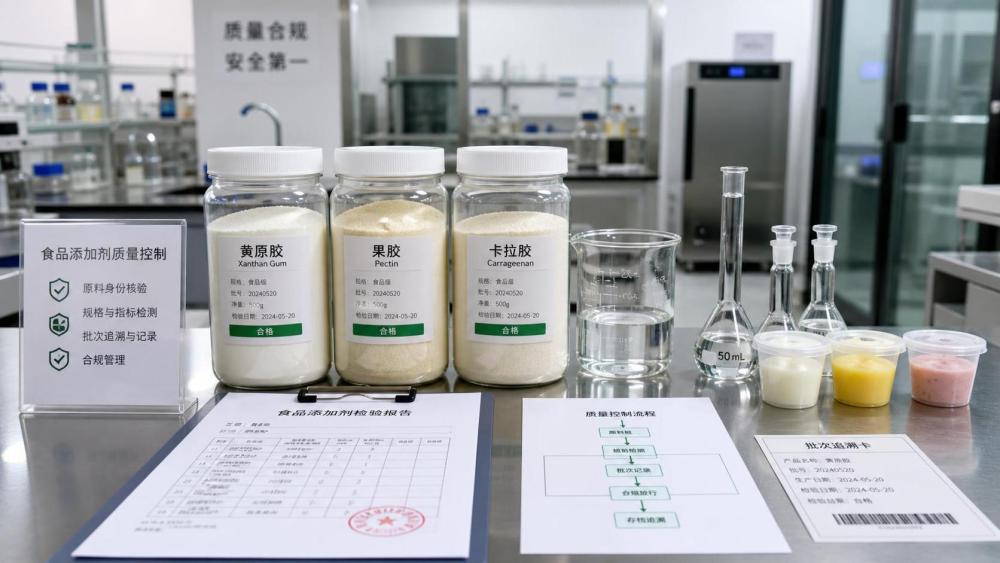
The phrase “FDA compliant” is widely used in sales materials, but it can be misleading. FDA generally does not approve most food ingredients, including many rheological thickeners, before market introduction.
Instead, manufacturers must establish that an ingredient is lawful for its specific intended use. For food applications, this normally means an applicable food additive regulation, a valid GRAS basis, or another recognized legal authorization.
Quality teams should therefore avoid accepting broad statements such as “FDA approved,” “FDA registered,” or “FDA compliant” without supporting regulatory references, technical documents, and a defined use scenario.
Rheological thickeners are ingredients that modify flow, viscosity, suspension, gel strength, mouthfeel, stability, or texture. Common examples include xanthan gum, guar gum, carrageenan, pectin, cellulose derivatives, alginates, and modified starches.
Compliance depends on more than the ingredient name. The botanical or chemical source, grade, manufacturing process, purity profile, food category, concentration, processing conditions, and final product claims can all affect the assessment.
A useful internal rule is simple: verify the use, not merely the material. A thickener may be acceptable in one food category, at one level, yet unsuitable for another application.
Define the Ingredient Identity Before Reviewing Regulatory Status
The first verification step is confirming precisely what material the supplier is offering. Trade names, generic labels, and marketing descriptions are insufficient for a compliance decision.
Request the complete ingredient identity, including common name, chemical name where applicable, CAS number, botanical source, standardized composition, production organism, processing aids, and relevant synonyms.
For fermentation-derived hydrocolloids, the dossier should identify the production microorganism and explain whether genetic modification, substrate residues, enzymes, antibiotics, or purification aids are involved in manufacturing.
For plant-derived gums, confirm the specific source material and extraction method. “Natural gum” is not a regulatory identity, and different gums can have different specifications and permitted uses.
Modified starches and cellulose derivatives require particularly close attention. Their legal status can depend on the modification chemistry, degree of substitution, residual reactants, and applicable food additive regulation.
Ask suppliers to provide a current technical data sheet, specification sheet, certificate of analysis template, safety data sheet, allergen statement, GMO statement, and manufacturing flow diagram where appropriate.
Identity records should match across all documents. Differences between the purchase specification, certificate of analysis, label declaration, and regulatory letter are a warning that requires investigation.
Match the Thickener to Its Intended Food Use
Once identity is established, document the intended use with operational precision. This is where many otherwise credible FDA compliance claims become incomplete or unusable.
Describe the finished product category, such as dairy beverage, plant-based yogurt, bakery filling, sauce, infant formula, confectionery, nutritional supplement, or beverage concentrate.
Record the maximum use level in the finished food, not only the dosage added during premix production. Include expected carryover from compound ingredients and processing losses where relevant.
Also identify the thickener’s technical function. It may act as a stabilizer, emulsifier, binder, suspending agent, bodying agent, gelling agent, film former, or texturizer.
FDA regulations and GRAS conclusions are often linked to function and conditions of use. A supplier letter that omits these details may not support the actual commercial application.
Consider vulnerable consumer groups early. Products directed toward infants, young children, medical nutrition users, or highly sensitive populations can require a more conservative regulatory and toxicological review.
For multi-market products, keep the U.S. intended use separate from European Union, United Kingdom, Canadian, or other regional evaluations. A permitted use elsewhere does not establish U.S. compliance.
Determine Whether the Legal Basis Is Food Additive Approval or GRAS
Most food-use verification begins by identifying the ingredient’s legal pathway. The two most common pathways are an FDA food additive regulation and a Generally Recognized as Safe, or GRAS, conclusion.
Some substances are regulated under specific sections of Title 21 of the Code of Federal Regulations. These provisions may define identity, purity, functional limitations, and permitted food uses.
When relying on a regulation, quality teams should save the exact citation and compare every limitation against the planned formulation. Do not rely on abbreviated supplier summaries alone.
A GRAS conclusion is different from FDA approval. It is based on qualified experts recognizing the safety of the substance under its intended conditions of use.
Some companies submit a GRAS notice to FDA. If FDA responds with a “no questions” letter, that correspondence is valuable evidence, but it still applies only to the evaluated identity and uses.
Other GRAS conclusions may be self-determined and not submitted to FDA. These can be lawful, but supplier documentation should be sufficiently detailed for your company’s risk-based review.
Request the GRAS notice number, FDA response letter, public GRAS dossier, or an appropriately detailed GRAS opinion. A one-page declaration without exposure and use information is weak evidence.
Where the ingredient is covered by a self-GRAS determination, assess whether the conclusion addresses the same material, manufacturing method, specifications, and maximum use level planned for your product.
Review Specifications, Purity Limits, and Contaminant Controls
Regulatory status alone does not prove that each delivered lot is compliant. Quality assurance must confirm that the actual commercial grade consistently meets applicable identity and purity expectations.
Start with the supplier specification and compare it with relevant FDA requirements, Food Chemicals Codex monographs, customer standards, and internal risk assessments.
Key parameters may include viscosity, pH, moisture, ash, particle size, microbial limits, heavy metals, residual solvents, pesticide residues, protein content, and foreign material controls.
For fermentation products, consider residual sugars, organic acids, microbial by-products, endotoxins where relevant, and limits for viable production organisms. The appropriate tests depend on the ingredient and use.
For botanical gums and seaweed-derived materials, evaluate risks related to heavy metals, iodine, microbiological contamination, agricultural residues, and geographical sourcing variability.
Confirm that analytical methods are defined, current, and suitable for the stated limits. A certificate of analysis is useful only when the reported tests, methods, frequencies, and specifications are meaningful.
Set a clear incoming-release strategy. It may include supplier certificates, periodic verification testing, enhanced testing for high-risk origins, and immediate escalation when results approach specification limits.
Verify Food Contact Compliance When the Thickener Is Not Directly Added to Food
Not every rheological thickener enters food as an intentional ingredient. Some are used in coatings, adhesives, packaging systems, processing aids, filters, or other food-contact applications.
In these cases, food ingredient documentation may not be sufficient. The relevant question is whether the material is authorized for its specific food-contact use and expected migration conditions.
Ask whether the thickener is used in direct food contact, indirect food contact, or both. Identify the substrate, temperature, food type, contact time, and maximum concentration in the finished article.
Relevant support may include a food-contact regulation citation, effective Food Contact Notification reference, letter of guaranty, migration assessment, or supplier compliance statement tied to the intended conditions.
Do not assume that a food-grade thickener automatically complies in packaging. Food-contact authorization can depend on the polymer system, use conditions, extraction profile, and additives used alongside the thickener.
Assess Supplier Documentation as a Connected Evidence Package
A reliable compliance file is not a single certificate. It is a connected evidence package that allows a reviewer to trace the conclusion from product identity to finished-product use.
At minimum, retain supplier legal status statements, regulatory citations, GRAS support where applicable, specifications, certificates of analysis, allergen declarations, GMO information, and country-of-origin details.
For higher-risk materials, request audit reports, food safety certifications, change-control procedures, contaminant monitoring plans, recall history, and evidence of supplier qualification under your approved-vendor program.
Review document dates carefully. A regulatory letter issued years ago may remain relevant, but specifications, manufacturing sites, raw material sources, and legal interpretations can change over time.
Supplier declarations should identify the exact product code and manufacturing site. Generic letters covering “all products” often fail to address relevant differences in grade, process, or intended use.
Quality teams should define document renewal intervals based on risk. Annual confirmation may suit critical thickeners, while lower-risk materials may follow a longer but still controlled review cycle.
Confirm Labeling, Allergen, and Claim Implications
FDA compliance for rheological thickeners also affects finished-product labeling. The ingredient declaration must accurately reflect the substance used and comply with applicable labeling conventions.
Confirm the common or usual name expected for the ingredient. A supplier trade name should not appear on the consumer label unless it also meets labeling requirements.
Assess whether the thickener contributes allergens, sulfites, processing residues, or other disclosure concerns. This is especially important for materials derived from wheat, soy, milk, shellfish, or fermentation media.
Clean-label claims require careful substantiation. “Natural,” “no artificial ingredients,” “plant-based,” and similar claims can create risk when the ingredient has been chemically modified or extensively processed.
Do not allow marketing language to override regulatory facts. A compliant food additive or GRAS ingredient can still create label or consumer-expectation concerns in a particular product positioning strategy.
Build a Practical Verification Workflow for Quality Teams
A structured workflow improves consistency and reduces approval delays. Assign ownership across regulatory affairs, quality assurance, procurement, product development, and supplier quality rather than relying on informal decisions.
First, collect the ingredient identity and intended-use profile before procurement approval. This prevents teams from evaluating a generic material while development is already using a specific grade.
Second, identify the legal basis and verify it against the intended food category, technical function, use level, and consumer population. Record citations and source documents in the approval file.
Third, compare specifications and contaminant controls against both regulatory requirements and internal risk thresholds. Define which parameters require every-lot certificates and which require periodic independent testing.
Fourth, complete supplier qualification and document any gaps. A supplier may provide a legally acceptable ingredient while still failing your company’s expectations for traceability, auditability, or change notification.
Fifth, review the finished label, claims, and food-contact implications. Complete this step before commercial launch, because reformulation after artwork approval is expensive and disruptive.
Finally, establish re-evaluation triggers. These should include new supplier sites, process changes, specification revisions, new product categories, increased use levels, regulatory developments, complaints, and adverse testing results.
Recognize Common Red Flags Before Approval
Several warning signs should pause the approval process. The most common is a supplier statement claiming “FDA approved” without a CFR citation, GRAS documentation, or clear intended-use limitations.
Another red flag is inconsistent identity across documents. Differences in botanical source, CAS number, product code, viscosity grade, or manufacturing location may indicate that the evidence does not cover the supplied material.
Be cautious when a GRAS notice concerns one grade but the supplier offers another. Changes in production strain, purification method, molecular weight distribution, or impurity profile can materially affect relevance.
Missing contaminant data is also significant. A thickener may meet viscosity and microbiological specifications while lacking adequate controls for heavy metals, pesticide residues, residual solvents, or process-related impurities.
Escalate broad claims such as “suitable for all food applications.” Legal permissions are often conditional, and formulations involving infant nutrition, supplements, high-temperature processing, or food contact deserve closer review.
Maintain Traceability After the Initial Compliance Decision
Verification does not end when the ingredient enters the approved-material list. Ongoing traceability is necessary to demonstrate continued control during audits, customer reviews, investigations, and recalls.
Link each incoming lot to the supplier certificate, batch record, receiving inspection, storage location, production batch, finished-product lot, and distribution record. Electronic systems should preserve this relationship clearly.
Maintain version control for specifications and regulatory documents. Teams should be able to show which evidence supported a decision at the time a particular lot was received and used.
Change-control agreements are particularly valuable for rheological thickeners because small shifts in molecular characteristics can affect both product performance and the applicability of prior compliance evidence.
Include compliance review in supplier performance meetings. Repeated late certificates, unexplained specification trends, document inconsistencies, or unreported changes should influence supplier risk ranking and corrective actions.
Conclusion: Make “FDA Compliant” a Verifiable Product-Specific Decision
For quality-control and safety professionals, verifying rheological thickeners FDA compliant requires a product-specific evidence review, not acceptance of a general supplier claim.
Confirm the exact ingredient identity, intended use, legal pathway, purity profile, supplier controls, labeling implications, and traceability system. Each element supports the others and exposes gaps early.
The strongest compliance decision is one that can be explained clearly to an auditor, customer, regulator, or internal management team using current, organized, and use-relevant documentation.
When evidence is incomplete, treat the issue as a controlled approval gap rather than a commercial inconvenience. That discipline protects consumers, preserves market access, and strengthens confidence in every finished formulation.