





A safety file for a nano-enabled cosmetic ingredient should allow an independent reviewer to answer four questions without relying on promotional claims: what particles are present, how they behave in the delivered material and finished formula, what exposure they create, and whether the evidence applies to the intended market. A document set is weak when it answers these questions with generic statements such as “non-toxic,” “nano-safe,” or “compliant” but does not identify the tested material, method, batch, or use conditions.
Start by defining the material under review with enough precision to distinguish it from a conventional grade of the same substance. For cosmetic nanotechnology, the ingredient name alone is rarely sufficient. Titanium dioxide, zinc oxide, silica, lipids, metals, and polymeric carriers can have very different safety profiles when particle size, coating, shape, solubility, agglomeration state, or surface treatment changes. A supplier’s documentation should describe the commercial material rather than an idealized primary particle described in a scientific paper.
Establish the identity of the actual nano-material
Request a current technical specification, safety data sheet, certificate of analysis template, full composition statement, and a description of the manufacturing route or critical process controls. The purpose is to establish traceability between the product being offered, the batches being tested, and the batches that will be supplied. A nano-form has to be identifiable across those records even when it is sold as a dispersion, powder, encapsulated active, or premix.
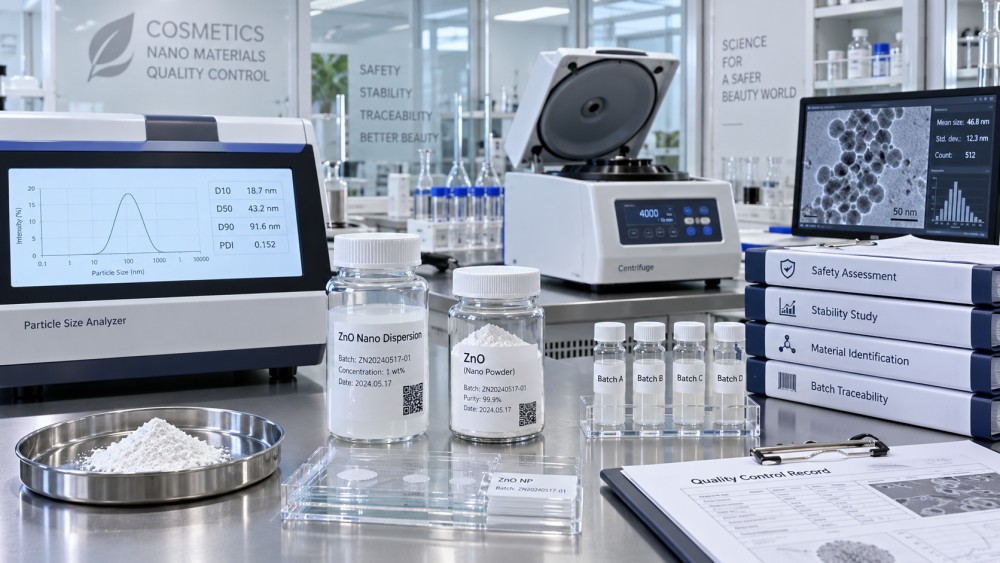
Particle size needs careful interpretation. A single average value does not establish whether a material contains nanoscale fractions or whether it remains dispersed in the product. Ask which distribution is reported, whether the value is number-based, volume-based, or intensity-based, and which analytical technique generated it. Laser diffraction is useful for broader distributions and larger agglomerates, while electron microscopy can show primary particle morphology. Dynamic light scattering is sensitive to dispersed particles but can be distorted by a small number of larger aggregates. Results from these methods should not be expected to match numerically; the important issue is whether their differences are explained and whether the method suits the sample state.
- Primary particle dimensions: Include the approximate size range, shape, aspect ratio where relevant, and representative images when microscopy is used.
- Particle state in the supplied form: Identify whether the material is dry, predispersed, encapsulated, coated, or deliberately agglomerated. A powder may redisperse during processing, while a stable dispersion may form aggregates after dilution or contact with electrolytes.
- Surface chemistry: Record coatings, functional groups, dispersants, residual monomers, catalysts, solvents, and other process-related constituents. A coating can alter photoreactivity, wettability, compatibility, and biological interaction.
- Batch controls: Confirm that meaningful particle attributes are release specifications rather than one-time development measurements. If the supplier cannot show how batch consistency is maintained, old characterization reports carry limited weight.
A common error is accepting a size statement from the raw ingredient and assuming it represents the finished cosmetic. Homogenization, milling, heating, pH adjustment, salt addition, freeze-thaw cycling, and interactions with surfactants or polymers can all change the effective particle population. For a coated ultraviolet filter, loss of coating integrity may matter as much as the size distribution. For a liposomal or polymeric delivery system, the relevant question may be whether encapsulation remains intact through the stated shelf life and use pattern.
Match the toxicology package to the material and exposure route
Toxicological support must be material-specific enough to support the intended use. Read across from a bulk material, a different surface treatment, or a different particle size band may be scientifically defensible, but it requires a written rationale. The rationale should compare identity, impurities, surface area, solubility, coating, dose form, and expected exposure. A broad statement that the base chemical is already known does not resolve nano-specific behavior.
Review study reports or sufficiently detailed study summaries rather than relying only on a supplier declaration. Each record should identify the test item, lot or representative batch, test method, exposure route, concentration range, vehicle, controls, and the reason that the result applies to the commercial material. Confirm whether the test article was characterized before and during the study. Nano-materials can settle, aggregate, dissolve, or react in a test medium. A negative result is difficult to interpret if the tested suspension was not shown to remain representative of the exposure being assessed.
The required evidence changes with the product format. A rinse-off cleanser, a facial cream, a spray mist, an eye-area product, and a lip product do not produce the same exposure pattern. Dermal deposition and possible penetration are central for leave-on skin products. Inhalation considerations become prominent when the finished product creates respirable droplets or dry airborne particles. Oral exposure can be relevant for products applied around the mouth or likely to be ingested incidentally. A report supporting dermal use cannot simply be carried over to an aerosol format because the route and target tissues differ.
Dermal penetration data should distinguish particles remaining on the surface from particles located in the outer skin layers and any signal found beyond the skin barrier. The test conditions matter: intact versus compromised skin, rinse-off versus leave-on contact, the vehicle, concentration, occlusion, and analytical detection limits can materially change interpretation. Fluorescent labels and other tracers require validation because a detached label may travel differently from the particle itself.
For photoactive or photo-reactive materials, assess whether the documentation addresses use under light exposure where relevant. This is especially important for nano-structured ultraviolet filters and materials containing reactive metal oxides. The question is not merely whether the ingredient absorbs ultraviolet radiation. The file should address photocatalytic activity, coating performance, reactive oxygen species where applicable, and whether formulation components suppress or amplify light-driven reactivity.
Read stability records as safety evidence, not only performance evidence
Stability documentation is often filed under product quality, yet it is also a safety control for nanotechnology. A formulation that separates, changes pH, loses preservative performance, degrades its carrier, or shifts its particle distribution may no longer resemble the material evaluated in its safety assessment. Request data that covers the supplied ingredient’s storage conditions and, where feasible, its behavior in a representative formulation class.
Useful records identify the packaging, storage temperature, light exposure, sample orientation, test intervals, and analytical methods. Look for changes in appearance, odor, pH, viscosity, microbial status, assay, particle size distribution, zeta potential where relevant, and evidence of sedimentation or phase separation. Zeta potential is not a universal pass-or-fail safety value; its value depends on the medium and formulation chemistry. It is more useful as a trend indicator when measured by a validated, repeatable method under defined conditions.
Transport can expose dispersions to temperature excursions and vibration. A file that supports refrigerated storage but gives no instructions for short excursions, freezing, or redispersion leaves an operational gap. Conversely, a change in viscosity after transit does not automatically prove particle destabilization. The right response is to determine whether the measured critical attributes changed, rather than treating a visible change as the only decision criterion.
Verify quality-system evidence and document control
Good manufacturing practice evidence should demonstrate control of the features that affect safety, not merely the existence of a quality certificate. Review the scope of the certificate, the legal entity and site named on it, its validity, and whether the activity covered includes the relevant manufacturing, processing, or packing operation. A certificate for a sales office does not demonstrate control at a production site.
Ask how the supplier manages changes to raw materials, equipment, milling conditions, coating chemistry, sterilization, and manufacturing location. Small process changes can shift size distribution, residual impurities, or surface properties without changing the ingredient’s commercial name. The change-control procedure should state what triggers customer notification and what revalidation is expected after a meaningful modification.
Separate regulatory status from safety substantiation
Market-specific notifications, ingredient restrictions, labeling provisions, and dossier expectations should be evaluated against the destination market and the finished product’s intended presentation. Regulatory status is not portable by default. A declaration prepared for one jurisdiction may use a different definition of nanomaterial, exposure assumption, or notification route than another. Obtain a document that states exactly what is being declared: the ingredient, its surface treatment, the cosmetic category, and any conditions of use.
Where a regulatory notification or ingredient dossier is confidential, the supplier may not disclose every detail. That does not eliminate the need for evidence. A controlled review arrangement, a signed attestation linked to a defined material, or a third-party assessment summary may be appropriate, provided it identifies the scope and limitations. A vague assurance that submission has occurred is not enough to establish that the submitted material matches the purchased grade.
Resolve contradictions before approval
Document inconsistencies are often more informative than missing polish. A technical sheet may state a median size in the nano range while the safety data sheet calls the material non-nano. A toxicology report may describe an uncoated powder, while the current product is a surface-treated dispersion. The certificate of analysis may use a particle-size method absent from the specification. These discrepancies should be treated as traceability questions, not editing defects.
Maintain a review record that links each claim to a source document, revision, material identifier, and unresolved question. Give priority to gaps that alter identity, exposure, hazard interpretation, or regulatory applicability. Administrative omissions can be corrected through document control. Missing characterization of the actual material, unsupported read-across, or safety data that does not cover the intended delivery format requires technical resolution before the material is accepted for use.
Approval should remain conditional on ongoing controls. Periodic document review, lot-level verification of agreed critical attributes, notification of material changes, and retention of the assessed evidence preserve the connection between the original safety conclusion and later deliveries. For nano-enabled cosmetic ingredients, that connection is the part of supplier documentation that must remain intact.
Related News
- How to verify a cosmetic nanotechnology supplier's safety documentationOct 04, 2026Dr. Chloe Vance
- How to set a control sensory flavour standard for panel consistencySep 27, 2026Dr. Chloe Vance
- How to verify compliance documents for cosmetic active compoundsSep 19, 2026Dr. Chloe Vance
- How to verify food grade flavor formulation ingredients for safetySep 18, 2026Dr. Chloe Vance
Related News
- 00
0000-00
When does amino acid surfactant powder improve cleanser mildness? - 00
0000-00
How to verify a cosmetic nanotechnology supplier's safety documentation - 00
0000-00
How rheological thickeners for shampoo affect suspension stability - 00
0000-00
How to assess recombinant collagen ingredients for cream stability - 00
0000-00
How to evaluate anti-aging cosmetic compounds for wrinkle care
Dr. Chloe Vance
Weekly Insights
Stay ahead with our curated technology reports delivered every Monday.