





For quality and safety teams, verifying that clean label ingredients Europe meet label claims requires more than collecting a supplier declaration and approving a certificate of analysis. A promising ingredient may be described as “natural,” “additive-free,” “no preservatives,” or “recognisable,” yet still create a mismatch between the product story, the formulation reality, and the evidence available during an audit.
In Europe, “clean label” is a market term rather than a single legal certification. That does not make it unimportant; it makes verification more demanding. Every consumer-facing phrase must be anchored in applicable EU rules, ingredient identity, manufacturing history, intended use, and the conditions under which the finished product is sold. The central question is not whether an ingredient sounds clean. It is whether the complete evidence file supports the exact claim consumers will see.
For food manufacturers in particular, the review must connect Regulation (EU) No 1169/2011 on food information, Regulation (EC) No 1333/2008 on food additives, allergen obligations, contaminant controls, and national enforcement expectations in the markets where the product will be placed. A similar discipline applies to cosmetic actives, fragrance materials, and household-care ingredients, although their sector-specific legal frameworks differ.
Start by separating a marketing idea from a verifiable claim
“Clean label” often gets used as shorthand for several different expectations: fewer familiar-sounding ingredients, no artificial colours, no added preservatives, natural sourcing, lower processing intensity, transparent origin, or no unnecessary additives. These expectations are not interchangeable.
A botanical extract can be natural in origin but processed with solvents. A fruit preparation may contain no added preservative but still derive its stability from acidity, heat treatment, sugar concentration, packaging, or an ingredient that performs a preservative function. A hydrocolloid can be familiar to formulation teams while being unfamiliar to consumers. None of these facts automatically makes the product acceptable or unacceptable. They determine what can be said accurately.
Before approving a label, turn broad language into a claim register. For each statement, record:
- the proposed consumer wording;
- the product and country markets covered;
- the legal or internal standard being applied;
- the ingredient and process facts needed to support it;
- the owner of the evidence file;
- the approval date, version, and re-review trigger.
This simple discipline prevents a common failure: a procurement specification says “natural colour,” R&D calls it “plant-based,” and the pack artwork promises “no artificial ingredients.” Those may appear close in spirit, but they are different statements that require different substantiation.
Build the evidence file around the ingredient’s real identity
A robust verification file begins with identity, not with promotional wording. Ask suppliers for a current technical specification that clearly names the ingredient, its botanical or chemical identity where relevant, grade, physical form, intended use, recommended dosage, storage conditions, shelf life, and country of origin. For food ingredients, ensure the name aligns with the way it will be declared on the finished-product ingredient list.
For extracts, cultures, flavours, antioxidants, colours, thickeners, and preservation systems, a short product description is rarely enough. Quality teams should understand the material’s full composition and functional role. That includes carriers, diluents, processing aids where disclosure is relevant, standardisation agents, residual solvents, extraction media, preservatives used in the ingredient itself, anti-caking agents, and any compound that may affect allergen, GMO, vegan, organic, or “free-from” positioning.
Supplier documents should be internally consistent. Compare the specification, certificate of analysis, safety data where applicable, allergen declaration, GMO statement, origin declaration, process flow summary, and questionnaire. A discrepancy does not always mean non-compliance, but it should never be silently reconciled by assumption.
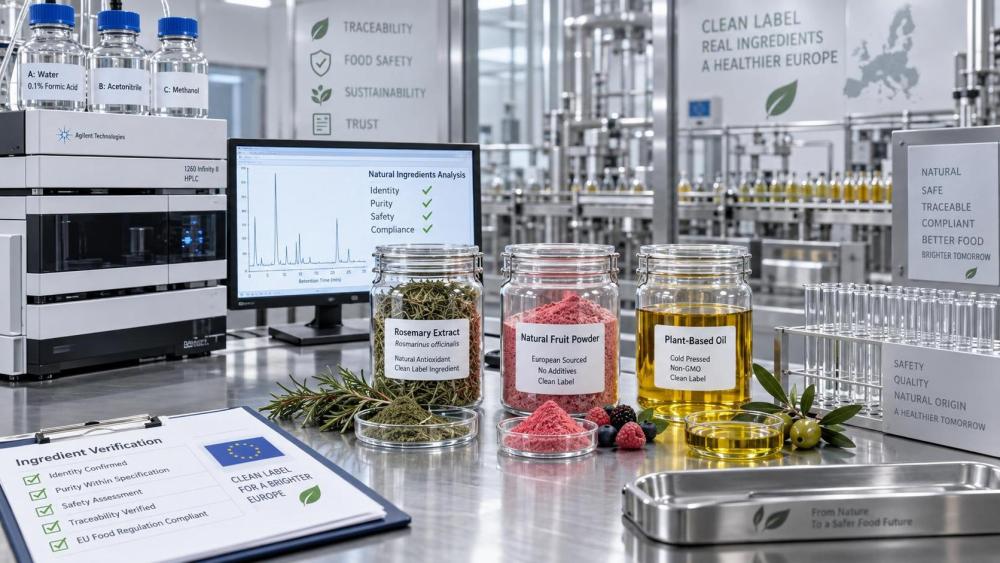
For example, a rosemary extract may be proposed as a clean-label oxidative stability solution for oils or baked goods. The verification question is broader than whether rosemary is a plant. Is the extract used as a flavouring, an antioxidant, or both? What extraction and carrier system is used? Does its legal classification and intended technological function fit the food category? Does the ingredient declaration accurately reflect the formulation? And does a “no artificial preservatives” claim remain fair in the context of the finished product’s preservation strategy?
Trace the ingredient backwards—and test the claim forwards
European food law places strong emphasis on traceability. Under Regulation (EC) No 178/2002, food business operators must be able to identify from whom they received food, feed, food-producing animals, or substances intended to be incorporated into food, and to whom they supplied products. In practice, this means a clean-label review cannot stop at a signed statement.
Traceability records should connect the approved ingredient specification to purchase orders, lot numbers, receiving checks, batch records, retained samples, and final product labels. If the ingredient is high-risk, variable by season, or sourced through multiple processors, the control plan should state how changes are communicated and assessed before use.
Origin claims need special care. “Made with Mediterranean citrus,” “European-grown,” or “sourced from [country]” may feel emotionally straightforward, but they can be misleading if they imply a level of geographical connection that the supply chain cannot prove. Confirm the meaning of origin: botanical harvest location, first processing location, final processing location, or supplier headquarters are not the same thing.
Then test the claim forwards, in the finished matrix. A raw material may qualify under an internal clean-label policy, yet the final product may not. Consider ingredient interactions, dosage, thermal processing, storage, and cross-contact. A natural pigment that performs well in a supplier sample may fade after retort processing; a fermentation-derived flavour may introduce an allergen consideration; a preservative-free sauce may require a more rigorous validation of pH, water activity, heat process, and packaging integrity.
“Natural,” “free from,” and “no added” are not casual phrases
There is no universal EU-wide legal definition that automatically validates every use of “natural” on food labels. Its acceptability depends on context, consumer understanding, applicable specific legislation, national guidance, and whether the overall presentation is fair, clear, and non-misleading under the Food Information to Consumers Regulation. Flavourings are a notable area with specific rules under Regulation (EC) No 1334/2008, including conditions for terms such as “natural [X] flavouring.”
Quality teams should therefore avoid treating a generic “natural certificate” as a blanket approval for pack claims. Request the supplier’s definition, the scope of the declaration, the basis for classification, and any exclusions. If the term will appear prominently on pack, obtain regulatory review in each target market.
“Free from” claims demand an equally cautious approach. “Preservative-free,” “additive-free,” “no artificial colours,” “without palm oil,” or “gluten-free” all create specific consumer expectations. The evidence needed may include formulation confirmation, supplier declarations, validated cleaning controls, analytical testing, legal threshold assessment, and review of any technically functional ingredient that could undermine the claim’s meaning.
A crucial distinction is between not added and not present. “No added sugar” has specific conditions under Regulation (EC) No 1924/2006 and does not mean a food contains no naturally occurring sugars. Similarly, “no added preservatives” should not imply the food cannot spoil or contains no preservation-relevant components. The finished claim should communicate a truthful benefit without creating a false impression about the product’s composition or safety.
Check function, not just the E-number question
One of the most persistent clean-label errors is reducing the review to “Does it have an E-number?” While food additives are regulated and their authorised uses must be respected, the absence of an E-number does not automatically make an ingredient suitable for a particular claim. Conversely, an E-number does not itself establish poor quality or consumer risk.
Assess why the ingredient is present. Is it colouring the food, controlling oxidation, thickening texture, emulsifying oil and water, adding sweetness, enhancing flavour, or extending microbial stability? Does that function trigger a particular regulatory classification? Is the use level consistent with authorisation or good manufacturing practice? Could the function conflict with a claim such as “no added stabilisers” or “preservative-free”?
This functional assessment matters especially for multifunctional ingredients. A fruit concentrate may contribute flavour, colour, acidity, and solids. Xanthan gum can create a desirable mouthfeel at a very low level, but it is still a hydrocolloid whose declaration and brand fit should be reviewed in the context of the company’s clean-label standard. Natural antioxidants can support shelf life, but their use should be understood rather than disguised in vague language.
Allergens, contaminants, and authenticity belong in the same review
A clean-looking ingredient list does not compensate for a weak safety file. Allergen management must address the 14 allergens listed in Annex II of Regulation (EU) No 1169/2011, including intentional ingredients and credible cross-contact risks. Obtain a detailed allergen matrix rather than accepting a broad statement such as “may contain traces.” Determine whether the supplier’s precautionary wording is evidence-based, how shared equipment is managed, and whether the finished-product label reflects the actual risk assessment.
Contaminant controls should match the material. Botanical materials may require attention to pesticide residues, heavy metals, mycotoxins, pyrrolizidine alkaloids, microbiological limits, or adulteration risks depending on the source and use. Marine-derived materials raise different questions. Fermentation products need process and microbial controls. Essential oils and fragrances may require identity, purity, oxidation, and sensitiser evaluation in their relevant regulatory context.
Authenticity is increasingly part of clean-label credibility. When a product carries a premium botanical, vanilla, honey, fruit, collagen, or essential-oil story, establish how substitution and dilution risks are controlled. Depending on the ingredient, this may involve documentary checks, supplier approval audits, targeted identity testing, batch fingerprinting, or risk-based third-party verification. The right method is determined by the risk, not by a desire to create paperwork.
Use change control as a claim-protection system
Claims often become inaccurate after launch, not because the original review was careless, but because a change was treated as operationally minor. A new extraction site, alternate carrier, adjusted standardisation level, revised flavour base, or substitute emulsifier can materially affect the label position.
Set a formal trigger for re-approval whenever there is a change in composition, source, manufacturing process, allergen status, legal status, country of origin, contaminant specification, certification scope, or intended function. The change-control form should ask a direct question: Could this alter a consumer-facing claim, the ingredient declaration, or the safety assessment?
For high-volume or high-risk materials, do not rely solely on annual document renewal. Use supplier performance reviews, batch trend monitoring, complaint findings, regulatory updates, and periodic specification challenge checks. The most reliable claim programmes are living systems, not folders prepared only for customer questionnaires.
A practical release decision for quality and safety teams
Before releasing a clean-label ingredient for European production, the reviewer should be able to answer five questions clearly:
- What is it? Identity, composition, processing route, origin, and intended technical function are documented.
- Is it legally suitable? Relevant EU and destination-market requirements have been assessed for the intended application.
- Is it safe and controlled? Allergen, microbiological, contaminant, authenticity, and traceability controls are proportionate to risk.
- What exactly may we say? Each proposed label claim has defined wording, scope, evidence, and approval ownership.
- Will the claim survive change? Supplier and internal change-control processes require reassessment before implementation.
For organisations working across food preservation, natural colours, texture systems, flavours, fragrance extracts, cosmetic actives, or surfactants, the principle remains the same: sensory appeal and technical performance should never outrun substantiation. Clean label is not achieved by removing unfamiliar words from a pack. It is achieved when formulation, supply-chain evidence, regulatory interpretation, and consumer communication all tell the same honest story.
That alignment protects more than compliance. It gives quality teams confidence when a retailer asks for proof, when an auditor follows a batch back through the chain, or when consumers look closely at the label and expect it to mean what it says.
Related News
- How to verify a cosmetic nanotechnology supplier's safety documentationOct 04, 2026Dr. Chloe Vance
- How to set a control sensory flavour standard for panel consistencySep 27, 2026Dr. Chloe Vance
- How to verify compliance documents for cosmetic active compoundsSep 19, 2026Dr. Chloe Vance
- How to verify food grade flavor formulation ingredients for safetySep 18, 2026Dr. Chloe Vance
Related News
- 00
0000-00
What drives micelles price differences in cosmetic formulations? - 00
0000-00
How to assess color stability from a natural food colors manufacturer - 00
0000-00
When does amino acid surfactant powder improve cleanser mildness? - 00
0000-00
How to verify a cosmetic nanotechnology supplier's safety documentation - 00
0000-00
How rheological thickeners for shampoo affect suspension stability
Dr. Chloe Vance
Weekly Insights
Stay ahead with our curated technology reports delivered every Monday.