





A flavor can arrive with a clean-looking certificate of analysis, an attractive specification sheet, and a supplier statement that it is “food grade.” That still does not establish that the formulation is safe or suitable for release. The risk usually appears at the gaps: a carrier omitted from the review, an allergen introduced through a subcomponent, a change in the natural-source material, or a use level that exceeds the limit applicable to the finished food category.
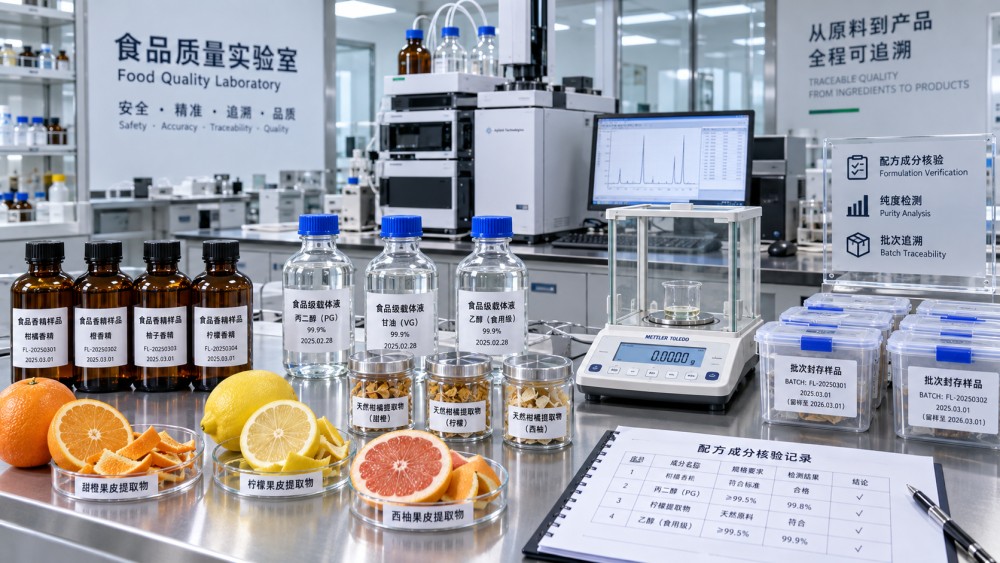
The practical answer is to verify food grade flavor formulation ingredients as a complete, traceable system rather than approving a flavor name or a single document. Confirm the identity and legal status of every intentionally added constituent, assess contaminants and allergens in the actual formulation, validate the intended use and dosage in the finished food, and maintain change-control evidence that links each production lot to the approved specification. “Food grade” should be treated as a claim requiring evidence, not as a regulatory conclusion.
Start with the formula behind the flavor name
A flavor may be described commercially as vanilla, citrus, smoke, berry, dairy, or savory, but the product supplied to manufacturing is often a blend. It can contain flavoring substances, extracts, reaction flavors, solvents, emulsifiers, antioxidants, processing aids, carriers, sweeteners, colors, or diluents. A review that examines only the characterizing flavor compound can miss the ingredients that create the most significant compliance or labeling issue.
Request a current compositional disclosure at a level sufficient for safety and regulatory review. A supplier may have legitimate confidentiality concerns, so the disclosure does not always need to reveal exact percentages. It should, however, enable the reviewer or a qualified third party to determine every component’s identity, function, origin where relevant, concentration range or maximum level, and applicable regulatory basis.
Do not accept broad descriptions such as “proprietary flavor blend” as the sole evidence. At minimum, the documentation should distinguish whether the product contains:
- Declared flavoring substances, natural flavor materials, extracts, oleoresins, essential oils, or reaction products;
- Carriers and solvents, including alcohols, oils, glycols, gums, starches, or other media;
- Emulsifiers, stabilizers, antioxidants, anti-caking agents, or preservatives;
- Ingredients derived from major food allergens or materials that may create allergen cross-contact concerns;
- Animal-derived materials, fermentation substrates, genetically modified inputs, or other origin-sensitive components when these affect the product claim or destination market;
- Substances that are subject to specific use restrictions, purity criteria, or food-category limitations.
One useful control is an internal ingredient map. It links the supplier’s ingredient description to a standardized identity, such as a chemical name, botanical name, CAS number where appropriate, FEMA number where available, or recognized additive identifier where applicable. The map should also record the ingredient’s role in the flavor. This prevents a reviewer from treating “orange flavor” and “natural orange flavor preparation” as equivalent when their compositions, carriers, and regulatory positions may differ.
Separate identity, purity, and suitability for use
These are related checks, but they answer different questions. Identity asks whether the material is what the supplier says it is. Purity asks whether it meets defined chemical and contaminant limits. Suitability asks whether it may be used in the intended food, at the proposed level, under the relevant jurisdiction’s rules. A passing result in one area does not automatically answer the other two.
For identity, compare the purchase specification, safety data, technical data, and lot certificate. Names should align across documents. When the flavor includes a botanical extract or essential oil, confirm the plant part, extraction method if relevant, and the marker profile used to establish consistency. Natural materials can vary with harvest conditions, geography, and processing; a generic name alone may not control the constituents that matter to safety.
Purity specifications should be meaningful for the material. Depending on composition and risk, they may cover assay, refractive index, specific gravity, moisture, residual solvents, peroxide value, acidity, heavy metals, pesticide residues, microbiological criteria, or marker compounds. A generic COA that lists only appearance, odor, and density is usually insufficient for a higher-risk natural extract, fermentation-derived component, or flavor intended for vulnerable consumer groups.
Test methods matter as much as reported values. Ask whether the method is suitable for the flavor matrix and whether the result is expressed on the same basis as the acceptance criterion. A result reported for the raw extract cannot necessarily be applied to the diluted flavor formulation. Likewise, a “not detected” statement is incomplete without a method detection or quantification limit when a meaningful contaminant decision depends on it.
Check the legal basis before calculating the dose
Regulatory status is jurisdiction-specific. A component that is acceptable in one market may require different conditions, labeling treatment, notification, or supporting evidence elsewhere. The review should begin by defining the destination country or countries, the food category, the consumer group, and whether the product will be sold as conventional food, a supplement, a beverage, a confectionery item, or another regulated format.
In the United States, flavoring substances may be reviewed through several possible legal pathways depending on the ingredient and use. Some substances may be regulated as food additives, may be covered by a relevant regulation, or may be used on the basis of a generally recognized as safe conclusion. The appropriate pathway cannot be inferred from a supplier’s “food grade” wording. The finished-food application, technical effect, identity, and conditions of use must support the conclusion.
For international distribution, obtain a market-specific regulatory statement rather than relying on a single global declaration. The statement should name the formulation version, list any conditions or exclusions, and clarify whether it addresses the flavor as sold or only individual components. A broad statement that a product is “compliant with food regulations” may not address category limits, restricted substances, local positive lists, or labeling obligations.
Calculate exposure from the finished product, not the drum label
The relevant concentration is normally the amount of each constituent reaching the consumed food. Start with the flavor addition rate, then multiply by the concentration of each relevant constituent in the flavor. Account for processing dilution, reconstitution, and serving instructions where they change the final exposure. For a multi-component flavor, retain the calculation sheet and its source assumptions; it becomes essential when formulation, supplier, or target market changes.
A review should be escalated when the product contains a constituent with a specific maximum use level, a prohibited-use category, a toxicological threshold, or a population-sensitive concern. This is especially important for concentrated beverages, products likely to be consumed frequently, foods for children, and applications where the flavor is added after a heat step and does not undergo the expected processing reduction.
Allergen review cannot stop at the allergen statement
An allergen declaration is useful, but it is not a substitute for formulation knowledge. Flavor systems may contain allergenic source materials, carriers derived from allergenic foods, or processing materials that affect label review. The risk may be obvious in nut, milk, egg, soy, wheat, sesame, fish, or shellfish-derived materials, but it can also be obscured by terms such as extracts, distillates, protein fractions, or fermentation media.
Review three separate questions. First, is an allergenic source intentionally present in the supplied flavor? Second, is there a credible cross-contact risk from the supplier’s production environment or shared equipment? Third, does the final product require a declaration under the law of the sale market? These answers may not be identical. A supplier’s statement should identify the scope of its assessment and whether it is based on formula review, facility controls, analytical testing, or a combination.
When a flavor is reformulated, allergen verification must be repeated even if its sensory profile and trade name remain unchanged. Replacing a carrier, changing an extract supplier, or introducing a new reaction flavor can alter the answer. The same principle applies to claims such as vegetarian, vegan, halal, kosher, alcohol-free, or natural: each depends on defined criteria, evidence, and market context rather than the general flavor classification.
Look for contaminants that fit the raw material and process
Contaminant testing should be risk-based, not copied from a generic supplier questionnaire. Natural extracts may call for attention to pesticides, heavy metals, mycotoxins, polycyclic aromatic hydrocarbons, or adulteration markers depending on the source and manufacturing method. Citrus oils and other oxidation-prone materials may need oxidation controls. Fermentation-derived materials may require attention to residual substrates, microbiological quality, or process-related impurities. Smoke-related flavors and thermally generated reaction flavors require a review tailored to their production chemistry and applicable restrictions.
Set acceptance criteria before receiving routine lots. A retrospective search for a limit after a nonconforming result often reveals that the specification was not designed for the actual use. The supplier should provide lot traceability, certificate dates, test status, and a defined procedure for deviations. Where a result is outsourced, the reviewer should know whether the laboratory result applies to the delivered lot, a composite, or a representative batch.
Odor and appearance checks remain useful receiving controls, but they are not safety verification. A flavor can smell normal while having an undeclared carrier change, a regulatory-status issue, or a contaminant level that cannot be detected sensorially.
Build approval around documents that can survive a change
A robust release file usually includes the approved formulation or confidential composition statement, product specification, lot-specific COA, allergen statement, regulatory statement for each target market, safety and origin information where relevant, and documented intended use level. The file should show a revision date and a direct link to the purchased material code. A document that identifies only a family of flavors is weak evidence when the actual purchased formulation is a specific version.
Supplier approval should also define what must trigger notification: changes to composition, source, manufacturing location, process, specification limits, analytical methods, allergen status, regulatory status, or sensory profile. The notification should occur before shipment whenever possible. Without this rule, a company can keep receiving a familiar trade name while the formulation that was originally assessed no longer exists.
Use incoming controls proportionately
Not every flavor needs the same testing frequency. A stable, well-characterized synthetic flavor from a controlled supplier may be managed through document verification, periodic identity confirmation, and change control. A complex natural flavor, a high-dose application, or a material with a history of variability may justify more frequent analytical verification or third-party testing. The decision should be documented against risk factors, not based solely on supplier reputation or purchasing volume.
At receiving, match the container label, lot number, manufacturing date, retest or expiry date, storage conditions, and seal condition to the release documents. Quarantine material when identifiers conflict, documentation is incomplete, a COA is outside the approved specification, or a supplier has reported an unreviewed change. Releasing on the assumption that missing paperwork will arrive later creates a traceability gap that is difficult to repair after production.
When the evidence is incomplete
Do not convert uncertainty into approval by relying on a generic “food grade” certificate. Place the material on hold and identify the missing decision point: undisclosed constituents, unclear legal pathway, incomplete allergen scope, unsuitable contaminant specification, or an unverified finished-product dose. The corrective request should be specific. Asking for “more compliance documents” often produces another broad declaration; asking for the formulation version, constituent identity, applicable food category, maximum intended use level, and regulatory rationale is more likely to resolve the actual issue.
Some situations require specialist regulatory or toxicological assessment, particularly when a component has restricted conditions of use, the formulation includes a novel or unusual extract, exposure may be high, or the product will be marketed across jurisdictions with different rules. That review should be completed before commercial release, with the resulting conclusion retained alongside the flavor approval record.
The strongest control is not a large stack of certificates. It is a documented chain showing what is in the flavor, what specifications apply, why each constituent is acceptable at the finished-food dose, and how future changes will be detected before they reach production.
Related News
- How to verify a cosmetic nanotechnology supplier's safety documentationOct 04, 2026Dr. Chloe Vance
- How to set a control sensory flavour standard for panel consistencySep 27, 2026Dr. Chloe Vance
- How to verify compliance documents for cosmetic active compoundsSep 19, 2026Dr. Chloe Vance
- How to verify food grade flavor formulation ingredients for safetySep 18, 2026Dr. Chloe Vance
Related News
- 00
0000-00
What drives fragrance ingredients price changes in bulk orders? - 00
0000-00
How to assess a food antioxidants distributor’s traceability practices - 00
0000-00
How minimum order quantities shape private label ingredient sourcing costs - 00
0000-00
What drives personal care ingredient price volatility in sourcing - 00
0000-00
What drives micelles price differences in cosmetic formulations?
Dr. Chloe Vance
Weekly Insights
Stay ahead with our curated technology reports delivered every Monday.