





For procurement teams, choosing reliable food additives manufacturers is no longer just about price or supply stability—it is about proving that every ingredient can stand up to regulatory scrutiny, customer audits, and internal quality review. A supplier may look impressive on paper, but if its GRAS position is vague or its batch records break halfway through the supply chain, the risk does not stay with the supplier. It lands with your brand, your product launch, and your compliance team.
That pressure has only intensified. Clean-label expectations, retailer compliance demands, and cross-border sales have made documentation as important as functionality. Whether you are sourcing preservatives, thickeners, flavor compounds, natural pigments, or specialty actives used in food-adjacent applications, vetting manufacturers now means asking a more serious question: can this supplier prove what the ingredient is, why it is lawful to use, and where it has been at every stage?
For buyers working in food, beverage, wellness, and FMCG-linked sectors, GRAS and traceability are often where promising supplier conversations either become viable—or quietly fall apart.
What procurement should really mean by “GRAS verified”
Many supplier profiles casually mention GRAS, but not every GRAS claim carries the same weight. In the United States, “Generally Recognized as Safe” does not simply mean “commonly used” or “unlikely to cause harm.” It refers to a safety conclusion based on qualified expert evaluation and publicly available evidence for the intended conditions of use.
When screening food additives manufacturers, procurement should separate three different situations:
- A substance with an FDA GRAS Notice and “no questions” response — often the easiest position to review because the notice is publicly visible.
- A self-affirmed GRAS conclusion — potentially legitimate, but more dependent on the supplier’s own dossier quality, expert panel process, and documentation transparency.
- An ingredient described as “GRAS compliant” without supporting basis — a phrase that may sound reassuring but often lacks legal or scientific precision.
This distinction matters because procurement is not just buying a material; it is inheriting the burden of due diligence. If the ingredient is used in a finished food, beverage, or nutritional system, your team should know the exact intended use level, technical function, and category restrictions. A manufacturer that cannot explain those points clearly may not have a defensible regulatory position, even if its sales sheet looks polished.
The first screen: documents that should appear before commercial negotiation goes too far
Experienced buyers often save time by requesting a core document pack before discussing annual volumes or rebate structures. This early screen reveals whether a supplier is truly audit-ready or simply commercially aggressive.
A serious review usually includes:
- Product specification sheet with identity, assay, purity, physical characteristics, and application limits
- Certificate of Analysis template with lot-specific testing parameters
- Regulatory statement covering GRAS basis, food-use status, and market scope
- Allergen, GMO, contaminant, and residual solvent statements where relevant
- Manufacturing flow summary or process description
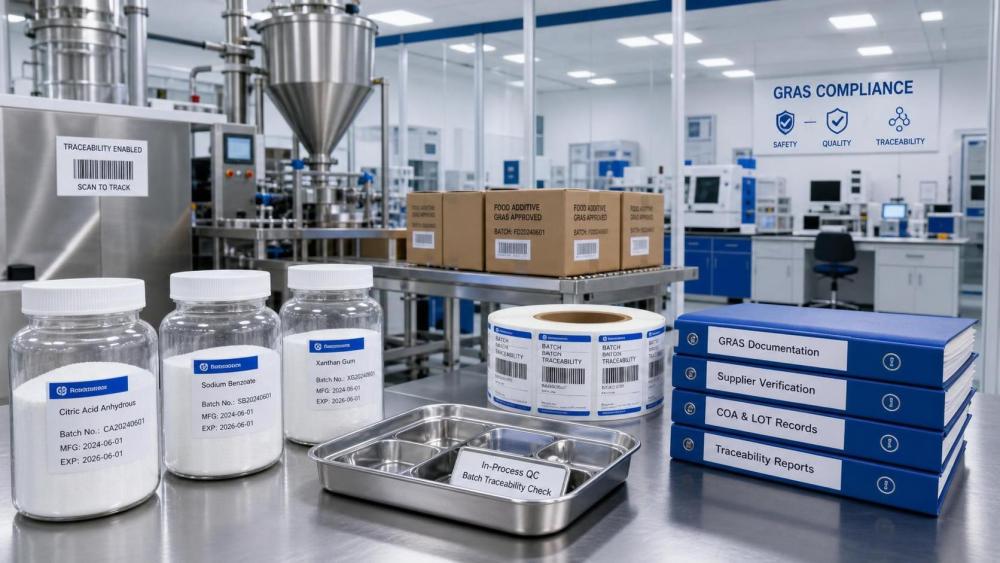
- Traceability statement covering raw materials, batch coding, and retention samples
- Quality certifications such as FSSC 22000, ISO 22000, BRCGS, or equivalent depending on product category
If these documents arrive slowly, in inconsistent formats, or with obvious contradictions, that tells you something important before an audit ever begins. Good food additives manufacturers usually treat documentation as part of the product itself.
How to read traceability beyond the marketing claim
“Full traceability” is one of the most overused phrases in ingredient sourcing. In practice, traceability is only meaningful if it can work in both directions: one step back to raw material origin and one step forward to finished distribution. For procurement, the real question is not whether a supplier says it has traceability, but whether it can reconstruct a batch history quickly and without guesswork.
Ask how the manufacturer handles:
- Raw material supplier qualification and incoming lot linkage
- Internal batch numbering logic
- Rework, blending, or batch consolidation controls
- Packaging lot assignment
- Sample retention period
- Recall simulation or mock recall testing
For example, a xanthan gum or natural pigment supplier may source fermentation media, extraction materials, processing aids, and packaging from different regions. A flavor manufacturer may rely on a complex chain involving aroma chemicals, carriers, and solvents. A preservative supplier may seem simple until you ask about impurities, stabilizers, or co-processed inputs. Traceability becomes fragile wherever supplier networks become layered.
The strongest manufacturers can usually answer a mock recall question in operational terms: how long it takes to identify affected lots, what records are linked digitally, and how deviations are escalated. That response often tells more than a glossy brochure.
Questions worth asking during a supplier audit or qualification call
Some of the most revealing questions are not dramatic. They are precise. Procurement teams evaluating food additives manufacturers should go beyond broad quality claims and probe how decisions are made inside the plant and quality unit.
- Who owns the GRAS documentation? Is it managed internally by regulatory affairs, outsourced, or copied from an upstream supplier?
- What triggers a regulatory reassessment? Changes in raw material source, process conditions, impurity profile, carrier system, or use level should not be treated casually.
- How are deviations documented? A supplier with no deviations is often less credible than one with a clear corrective action system.
- Can the supplier distinguish food-grade from industrial-grade output? Mixed-site manufacturing raises important segregation questions.
- How is label-sensitive risk handled? This includes allergens, solvent residues, animal-derived inputs, and processing aids.
- What happens when a customer asks for lot-specific supporting evidence? Response quality here reveals whether traceability is real or performative.
These discussions are especially important in categories where functionality and compliance intersect tightly. Preservatives, antioxidants, hydrocolloids, flavor systems, and color ingredients often live at the center of formulation performance, consumer perception, and regulatory exposure at once.
Red flags that deserve more than a polite follow-up email
Procurement teams are used to imperfect supplier packs. That alone is not unusual. What matters is whether gaps are explainable, temporary, and being corrected—or whether they point to structural weakness.
Common warning signs include:
- GRAS statements that do not mention intended use conditions
- COAs that report too few parameters for the product type
- Specifications with broad ranges that hide process inconsistency
- Conflicting country-of-origin information across documents
- No clear distinction between manufacturer and trader roles
- Reluctance to discuss subcontracted processing steps
- Traceability explanations that depend on “manual checking” without system support
Another subtle red flag is excessive confidence unsupported by technical detail. A supplier may insist that an ingredient is widely accepted in the market, but wide use does not replace a documented safety and traceability foundation. In regulated categories, familiarity is not proof.
Why manufacturer type matters more than many buyers expect
Not every supplier in your inbox is the actual producer. Some are distributors, some are exporters managing multiple plants, and some are private-label operators sourcing from third parties. None of these models is automatically disqualifying, but procurement needs clarity because traceability strength often depends on how close the commercial entity is to the manufacturing reality.
When evaluating food additives manufacturers, confirm:
- Which company physically manufactures the ingredient
- Whether the site you are qualifying is the site producing your commercial batches
- Whether critical processing or packaging is subcontracted
- Who controls change notification
- Who maintains the master quality and regulatory files
This is especially relevant in global FMCG supply chains. A supplier might offer attractive pricing on a natural thickener, antioxidant, or flavor ingredient, yet rely on a chain of brokers and secondary processors that weakens documentation integrity. The further procurement sits from the original plant, the more important document discipline becomes.
Building a practical scorecard: compliance depth, not just commercial appeal
A useful supplier scorecard should weigh regulatory fitness and traceability discipline as heavily as cost, lead time, and capacity. Buyers often regret treating compliance as a pass-fail box instead of a comparative advantage.
A balanced evaluation framework may score suppliers on:
- Clarity of GRAS basis and intended-use coverage
- Completeness of technical dossier
- Speed and consistency of document response
- Batch traceability and recall readiness
- Change control transparency
- Quality system maturity
- Raw material sourcing visibility
- Site audit openness
This kind of scorecard is particularly valuable when comparing suppliers across categories that look similar commercially but differ in regulatory complexity. A clean-looking flavor blend, a “natural” color extract, or a fermentation-derived preservative may each carry different levels of traceability burden depending on processing, composition, and market destination.
Where market intelligence can sharpen qualification decisions
Procurement does not work in isolation anymore. Ingredient markets are moving under the influence of clean-label reformulation, changing regional standards, and growing scrutiny over origin, contaminants, and processing transparency. That is why buyers increasingly need more than a supplier submission—they need context.
For companies operating across food, fragrance, and advanced ingredient categories, intelligence platforms such as FFAI can help connect technical function with regulatory and sourcing judgment. A buyer assessing antioxidants, hydrocolloid thickeners, natural pigments, flavor ingredients, or high-purity actives often needs to understand not only what a material does, but how process stability, safety positioning, and market expectations interact. Those signals can be easy to miss when teams are buried in quotations and specification sheets.
In practice, the strongest procurement decisions tend to come from combining internal QA review with external market visibility: how an ingredient survives processing, how its impurity profile may shift, how regional compliance expectations differ, and where sourcing claims deserve closer inspection.
Vetting should end with confidence, not assumption
The best supplier relationships in food ingredients usually begin with uncomfortable questions handled well. A manufacturer that can explain its GRAS position, trace a batch cleanly, document its process controls, and respond calmly to audit-level scrutiny is giving procurement something more durable than a competitive offer. It is giving you usable confidence.
For teams sourcing from food additives manufacturers, that confidence is what protects product timelines, customer trust, and regulatory resilience. Price still matters. Capacity still matters. But when GRAS status is ambiguous or traceability is shallow, every other commercial advantage becomes fragile. The more disciplined your vetting process, the fewer surprises you inherit later—on the label, in the plant, or during an audit no one wanted but everyone has to be ready for.
Related News
- How to verify a cosmetic nanotechnology supplier's safety documentationOct 04, 2026Dr. Chloe Vance
- How to set a control sensory flavour standard for panel consistencySep 27, 2026Dr. Chloe Vance
- How to verify compliance documents for cosmetic active compoundsSep 19, 2026Dr. Chloe Vance
- How to verify food grade flavor formulation ingredients for safetySep 18, 2026Dr. Chloe Vance
Related News
- 00
0000-00
Verifying halal status of hydrocolloid ingredients in the Middle East - 00
0000-00
How to interpret active matter on a surfactant specification sheet - 00
0000-00
What Quality Checks Should You Run on Fragrance Ingredient Suppliers? - 00
0000-00
How to assess a flavor chemistry manufacturer's batch consistency - 00
0000-00
What drives fragrance ingredients price changes in bulk orders?
Dr. Chloe Vance
Weekly Insights
Stay ahead with our curated technology reports delivered every Monday.