





IFRA and FDA GRAS gaps matter most when one formula crosses category boundaries
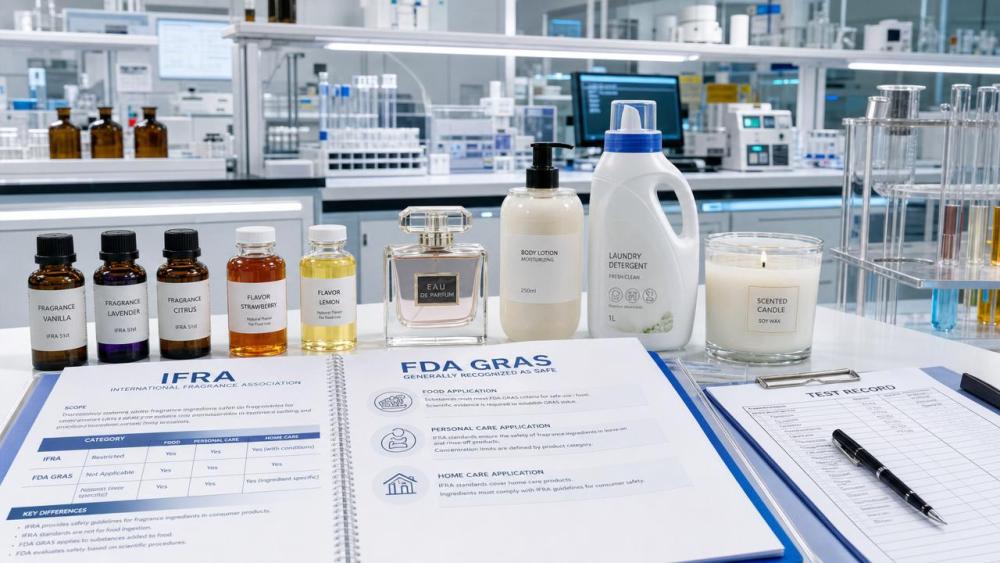
In flavors & fragrances, regulatory confusion rarely starts in theory. It usually starts when one ingredient travels across product types, claims, and markets.
A material may seem acceptable because it appears on a food-related list. Yet that does not automatically support fragrance use in perfume, lotion, detergent, or candles.
That is where IFRA and FDA GRAS gaps become expensive. One framework manages fragrance exposure conditions. The other addresses safety recognition for intended food use.
For businesses working across FMCG categories, this difference affects formulation screening, supplier documentation, label logic, and audit readiness.
FFAI often tracks these overlaps because flavors & fragrances no longer live in isolated departments. Sensory design, toxicology, preservation, and export compliance now interact earlier in development.
Why similar ingredients trigger different judgments in real applications
The main issue is intended use. FDA GRAS evaluates whether a substance is generally recognized as safe under specific food conditions.
IFRA does something different. It sets use restrictions for fragrance materials according to product category, dermal exposure, inhalation potential, and sensitization concerns.
So the same molecule can sit comfortably in a beverage flavor system, but face concentration limits in a fine fragrance or rinse-off cosmetic.
In practice, flavors & fragrances teams often miss this because ingredient names look familiar, supplier brochures sound reassuring, and safety summaries are written too broadly.
Another reason is portfolio expansion. A company may begin with food flavoring, then extend the same scent story into personal care, home care, or ambient scenting.
That commercial move is common. The compliance logic behind it is not interchangeable.
A quick comparison before deeper scenario review
In food and beverage flavor work, the GRAS file is only the starting point
Within edible applications, FDA GRAS often takes center stage because ingestion drives the safety discussion.
Still, flavors & fragrances decisions are rarely that simple in modern FMCG portfolios. A food flavor may inspire a companion lip product, body mist, or scented packaging.
The risk appears when development teams treat the food dossier as a universal safety passport.
For example, a citrus note used in confectionery may be well supported for ingestion. Yet its expressed oil fraction may raise phototoxicity questions in leave-on fragrance use.
A vanilla-type material may also be acceptable in flavoring, but behave differently under repeated skin exposure, oxidation, or heat in non-food systems.
The better approach is to split the review into two tracks. One examines food legality and intake. The other checks fragrance exposure route and category limits.
Personal care is where IFRA usually becomes the sharper filter
Leave-on lotions, facial masks, deodorants, and hair products create a different judgment environment. Contact duration and skin condition matter more than ingredient familiarity.
Here, flavors & fragrances often share aromatic building blocks, but the compliance pathway diverges quickly.
An ingredient promoted as naturally derived may still require strict IFRA concentration control in a body spray or cream.
This is especially important for anti-aging and premium beauty products. FFAI follows these intersections closely because sensory luxury and dermal safety must coexist in the same formula.
A prestige serum may contain high-end actives, but a misjudged fragrance level can still delay launch, trigger reformulation, or complicate CPNP-related documentation downstream.
More often than not, the problem is not the ingredient itself. It is the exposure context that changes the answer.
Different applications ask different questions
- Lip-adjacent products need ingestion-adjacent thinking, but still cannot skip fragrance restriction review.
- Leave-on skin care requires stronger attention to sensitization, oxidation stability, and cumulative exposure.
- Rinse-off cleansing products may allow different limits, yet wash frequency changes practical risk.
- Fine fragrance formats raise volatility and inhalation questions beyond simple ingredient listing.
Home care and ambient scenting often hide the biggest classification mistakes
Detergents, softeners, air care products, and candles sit outside the food lens, but they still borrow from flavors & fragrances chemistry.
That familiarity can create false confidence. Teams may assume a food-recognized aroma material is automatically low risk in a diffuser or cleaning spray.
In reality, aerosolization, heated release, and repeated indoor exposure can shift the risk profile.
Laundry products add another twist. Fragrance residues remain on fabrics, so the final exposure pattern differs from both food and classic rinse-off cosmetics.
This matters for washing surfactants too. Surfactant systems can change deposition, release, and skin interaction of fragrance ingredients.
In these cases, the best judgment is cross-functional. Sensory performance, substrate behavior, and IFRA category fit must be reviewed together, not one by one.
Where compliance teams most often misread flavors & fragrances data
The common error is treating ingredient status as a permanent property instead of a use-dependent conclusion.
Several blind spots appear repeatedly across flavors & fragrances projects:
- Reading “GRAS” as proof for all routes of exposure.
- Using supplier fragrance summaries without checking the latest IFRA Amendment alignment.
- Reviewing raw materials individually, but not the finished formula concentration.
- Ignoring oxidation byproducts, impurity profiles, or botanical variation.
- Assuming natural essential oils carry fewer restrictions than synthetic aroma chemicals.
That last point causes frequent trouble. Natural origin does not eliminate IFRA restrictions, allergen concerns, or market-specific documentation demands.
A practical way to compare scenario differences before launch
Before approving ingredients in flavors & fragrances development, it helps to map the intended application instead of debating the ingredient in isolation.
What stronger adaptation looks like in day-to-day regulatory work
The most reliable process is not longer paperwork. It is earlier scenario sorting.
Start by grouping flavors & fragrances materials by exposure route, not by supplier catalog section.
Then review four points for each formula:
- Intended use and category boundaries
- Actual concentration in the finished product
- Processing or storage factors that may alter exposure
- Documentation version control across markets
For companies spanning food preservation, rheology systems, cosmetic actives, and scent design, this cross-check is especially useful.
It aligns with the broader FFAI view that molecular performance only creates value when safety logic survives real manufacturing and real market transfer.
A better next step is to audit the use case, not just the ingredient name
The gap between IFRA and FDA GRAS is not a technical detail. In flavors & fragrances, it changes launch timing, reformulation cost, and compliance confidence.
The safer path is to document where each aromatic material will be used, how people are exposed, and which standard actually governs that context.
If a portfolio touches food, beauty, and home care at once, build a shared screening checklist before formula lock.
That means comparing category restrictions, confirming current supplier evidence, checking impurity and oxidation issues, and reviewing labeling implications early.
When those steps are done in the right order, flavors & fragrances decisions become easier to defend, easier to audit, and far less likely to fail at market entry.
Related News
- How to verify a cosmetic nanotechnology supplier's safety documentationOct 04, 2026Dr. Chloe Vance
- How to set a control sensory flavour standard for panel consistencySep 27, 2026Dr. Chloe Vance
- How to verify compliance documents for cosmetic active compoundsSep 19, 2026Dr. Chloe Vance
- How to verify food grade flavor formulation ingredients for safetySep 18, 2026Dr. Chloe Vance
Related News
- 00
0000-00
Verifying halal status of hydrocolloid ingredients in the Middle East - 00
0000-00
How to interpret active matter on a surfactant specification sheet - 00
0000-00
What Quality Checks Should You Run on Fragrance Ingredient Suppliers? - 00
0000-00
How to assess a flavor chemistry manufacturer's batch consistency - 00
0000-00
What drives fragrance ingredients price changes in bulk orders?
Dr. Chloe Vance
Weekly Insights
Stay ahead with our curated technology reports delivered every Monday.