





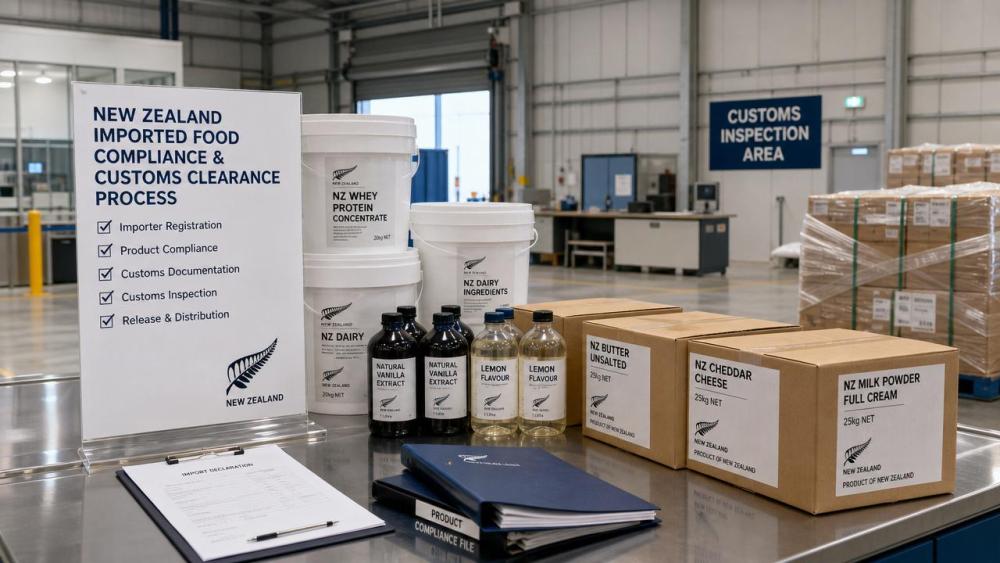
New Zealand’s new requirements took effect on June 1, 2026, requiring imported food sold in the local market to be handled through a registered local importer and aligned with its Food Act and a CPNP-style notification mechanism. For companies dealing in natural colorants, water-soluble flavors, high-purity hyaluronic acid and other food or cosmetic active ingredients, this is not just a labeling or filing issue; it changes the practical route to market, including customs clearance, local representation and product readiness for sale.
What the new entry requirement now requires
The confirmed change is that, from June 1, 2026, imported food intended for sale in New Zealand must be represented by a registered local importer. Products must also comply with the country’s Food Act and a CPNP-style notification mechanism. The rule directly affects import access procedures for natural colorants, water-soluble flavors, high-purity hyaluronic acid and related food and cosmetic active ingredients. Where the importer is not registered, the goods cannot complete customs clearance or be placed on shelves for sale.
Where the pressure is likely to appear first
Export transactions now depend on local importer status
From an industry perspective, exporters and direct trading companies are likely to feel the impact first because market access no longer depends only on shipment arrangements or buyer demand. The ability of the local importer to meet the registration requirement becomes a practical precondition for entry, which means supplier-side sales planning, document preparation and shipment timing may all need closer coordination.
Procurement teams need to recheck supply chain continuity
For ingredient buyers and processors, the main issue is whether existing supply arrangements into New Zealand still match the new compliance path. Analysis shows that procurement teams will need to pay closer attention to importer qualification, supporting documents and whether products are prepared for the required compliance and notification process before goods move into the sales channel.
Distributors and channel operators face saleability risks
Channel and distribution businesses may be affected at the point where imported goods move from clearance to commercial sale. Observably, the rule links customs access and shelf availability more tightly, so any mismatch in importer registration or product compliance could disrupt listing plans, launch timing or inventory turnover.
Compliance and service partners may see earlier involvement
Testing, certification and supply chain service providers are also likely to be drawn in earlier in the transaction cycle. What deserves closer attention is not a confirmed increase in formal requirements beyond the provided information, but the higher need for document review, technical file readiness and coordination around import entry conditions.
What companies should review now
Check whether the importer arrangement is still valid
Analysis shows that companies supplying into New Zealand should first confirm whether the local importer handling the goods is registered under the new framework. This matters because the importer’s status is now tied directly to customs clearance and saleability, rather than being only a commercial counterpart issue.
Reassess product files against the stated compliance path
Businesses dealing in natural colorants, water-soluble flavors, high-purity hyaluronic acid and similar ingredients should review whether current product documentation is consistent with the Food Act requirement and the stated CPNP-style notification path. As the input does not provide detailed implementation criteria, this should be treated as a compliance checkpoint rather than proof of a completed filing outcome.
Prepare for procurement and delivery timing changes
From an operational perspective, companies may need to review order schedules, shipment timing and customer commitments for New Zealand-bound goods. It is more appropriate to understand this as a potential execution adjustment: if importer registration or related product readiness is incomplete, downstream delivery and on-sale timing may be affected.
Continue tracking how the rule is applied in practice
Observably, the headline requirement is already in force, but detailed enforcement wording, document expectations and market practice still deserve attention. Companies should therefore keep watching for later clarifications that may affect technical files, compliance review, channel onboarding or transaction documents.
Why this looks like an execution signal, not a symbolic update
Analysis shows that this development is best read as an implemented market-entry condition rather than a distant policy direction. The key signal is that importer registration is linked to both customs clearance and retail sale, which gives the rule immediate operational relevance. At the same time, it would be premature to treat all downstream effects as settled, because the provided information does not define detailed enforcement scenarios or product-specific compliance standards beyond the stated framework.
How the market is likely to read this change
For the industry, the practical meaning of this update is that access to the New Zealand market now depends more clearly on the compliance position of the local importer and the readiness of product-related documentation. A neutral reading is more appropriate than an exaggerated one: this is an effective rule change with direct trade and compliance consequences, while its full execution rhythm and market response still require continued observation.
Basis of this article and what still needs verification
This article is generated based on the user-provided news title, event date and event summary. For developments of this kind, relevant source types usually include official notices, releases from regulatory authorities, customs or trade administration information, industry association updates, standards documents and reporting by authoritative media. A specific official source link was not provided in the input, so the exact source path still needs to be verified on an ongoing basis. What also remains worth monitoring includes detailed implementation language, compliance interpretation, changes in procurement or tender documents, market feedback and how companies execute the requirement in practice.
Related News
- How to verify a cosmetic nanotechnology supplier's safety documentationOct 04, 2026Dr. Chloe Vance
- How to set a control sensory flavour standard for panel consistencySep 27, 2026Dr. Chloe Vance
- How to verify compliance documents for cosmetic active compoundsSep 19, 2026Dr. Chloe Vance
- How to verify food grade flavor formulation ingredients for safetySep 18, 2026Dr. Chloe Vance
Related News
- 00
0000-00
Can biomimetic peptides in cosmetics reduce the look of wrinkles? - 00
0000-00
How to assess a bio-based thickener manufacturer's batch consistency - 00
0000-00
Verifying halal status of hydrocolloid ingredients in the Middle East - 00
0000-00
How to interpret active matter on a surfactant specification sheet - 00
0000-00
How Do You Test Hydrocolloid Viscosity After Changing a Thickener?
Dr. Chloe Vance
Weekly Insights
Stay ahead with our curated technology reports delivered every Monday.