





Synthetic Flavor Ingredients: What should be checked before launch?
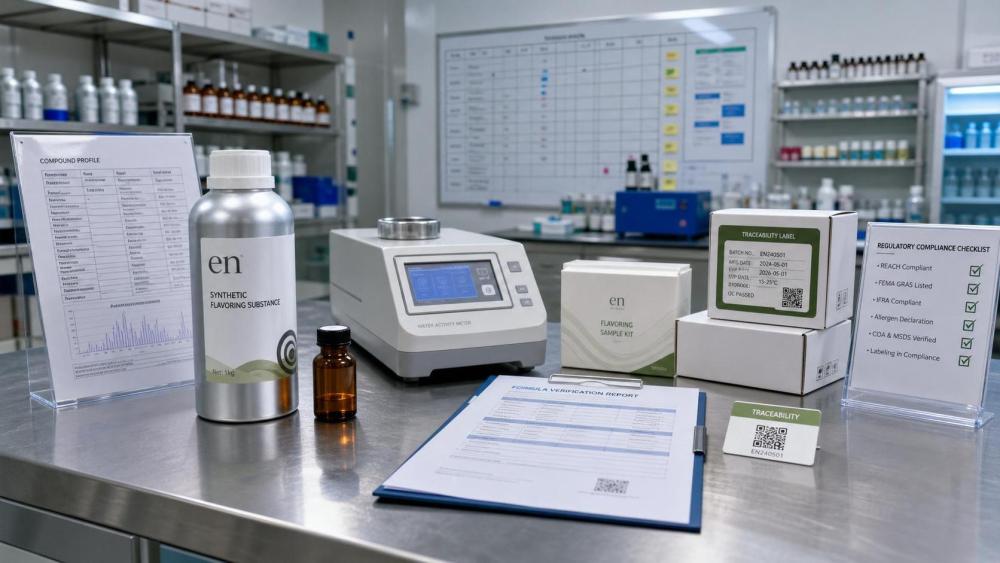
Launching a product with synthetic flavor ingredients is rarely delayed by one dramatic issue. More often, it slips because several small compliance gaps appear at once.
A formula may smell right, perform well, and pass sensory review, yet still face relabeling, customs questions, or regional rejection.
That is why pre-launch review needs to connect formulation science, regulatory evidence, supplier control, and commercialization timing.
Within fast-moving FMCG categories, synthetic flavor ingredients sit close to consumer perception. They shape taste, aroma, and brand memory in very direct ways.
At the same time, they are judged through strict rules on composition, usage level, labeling, and market-specific acceptability.
FFAI often frames this space as the meeting point between molecular sensory design and absolute safety, where a good launch depends on both chemistry and documentation.
So the practical question is not whether synthetic flavor ingredients can be used. The real question is whether every compliance checkpoint is launch-ready.
Is GRAS status enough, or is that only the starting point?
This is one of the most common misunderstandings. GRAS status matters, but it does not automatically clear a product for every market, format, or use level.
In practice, teams should confirm the exact regulatory identity of each substance. Name similarity is not enough. CAS number, FEMA reference, purity, and intended function must align.
A synthetic flavor ingredient may be acceptable in one application, yet restricted in another because exposure assumptions change.
Regional interpretation also matters. U.S. review may focus on GRAS or FEMA-related support, while the EU may require closer attention to flavoring regulations and restricted substances lists.
The safer approach is to verify four points together, not separately.
- Legal status of each flavor substance in target markets.
- Maximum use level based on category and exposure logic.
- Specification match between purchased material and reviewed material.
- Any local notification, dossier, or customer-specific requirement.
When these checks happen early, launch planning becomes more realistic. When they happen after artwork approval, deadlines tighten quickly.
Which documents usually decide whether synthetic flavor ingredients are truly launch-ready?
Documentation is where many otherwise strong projects lose momentum. A supplier may say the ingredient is compliant, but the file set often tells a more complicated story.
For synthetic flavor ingredients, a launch file should support identity, safety, quality, and traceability in a way that survives internal review and external challenge.
The most useful records are not always the longest. They are the ones that answer likely questions before auditors, import agents, or customers ask them.
In actual projects, traceability is often underestimated. Yet for synthetic flavor ingredients, change control can alter odor profile, impurity pattern, or legal position without obvious warning.
That is why FFAI’s compliance-oriented view is useful. It connects flavor performance with the less visible file discipline needed for smooth commercialization.
How do labeling and claims create unexpected compliance risk?
Many launch teams focus heavily on the formula, then discover that the label creates the bigger problem.
With synthetic flavor ingredients, wording choices can trigger review questions about ingredient nature, flavor representation, and implied composition.
A claim that sounds commercially attractive may conflict with the actual source profile. For example, “natural” language becomes risky if the aroma system relies on synthetic flavor ingredients.
Another issue is flavor naming. A characterizing flavor on pack may require consistency between sensory expectation, ingredient composition, and local labeling rules.
More careful teams review the label as a compliance tool, not just a marketing surface. That means checking:
- Whether flavor descriptions match the regulatory status of the formula.
- Whether allergen disclosure is complete and current.
- Whether local language and naming conventions are correct.
- Whether claims imply purity, origin, or health effects that are unsupported.
This matters beyond foods. In fragrance-linked or personal care applications, the same discipline applies to fragrance allergens, declaration triggers, and market-specific communication rules.
A good label review protects launch timing because artwork changes are usually slower and more expensive late in the process.
When do formulation changes turn synthetic flavor ingredients into a new compliance question?
Not every reformulation is major, but even small adjustments can reopen compliance review. This is especially true when flavor systems interact with heat, pH, carriers, or other actives.
A dosage increase may change exposure calculations. A carrier swap may change labeling. A process change may create new degradation concerns or alter impurity behavior.
In baked, beverage, dairy, and hybrid wellness products, synthetic flavor ingredients are often sensitive to the full formulation environment rather than the flavor house brief alone.
This is where cross-functional review becomes valuable. FFAI’s broader ingredient lens is relevant because flavors do not act in isolation.
Antioxidants may protect aroma stability. Thickeners may affect release perception. Preservatives may shift sensory balance. Surfactant systems may influence fragrance behavior in cleansing products.
A practical trigger list helps decide whether to reopen the file.
- New supplier or manufacturing site for the same ingredient.
- Higher inclusion rate than the reviewed benchmark.
- New market destination with different flavor rules.
- Major process stress such as baking, retort, or extended storage.
- Revised claims that change how the product is positioned.
If one or more of these appear, the safer move is to reassess before commercialization, not after the first complaint.
What usually slows approval: regulation, suppliers, or internal process?
Most delays come from the intersection of all three. Regulation sets the rules, suppliers provide the proof, and internal teams decide whether the evidence is complete enough to proceed.
The more common bottleneck is not a banned ingredient. It is incomplete readiness.
For example, synthetic flavor ingredients may be legally acceptable, but the supplier file may lack updated declarations. Or the formula may be approved, but packaging still carries outdated flavor wording.
Cost and timing are also linked. Late compliance work usually raises artwork costs, warehousing risk, expedited testing fees, and launch rescheduling pressure.
A more efficient model is to gate the project with a short pre-launch checklist before final production booking.
- Lock the ingredient list and supplier version control.
- Confirm market-by-market acceptance for synthetic flavor ingredients.
- Review label text against actual composition and claims.
- Verify batch traceability and release documentation.
- Record open risks, owners, and launch impact dates.
This kind of discipline supports faster decisions because it reduces last-minute debate over missing facts.
So what does a confident launch decision actually look like?
A confident launch is not just a signed approval form. It is a documented conclusion that the synthetic flavor ingredients are suitable, traceable, correctly declared, and regionally acceptable.
It also means the formula has been reviewed as a whole system, not as isolated raw materials. That mindset is increasingly important across food, fragrance, and adjacent FMCG categories.
The strongest teams usually make one quiet but valuable shift. They stop treating compliance as a final checkpoint and start treating it as part of formulation design.
That approach fits well with the FFAI perspective, where molecular sensory performance and safety evidence are stitched together rather than reviewed in isolation.
Before moving forward, it helps to organize the next step around a few concrete actions.
- Map each synthetic flavor ingredient to its legal status and use condition.
- Recheck supplier files for current specifications and lot traceability.
- Compare label language against composition and target-market rules.
- Review any recent formulation or process change for compliance impact.
- Set a final evidence gate before commercial release.
When those steps are complete, launch decisions become clearer, timelines become steadier, and brand risk becomes easier to manage.
Related News
- How to verify a cosmetic nanotechnology supplier's safety documentationOct 04, 2026Dr. Chloe Vance
- How to set a control sensory flavour standard for panel consistencySep 27, 2026Dr. Chloe Vance
- How to verify compliance documents for cosmetic active compoundsSep 19, 2026Dr. Chloe Vance
- How to verify food grade flavor formulation ingredients for safetySep 18, 2026Dr. Chloe Vance
Related News
- 00
0000-00
Can biomimetic peptides in cosmetics reduce the look of wrinkles? - 00
0000-00
How to assess a bio-based thickener manufacturer's batch consistency - 00
0000-00
Verifying halal status of hydrocolloid ingredients in the Middle East - 00
0000-00
How to interpret active matter on a surfactant specification sheet - 00
0000-00
How Do You Test Hydrocolloid Viscosity After Changing a Thickener?
Dr. Chloe Vance
Weekly Insights
Stay ahead with our curated technology reports delivered every Monday.