





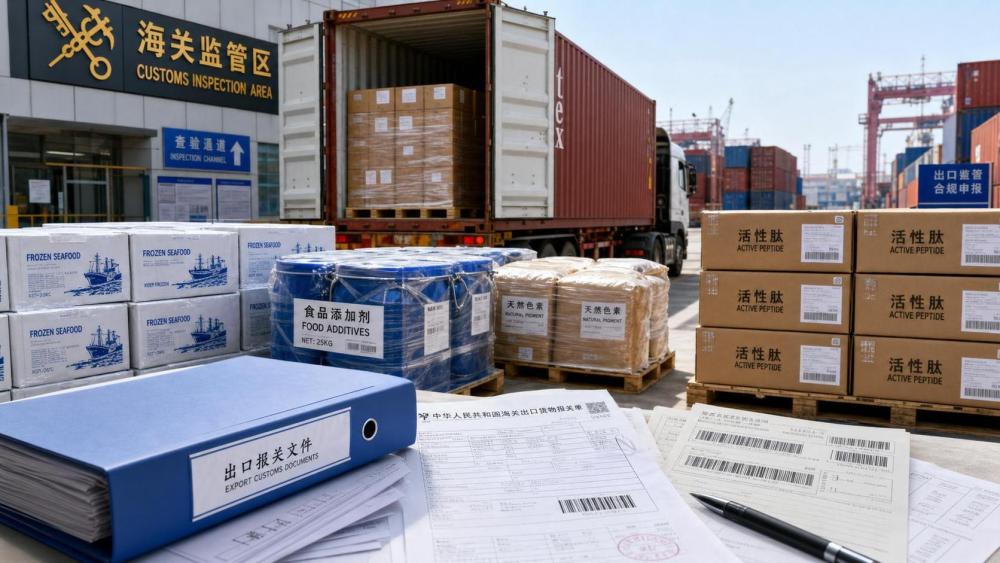
On June 2, 2026, the Office of the United States Trade Representative (USTR) released the result of a Section 301 investigation and proposed an additional 12.5% tariff on goods from China and 46 other economies, citing a failure to establish and effectively enforce import bans on products linked to forced labor. With the measure potentially taking effect as early as July, exporters and buyers in seafood, food additives, natural pigments, active peptides, and other FMCG ingredient categories should pay close attention, as the development points not only to higher landed costs but also to tighter compliance review at the border.
What the USTR Announced on June 2
According to the information provided, the USTR published the outcome of its Section 301 investigation on June 2, 2026. The agency determined that China and 46 other economies had not implemented, and had not effectively enforced, import bans on products associated with forced labor.
Based on that finding, the U.S. side proposed an additional 12.5% tariff. The measure could be implemented as early as July. The product scope mentioned in the provided information includes multiple FMCG raw material export categories, such as seafood, food additives, natural pigments, and active peptides.
The immediate practical implication described in the source information is a rise in customs clearance costs together with stronger compliance scrutiny.
Where the pressure may appear across the supply chain
Export-facing suppliers may feel the first cost shock
From an industry perspective, direct trading companies and upstream exporters are among the first groups likely to feel the effect if the proposed measure moves forward. The reason is straightforward: the additional tariff would directly affect the cost structure of shipments entering the U.S. market, while the stated compliance issue increases the likelihood of closer documentation and review during customs clearance.
What deserves closer attention is not only the tariff rate itself, but also whether specific product lines in seafood, food additives, natural pigments, and active peptides face different levels of operational friction once enforcement begins.
Procurement teams may need to reassess sourcing and delivery assumptions
For raw material buyers and procurement teams, the likely impact lies in sourcing continuity, landed-cost calculations, and delivery timing. If customs review becomes more stringent, buyers may need to revisit lead times, supplier documentation requirements, and the commercial assumptions behind existing purchase plans for affected categories.
Analysis shows that even before any final implementation date, the policy signal alone may prompt internal reviews of U.S.-bound supply arrangements, especially where contracts depend on stable import timing or predictable clearance procedures.
Processors and downstream users may face indirect operational pressure
Processing manufacturers, channel operators, and end-use companies may not be the first point of policy contact, but they could still feel secondary pressure through input costs, scheduling uncertainty, and supplier communication burdens. This is particularly relevant for businesses that rely on imported FMCG ingredients as part of production or formulation planning.
Observably, the issue is not limited to trade policy interpretation. It also touches day-to-day execution, including whether incoming materials can clear on time and whether compliance-related questions disrupt shipment planning.
Supply chain service providers may see higher compliance workloads
Customs brokers, logistics coordinators, and other supply chain service providers may need to prepare for heavier document review and more frequent client communication. The reason is that a policy framed around forced labor compliance tends to raise the standard of scrutiny attached to shipments, even where the commercial product category itself is familiar.
For this group, the key change to watch is whether operating procedures, document expectations, or review intensity shift as implementation details become clearer.
What companies should monitor now
Watch for the final policy language and timing
Analysis shows that the current headline is important, but the practical effect will depend on how the U.S. side frames final implementation language, timing, and enforcement details. Companies should distinguish between the investigation result already announced and the exact operational rules that may follow.
Map exposure by product and destination market
Businesses involved in seafood, food additives, natural pigments, active peptides, and related FMCG raw materials should review which SKUs, contracts, and customer accounts are tied to U.S.-bound trade. What deserves closer attention is where tariff exposure and compliance exposure overlap within the same shipment flow.
Recheck supplier files and shipment documents
From an operational perspective, supplier qualifications, transaction records, and shipment-related documents may become more important if customs review intensifies. This is not a conclusion about any one company, but an observation that documentation quality may become a more visible factor in trade execution under a stricter compliance environment.
Prepare customer communication and delivery contingencies
Companies with U.S.-linked business may also need to prepare for questions around pricing, delivery schedules, and compliance handling. Observably, the difference between a policy announcement and real shipment disruption often lies in how quickly firms can align internal teams, external suppliers, and customer expectations.
Why this matters beyond the immediate tariff proposal
Analysis shows that this development should not be read only as a short-term cost event. It also serves as a policy signal that trade measures and forced labor compliance are being linked more directly in sectors connected to everyday consumer goods ingredients.
At the same time, it is more appropriate to understand this as an evolving industry development rather than a fully settled outcome. The investigation result and the proposed tariff provide a clear direction of travel, but the full business effect still depends on implementation details, timing, and how enforcement is applied in practice.
How the market may need to read the current stage
For the industry, the current significance lies in the combination of two pressures: added tariff cost and stronger compliance review. That combination matters because it can affect pricing, documentation, lead times, and customer communication at the same time.
Still, a neutral reading is more appropriate than an exaggerated one. Based on the information provided, this is best understood as a concrete near-term policy risk and a longer-term compliance signal that warrants continued monitoring, rather than as a final and fully measurable market outcome today.
Basis of this article and follow-up verification
This article is generated from the user-provided news title, event date, and event summary concerning the U.S. Section 301 investigation result announced on June 2, 2026, and the proposed additional 12.5% tariff affecting China and 46 other economies.
For this type of development, commonly relevant source categories may include official government announcements, company disclosures, industry association updates, authoritative media reporting, and compliance-related policy documents. A specific official source link was not provided in the input, so further verification remains necessary as subsequent official wording, implementation details, and market responses become clearer.
Areas that still merit continued attention include whether the measure takes effect in July, whether the covered product scope changes, and how customs and compliance review are applied in actual trade operations.
Related News
- How to verify a cosmetic nanotechnology supplier's safety documentationOct 04, 2026Dr. Chloe Vance
- How to set a control sensory flavour standard for panel consistencySep 27, 2026Dr. Chloe Vance
- How to verify compliance documents for cosmetic active compoundsSep 19, 2026Dr. Chloe Vance
- How to verify food grade flavor formulation ingredients for safetySep 18, 2026Dr. Chloe Vance
Related News
- 00
0000-00
What drives fragrance ingredients price changes in bulk orders? - 00
0000-00
How to assess a food antioxidants distributor’s traceability practices - 00
0000-00
How minimum order quantities shape private label ingredient sourcing costs - 00
0000-00
What drives personal care ingredient price volatility in sourcing - 00
0000-00
What drives micelles price differences in cosmetic formulations?
Dr. Chloe Vance
Weekly Insights
Stay ahead with our curated technology reports delivered every Monday.