





Why does cosmetic compliance cost usually end up higher than the initial filing budget?
Because the filing itself is rarely the expensive part. For a business evaluator, the real cosmetic compliance cost sits in the work needed to support a formula before it reaches market: ingredient review, fragrance restriction checks, safety substantiation, supplier document collection, label review, and the time lost when any of those pieces are incomplete.
On the US side, FDA expectations are tied to product safety, proper labeling, adverse event handling, and defensible records. On the fragrance side, IFRA costs build around formula screening against the current IFRA Standards, use category classification, and documentation from the fragrance house. If a buyer only prices the submission step, they usually miss the heavier commercial burden: reformulation risk, retesting, procurement delays, and launch rescheduling.
Which cost drivers matter most when comparing suppliers or formulas?
Five factors usually move the number more than anything else.
- Formula complexity: More ingredients, more interactions, more documents to review.
- Fragrance profile: Fragrance-heavy products often carry added IFRA screening work and more frequent reformulation risk.
- Supplier transparency: A cheap raw material becomes expensive fast when its COA, allergen data, composition disclosure, or impurity information is weak.
- Claims strategy: “Moisturizing” and “anti-aging peptide repair” do not trigger the same evidence burden.
- Target market path: A formula built for one market with minimal records may need substantial cleanup before it is usable in a more tightly reviewed commercial setting.
This is why two shampoos with similar filling volumes can have very different compliance budgets. The cheaper one on paper may require more document chasing, more label correction rounds, and more time from regulatory and sourcing teams.
How much of the cost comes from FDA requirements versus IFRA requirements?
That depends on what is in the formula. If the product has little or no fragrance complexity, FDA-related work often dominates: ingredient review, safety support, packaging and label checks, complaint-readiness, and manufacturing documentation. Once a formula relies on a proprietary fragrance compound or essential oil blend, IFRA can become a major cost center.
A useful way to frame it in procurement reviews is this: FDA cost is usually tied to whether the finished cosmetic can be supported as safe and properly marketed, while IFRA cost is tied to whether the fragrance portion is acceptable for the intended product type and use pattern. Both can stall a launch, but they fail for different reasons.
When does fragrance become the main reason cosmetic compliance cost increases?
Usually when the formula includes one or more of these conditions: a high fragrance load, a leave-on application, sensitive-use positioning, essential oil complexity, or multiple markets using different internal acceptance standards.
The cost jump is not just about the fragrance oil itself. It shows up in the surrounding work:
- Obtaining a current IFRA Certificate for the correct application category
- Checking whether restricted substances in the fragrance are acceptable at the actual use level
- Reviewing allergen disclosure implications for packaging and downstream market expectations
- Reworking the formula if the intended fragrance dosage exceeds the allowed level for that product type
This is where evaluators often miss cost. A fragrance that smells right in development may still be commercially wrong if it forces dilution, replacement, or repeated compatibility work late in the process.
What documents should be checked early to avoid hidden compliance spend?
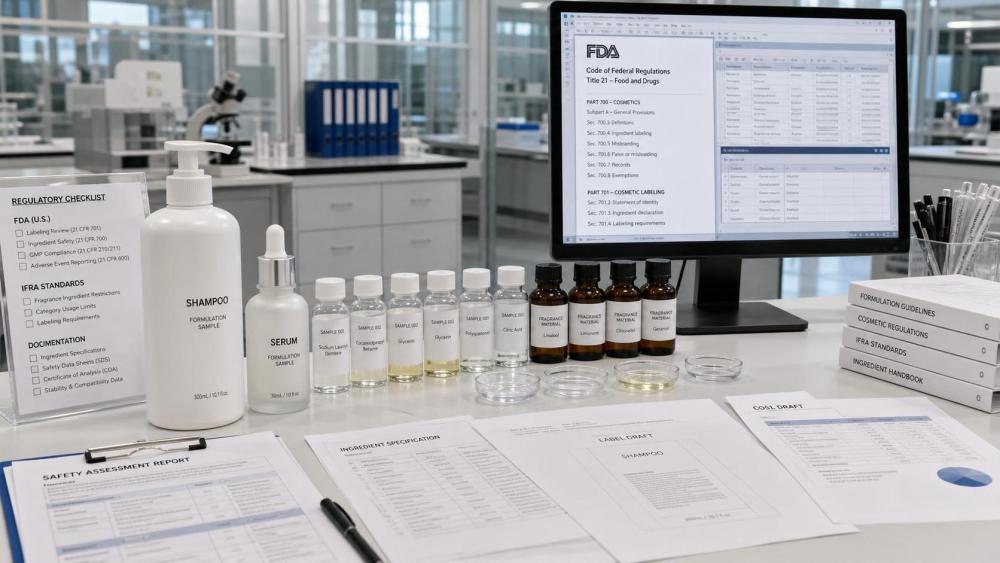
If you want a realistic cost picture, ask for the record set before price negotiation is finalized. At minimum, the review file should include the documents below.
If any of these arrive late, teams end up spending more on internal review cycles than on the document itself.
Do claims like “natural,” “clean,” or “anti-aging” change the budget?
Yes, often more than expected. Claims do not just affect marketing. They change the amount of substantiation work, wording review, and cross-checking needed between formula composition and packaging language.
“Anti-aging” is a common budget trap. Even when a product is intended to stay within cosmetic positioning, stronger efficacy language tends to trigger heavier legal and regulatory scrutiny. “Natural” and “clean” can be just as expensive in another way: they often narrow raw material options, limit preservation systems, and create more supplier verification work around origin, processing, and composition.
For business evaluation, the question is not whether the claim sounds attractive. It is whether the supporting file is already available, or whether the claim will force new work across formulation, documentation, and packaging.
Why do supplier quality and traceability have such a large impact on compliance cost?
Because missing traceability turns a routine review into an investigation. A well-priced active, surfactant, preservative, or fragrance component can become expensive when the supplier cannot clearly show what the material is, how it is specified, and whether each batch can be linked to the same documented standard.
In practice, cost rises in three places: more back-and-forth with the vendor, slower internal approval, and a greater chance of substitution later. That last point matters most. Substituting one raw material after artwork, stability work, or fragrance balancing has started usually costs more than paying for a stronger supplier package at the beginning.
Which products are usually cheaper to clear, and which ones tend to run expensive?
Rinse-off products with straightforward formulas and modest fragrance loads are often easier to support. A basic body wash or shampoo with conventional ingredients and controlled claims tends to move faster than a leave-on serum built around peptides, botanicals, essential oils, and aggressive anti-aging messaging.
The products that usually pull higher cosmetic compliance cost share the same pattern: complex actives, sensitive application area, strong sensory positioning, and premium claims. It is not that any one feature is automatically a problem. It is the stacking effect. Each extra variable adds another layer of document review and another opportunity for reformulation.
Where do companies most often underestimate cost during sourcing?
Three places come up again and again.
- They assume a fragrance approval from one project can be reused without checking IFRA category fit for the new product.
- They approve a raw material on commercial price before seeing whether the document package supports the intended claims and finished-product position.
- They treat reformulation as a minor adjustment, even though one change can trigger renewed screening, artwork edits, and another supplier qualification round.
That is why the lowest quote is not always the lowest landed compliance cost. Procurement savings can disappear quickly when technical and regulatory teams have to rebuild the file later.
What is the most practical way to estimate cosmetic compliance cost before purchase approval?
Use a gate review instead of a single number. Start with the formula type, fragrance load, claims language, and intended market channel. Then check whether the supplier file is complete enough to answer four basic questions:
- Can every ingredient be identified and traced?
- Is the fragrance covered by a current IFRA Certificate for the intended use?
- Does the claim set match the available substantiation?
- Would a single ingredient change force a major rework of the file?
If the answer to any of those is weak, do not treat the project as a standard-cost item. Put it in a higher-risk bucket with room for added review time and possible reformulation expense. For business evaluators, that approach is far more reliable than relying on filing fees alone. The real question is not “What does submission cost?” but “What will it take to keep this formula commercially usable without rework?”
Related News
- How to verify a cosmetic nanotechnology supplier's safety documentationOct 04, 2026Dr. Chloe Vance
- How to set a control sensory flavour standard for panel consistencySep 27, 2026Dr. Chloe Vance
- How to verify compliance documents for cosmetic active compoundsSep 19, 2026Dr. Chloe Vance
- How to verify food grade flavor formulation ingredients for safetySep 18, 2026Dr. Chloe Vance
Related News
- 00
0000-00
What drives fragrance ingredients price changes in bulk orders? - 00
0000-00
How to assess a food antioxidants distributor’s traceability practices - 00
0000-00
How minimum order quantities shape private label ingredient sourcing costs - 00
0000-00
What drives personal care ingredient price volatility in sourcing - 00
0000-00
What drives micelles price differences in cosmetic formulations?
Dr. Chloe Vance
Weekly Insights
Stay ahead with our curated technology reports delivered every Monday.