





Food additive compliance is usually proven through a document set rather than a single certificate. Auditors and border inspectors tend to look for a chain of evidence that connects the additive name on paper to the substance in the drum, the function in the formula, the legal basis for use, and the way it appears on the finished label. If one link is missing, the additive may still be lawful, but the file will often be treated as incomplete.
The first document is the product specification or technical data sheet. This is the core identity record for the additive itself. It should state the correct substance name, any recognized synonym, grade, composition, physical appearance, assay or purity range, key analytical limits, recommended storage conditions, shelf life, and intended technological function such as preservative, antioxidant, thickener, color, sweetener, acidity regulator, or flavor carrier. A useful specification also distinguishes food grade material from industrial or cosmetic grades when the same chemistry exists in multiple markets. If the specification leaves out critical parameters, later documents become harder to interpret because there is no fixed reference point for what was actually purchased.
Closely tied to that is the certificate of analysis issued for the specific batch. A general specification shows what should be true; the batch certificate shows what was tested for that lot. The file is stronger when the batch number on the certificate matches the label on the packaging, the invoice, and the receiving record. Typical entries include assay, moisture, pH where relevant, viscosity for hydrocolloids, color value for pigments, microbial limits, and contaminant markers that matter for the additive type. For example, a thickener may need viscosity and particle size confirmation, while an antioxidant may need purity and residual solvent data if the manufacturing route makes that relevant. A certificate that simply says “pass” without test methods or limits may satisfy internal trade practice, but it is weaker in a formal compliance review.
Legal status documentation is the next essential layer. This may take the form of a regulatory declaration, compliance statement, or legal opinion identifying where the additive is authorized and under what conditions. The practical purpose is to confirm that the substance is permitted for food use in the intended market and category. A strong declaration does not stop at saying the additive is “compliant.” It normally identifies the legal naming convention, any numerical identifier used by the market, purity criteria where applicable, restrictions on food categories, maximum use levels if such limits exist, and any special labeling conditions. When a substance is lawful in one jurisdiction but restricted in another, the declaration should make that distinction explicit rather than merging all markets into one vague sentence.
Raw legal status is still not enough without composition disclosure. Many additives are not single-molecule materials. They may contain carriers, stabilizers, anticaking agents, solvents, processing aids, or standardization agents. A composition statement or full formulation disclosure is therefore often needed, especially when the additive is a blend, flavor preparation, enzyme preparation, or encapsulated system. This document allows a reviewer to determine whether every component inside the commercial product is suitable for food use and whether any hidden sub-ingredients create separate labeling or import issues. Natural color preparations, flavor systems, and preservation blends frequently fail initial review because the main active ingredient is documented, but the carrier system is not.
A manufacturing process description is also valuable, and in some product categories it becomes indispensable. It does not need to reveal trade secrets in exhaustive detail, but it should explain the production route well enough to assess compliance risk. Fermentation-derived additives, solvent-extracted flavor ingredients, botanical concentrates, and chemically modified starches all raise different questions. The process summary may show whether a solvent is removed, whether a catalyst could leave residues, whether animal-derived media were used, or whether a modification changes regulatory classification. When the route affects purity criteria or the acceptability of residual compounds, the process description becomes part of the proof package rather than background information.
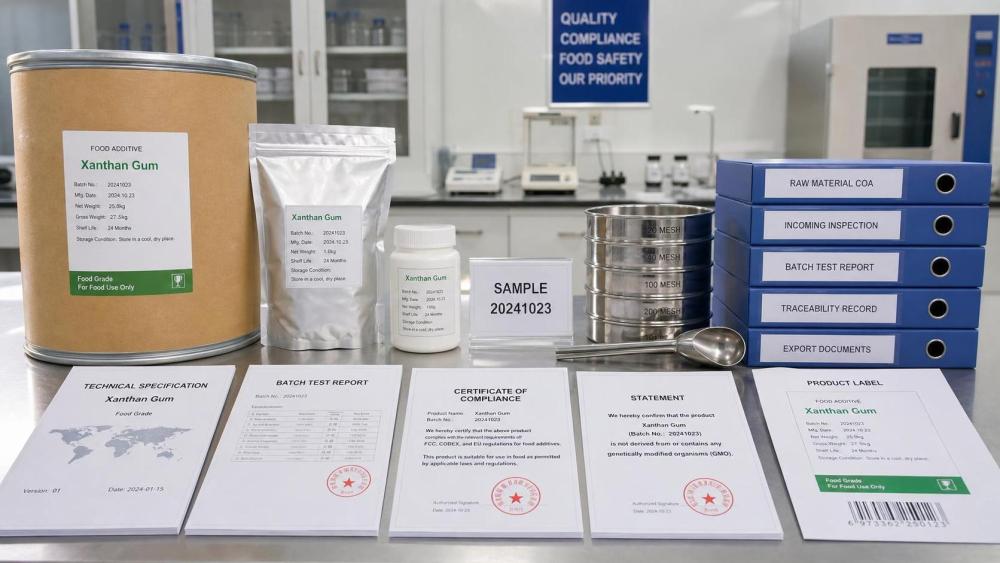
Safety-related supporting records often sit in a separate file, but they are part of food additive compliance documentation in practice. These can include allergen statements, GMO status declarations, irradiated material statements where relevant, and contaminant declarations covering heavy metals, residual solvents, pesticide residues, polycyclic aromatic hydrocarbons, mycotoxins, or other hazard groups depending on source material and process. Botanical extracts and natural pigments tend to need broader contaminant review than highly refined synthetic additives because agricultural origin introduces more variable impurity patterns. Marine-derived or fermentation-derived materials may require additional controls tied to source and process hygiene.
For many imported ingredients, traceability documents are examined as closely as technical documents. The purchase order, commercial invoice, packing list, bill of lading, warehouse receipt, and internal receiving log help show that the tested batch is the same batch that entered production. If relabeling occurred during repacking or local warehousing, the file should preserve the original batch identity and the link to the new internal code. Gaps often appear here: the certificate of analysis refers to one lot number, the drum label shows another, and the ERP record uses a third code created on receipt. Unless the cross-reference is documented, the compliance story becomes difficult to defend.
A supplier declaration on food contact, quality, and regulatory conformance adds another layer, especially when documentation must withstand external review. This declaration should identify the legal manufacturer, manufacturing site where possible, and the entity responsible for the statement. It should also define scope. Some declarations speak only to the additive as shipped; others extend to packaging suitability, transport conditions, or absence of unauthorized treatments. A generic letter with no product code, no signatory, and no date is easy to file but weak in an audit. Document control matters: undated declarations can survive in files long after formulations, source plants, or legal interpretations have changed.
Labeling support documents are frequently underestimated. Yet labeling is where compliant material can still become a non-compliant finished product. The support file may include the ingredient declaration format, any required class name, statements related to carry-over where locally recognized, and rules on whether the additive must be declared by functional class, specific name, or both. For colors, sweeteners, preservatives, and flavor-related components, naming conventions can differ across markets. An internal label review record that traces each additive in the formula to its exact declaration text is often more useful than a broad statement claiming that labels were “reviewed.”
Use-level justification should also be documented. This is not always a formal regulatory filing, but it is often necessary evidence. The record should show the intended dosage range, the food category in which the additive is used, any legal maximum if one applies, and the technical reason for that use level. This becomes especially important for preservatives, antioxidants, sweeteners, and colors, where category-specific limits may exist or where quantum satis principles may be misunderstood. A common mistake is to rely on a supplier’s recommended addition level without confirming whether that recommendation was developed for the same food matrix, pH, water activity, thermal profile, and shelf-life target.
Processing conditions can change the interpretation of the documents. An additive may be compliant as purchased but become questionable if process stress alters concentration, degradation pattern, or function. Heat-sensitive antioxidants, volatile flavor preparations, acid-labile colors, and viscosity-modifying gums can behave differently after retort, extrusion, baking, or freeze-thaw cycles. Stability records, pilot batch observations, and process validation notes therefore support compliance indirectly by showing that the additive remains within its intended technological role. If an encapsulated flavor loses its carrier integrity during drying, the actual exposure and labeling basis may differ from the original documentation.
In cross-border trade, language and document version control create avoidable failures. A certificate translated informally may replace the legally relevant substance name with a commercial shorthand. A regulatory declaration written for one market may be reused for another after only the country name is changed. A specification may be current, while the allergen statement attached to it is from an older formula version. The strongest files use a controlled document matrix listing product code, revision date, issuing party, covered site, and expiration or review trigger. That matrix is rarely glamorous, but it prevents outdated paperwork from being treated as current proof.
Some additive categories need extra documents because of how they are sourced. Enzyme preparations may require statements on production organism and residual activity. Gelatin-based or dairy-derived ingredients may need source declarations tied to animal species or milk allergen status. Essential oil extracts and natural flavor fractions may need solvent and authenticity support because source variability is high. Anti-caking systems, carrier oils, and microencapsulation wall materials should not be ignored simply because they are minor components; they can affect both food legality and label accuracy.
Transport and storage records matter when the additive is sensitive to moisture, light, oxygen, or temperature. A compliant batch at dispatch may no longer meet specification after poor storage, especially for pigments, flavors, antioxidants, and certain high-purity actives used in adjacent sectors. Temperature logs, seal integrity records, container condition reports, and warehouse segregation records can therefore become part of the evidence package when a deviation is investigated. This is especially relevant when the additive is transferred between sites, repacked, or held for long periods before use.
The weakest assumption in many files is that supplier approval replaces product compliance proof. It does not. A qualified supplier may still ship a non-conforming lot, revise a manufacturing aid, change a raw material source, or update a carrier without immediate visibility downstream. Product-specific documents, lot-specific records, and change notification history are all needed. A change control record should capture reformulation, site transfer, revised specification limits, updated analytical methods, and shifts in legal interpretation. Without this history, an older approval may be mistakenly applied to a newer material that is no longer equivalent.
When assembling the file, the useful question is simple: can an external reviewer trace legality, identity, composition, tested quality, intended use, and label outcome without making assumptions? If the answer depends on personal memory, email threads, or undocumented verbal confirmation, the documentation is still incomplete. A defensible food additive compliance documentation package usually combines the specification, batch certificate, legal status declaration, composition disclosure, process summary where relevant, safety and contaminant statements, traceability records, labeling support, and use-level justification into one controlled record set. That level of detail tends to withstand routine audits far better than a folder built around a single supplier certificate.
Related News
- How to verify a cosmetic nanotechnology supplier's safety documentationOct 04, 2026Dr. Chloe Vance
- How to set a control sensory flavour standard for panel consistencySep 27, 2026Dr. Chloe Vance
- How to verify compliance documents for cosmetic active compoundsSep 19, 2026Dr. Chloe Vance
- How to verify food grade flavor formulation ingredients for safetySep 18, 2026Dr. Chloe Vance
Related News
- 00
0000-00
What drives fragrance ingredients price changes in bulk orders? - 00
0000-00
How to assess a food antioxidants distributor’s traceability practices - 00
0000-00
How minimum order quantities shape private label ingredient sourcing costs - 00
0000-00
What drives personal care ingredient price volatility in sourcing - 00
0000-00
What drives micelles price differences in cosmetic formulations?
Dr. Chloe Vance
Weekly Insights
Stay ahead with our curated technology reports delivered every Monday.