





Biodegradable Ingredients: Cost Tradeoffs and Performance Gaps
For procurement teams, biodegradable ingredients sound like a clear win.
They support cleaner positioning, lower environmental impact, and stronger compliance narratives.
But sourcing decisions rarely stop at sustainability claims.
The harder questions involve price volatility, formulation performance, and supply reliability.
That is especially true across food, fragrance, cosmetics, and cleaning applications.
In practice, biodegradable ingredients can create value.
Still, they do not replace conventional materials on equal terms in every category.
A smart buying strategy starts with knowing where tradeoffs are manageable.
It also requires clarity on where performance gaps still raise commercial risk.
Why biodegradable ingredients are moving into core sourcing decisions
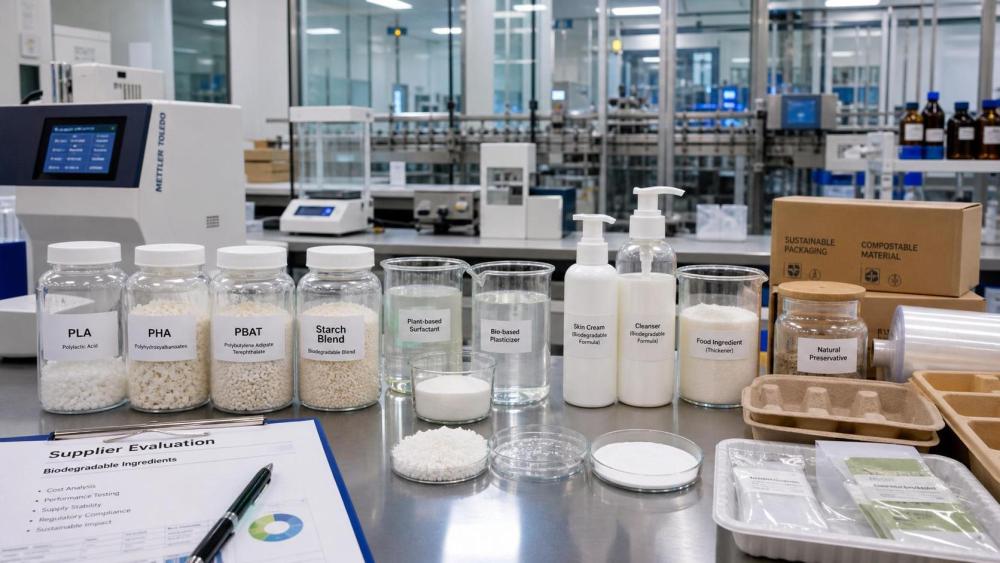
Recent market shifts make biodegradable ingredients more relevant than a few years ago.
Brand owners now face tighter retailer standards and more visible sustainability audits.
Consumers also connect ingredient choices with safety, transparency, and product quality.
This is not limited to packaging.
Internal formulations now receive the same level of scrutiny.
In food systems, buyers assess preservatives, antioxidants, pigments, and thickeners more closely.
In beauty and personal care, surfactants and actives face stronger biodegradability expectations.
Fragrance and essential oil sourcing also receives more lifecycle attention.
That said, biodegradable ingredients are not a single procurement category.
Each ingredient family carries different cost drivers and different performance limits.
Where cost tradeoffs usually appear first
The first issue is raw material economics.
Many biodegradable ingredients depend on plant-based, fermented, or bio-derived feedstocks.
Those supply chains can be less mature than petrochemical alternatives.
As a result, unit costs often start higher.
The second issue is processing complexity.
Biodegradable ingredients may require tighter storage, gentler handling, or more controlled formulation conditions.
That adds indirect cost beyond the purchase price.
The third issue is dosage efficiency.
Some biodegradable ingredients need higher use levels to match incumbent performance.
This changes the real cost-in-use calculation.
- Bio-based surfactants may cost more per kilogram than conventional sulfates.
- Natural preservatives may need combination systems for comparable shelf life.
- Biodegradable thickeners can require formula adjustment to preserve texture stability.
- Certain natural aroma materials show stronger crop-linked price volatility.
So the relevant benchmark is not price per ton, but delivered business value.
The main performance gaps buyers should test early
Performance gaps vary sharply by application.
That is why early screening matters more than broad supplier claims.
Food preservation and stability
Biodegradable ingredients used in preservation often face heat and oxygen stress.
Some natural antioxidant systems degrade faster during baking or long storage.
That can reduce shelf life and increase return risk.
Texture and rheology control
In sauces, dairy, and desserts, texture is part of product identity.
Biodegradable ingredients such as natural hydrocolloids can perform well.
Still, batch consistency and pH tolerance may differ from synthetic systems.
Foam, cleansing, and mildness
In shampoos and cleansers, biodegradable ingredients often improve story and skin feel.
However, foam volume, flash rinsing, and heavy soil removal can lag.
This is where blending strategies become important.
Fragrance and active delivery
Some biodegradable ingredients affect release profiles or penetration behavior.
That matters for fragrance longevity and cosmetic active efficacy.
A greener input that weakens performance can erase brand gains quickly.
How to compare biodegradable ingredients using total procurement value
A useful sourcing model looks beyond invoice price.
It compares biodegradable ingredients across five measurable dimensions.
This kind of matrix helps separate strategic upgrades from expensive experiments.
It also makes supplier conversations more fact-based and easier to benchmark.
Category-by-category guidance for lower-risk adoption
Not every application should move at the same speed.
A phased approach usually delivers better commercial results.
- Start with biodegradable ingredients in low-risk support functions, such as texture adjustment or secondary surfactant roles.
- Use blended systems where full replacement would weaken preservation, foam, or fragrance performance.
- Prioritize categories where biodegradability adds visible claim value and supports premium pricing.
- Avoid single-source dependence for bio-derived materials with seasonal or regional supply exposure.
- Request stability, biodegradation, and application data under conditions close to your real process.
For example, natural thickeners may be a smoother transition than full preservative replacement.
Likewise, mild biodegradable surfactants often work best in hybrid cleansing systems.
The point is not to buy greener ingredients at any cost.
The point is to buy biodegradable ingredients where value survives real-world formulation pressure.
Questions to ask suppliers before making the switch
Good procurement outcomes depend on sharper supplier qualification.
These questions usually reveal hidden gaps quickly.
- What test method supports the biodegradability claim?
- How does performance compare at equal dosage?
- What happens under heat, light, pH, or oxidative stress?
- Which regions already approve or accept this ingredient?
- Is there a backup plant, fermentation line, or second source?
- Can the supplier document batch consistency over time?
- What premium claim or reformulation benefit justifies the cost?
Answers should be specific, not marketing-heavy.
If a supplier cannot translate biodegradable ingredients into operational evidence, the risk remains yours.
A practical path forward
Biodegradable ingredients are becoming a serious sourcing priority, not a niche preference.
Even so, the best decisions stay grounded in cost, resilience, and verified performance.
Some biodegradable ingredients already compete well in value terms.
Others still need blending, reformulation, or selective use to make financial sense.
In actual sourcing work, the strongest results come from disciplined comparison.
Focus on cost-in-use, test under real conditions, and challenge every performance assumption.
That approach turns biodegradable ingredients from a branding concept into a smarter procurement lever.
And over time, it builds a supply base that is more credible, more adaptable, and easier to scale.
Related News
- How rheological thickeners for shampoo affect suspension stabilityOct 03, 2026Prof. Elian Thorne
- When does OEM ingredient sourcing support make custom formulations viable?Sep 29, 2026Prof. Elian Thorne
- What to check in a transdermal penetration supplier for skincareSep 26, 2026Prof. Elian Thorne
- How farnesene market pricing affects renewable ingredient sourcingSep 26, 2026Prof. Elian Thorne
Related News
- 00
0000-00
How to assess color stability from a natural food colors manufacturer - 00
0000-00
When does amino acid surfactant powder improve cleanser mildness? - 00
0000-00
How to verify a cosmetic nanotechnology supplier's safety documentation - 00
0000-00
How rheological thickeners for shampoo affect suspension stability - 00
0000-00
How to assess recombinant collagen ingredients for cream stability
Prof. Elian Thorne
Weekly Insights
Stay ahead with our curated technology reports delivered every Monday.