





Cosmetic active ingredients wholesale: why the lowest quote often costs more
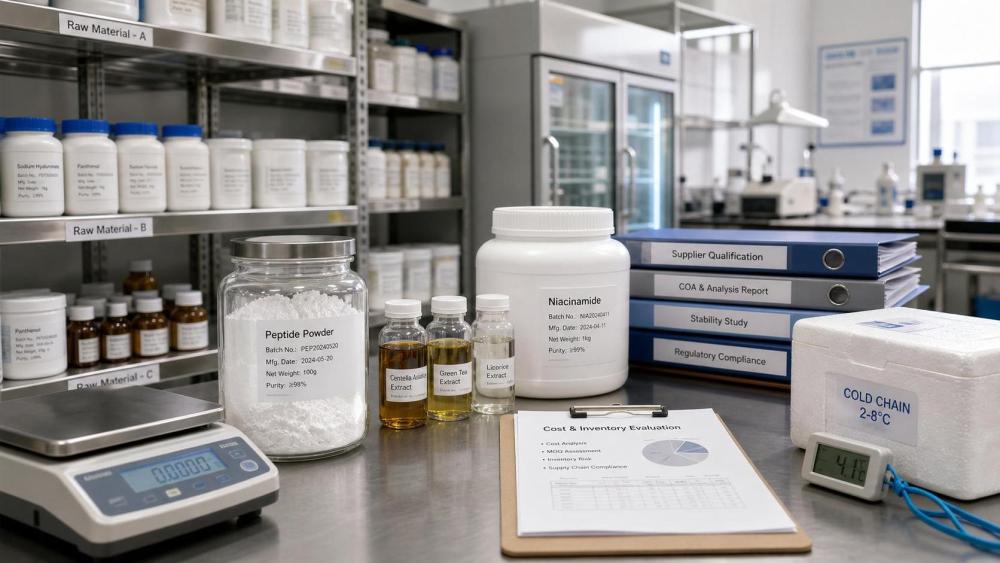
In cosmetic active ingredients wholesale, the visible price is only the starting point. The real bill usually appears later, through reformulation, delays, compliance gaps, or excess stock.
That is especially true for premium actives such as peptides, Pro-Xylane alternatives, ferments, ceramides, and botanical isolates. A small purity shift can change both performance claims and formula stability.
Within the broader FMCG landscape, cosmetic actives behave differently from flavors, thickeners, preservatives, or surfactants. They carry higher technical sensitivity and often tighter documentation expectations.
This is why market observers like FFAI pay close attention to both molecular efficacy and commercial practicality. In wholesale buying, those two issues are rarely separate.
The useful question is not, “Who is cheapest?” It is, “Which offer protects margin, timing, and formulation confidence with the least hidden risk?”
What actually drives cost in cosmetic active ingredients wholesale?
Several cost drivers sit behind the quotation. Some are obvious, such as concentration and pack size. Others only surface during technical review or after the first pilot batch.
Purity grade is usually the first one. A 98% active content and an 80% active content may both sound acceptable, yet their dosage economics can be very different.
Processing route also matters. Fermentation-derived, recombinant, encapsulated, and highly purified peptide materials often carry a premium because manufacturing yields are lower and controls are stricter.
Then comes documentation. COA, TDS, SDS, allergen statements, residual solvent data, stability support, and regulatory declarations all consume time and technical resources.
Lead time is another hidden lever. If a supplier quotes attractively but needs ten weeks, the carrying cost may erase the savings, especially near launch windows.
Raw material volatility should not be ignored either. Peptide intermediates, specialty solvents, biotech feedstocks, and some plant extracts can move sharply with energy, crop, or capacity shifts.
A practical way to compare offers is to look beyond price per kilogram:
- Cost per effective active content
- Cost after freight, duties, and cold-chain needs
- Cost of required validation and reformulation risk
- Cost of slower replenishment during demand spikes
When does MOQ become a real risk instead of a volume advantage?
MOQ can look efficient on paper. Larger commitments usually reduce the unit price. In reality, unsuitable minimums often create cash pressure and aging inventory.
This happens most often with high-value actives used at low inclusion rates. Even one drum can represent many months of production, especially in early-stage or regional launches.
Shelf life is the next concern. Some anti-aging actives remain stable for two years, while others are sensitive to moisture, temperature, oxygen, or repeated opening.
A low purchase price loses meaning if the last third of the lot requires retesting, potency adjustment, or write-off. That is a classic MOQ trap in cosmetic active ingredients wholesale.
More common warning signs include:
- Forecast demand is still tied to a new claim or new market entry
- The formula uses multiple premium actives, raising total inventory value
- Storage requires refrigeration, nitrogen protection, or special packaging
- Regulatory approval timing is uncertain across destination markets
In those cases, a higher unit price with a lower MOQ can be financially healthier. The important metric is not discount percentage. It is stock efficiency over time.
How should you compare suppliers when quotes look similar?
Two suppliers can appear equal until technical review begins. Cosmetic active ingredients wholesale should be compared with a broader checklist than pricing tables alone.
Start with identity and consistency. Batch-to-batch variation can affect odor, color, solubility, and compatibility with emulsions, gels, or surfactant systems.
Then assess the regulatory file. For export-oriented beauty products, missing declarations can slow formula registration and packaging claims, even when the material itself is acceptable.
This is where FFAI’s intelligence approach is relevant. Compliance, molecular behavior, and price discipline need to be assessed together, not as separate departments.
The table below helps turn that review into a usable buying screen.
Is higher purity always the better buying decision?
Not always. Higher purity is valuable when efficacy data, skin tolerance, claim language, or formulation precision depends on it. But premium specs can be excessive for some concepts.
For example, a hero serum built around a peptide complex may justify a tighter assay and cleaner impurity profile. A rinse-off product may not need the same specification depth.
The stronger approach is to match spec to finished-product role. That means checking dosage, contact time, claim sensitivity, and interaction with the full formula matrix.
In actual evaluation, three questions usually clarify the decision:
- Does the higher grade improve measurable performance?
- Does it reduce compliance or stability uncertainty?
- Does the premium still work after dosage economics are calculated?
If the answer is no across all three, the best value may sit in the middle specification, not at the top end.
What procurement mistakes show up most often in cosmetic active ingredients wholesale?
One common mistake is treating actives like standard commodities. In food antioxidants or surfactants, substitution can sometimes be easier. In anti-aging actives, it is often much harder.
Another mistake is approving a supplier from sample performance alone. Lab samples may come from ideal batches, while commercial lots reveal broader variation.
Short-term discount chasing is also risky. A lower quote loses value quickly if documentation is incomplete or technical response time is poor during validation.
There is also the freight blind spot. Temperature-sensitive ingredients can require faster shipping modes, insulated handling, or tighter customs timing, all of which change landed cost.
Finally, some teams do not separate “trial MOQ” from “annual contract MOQ.” That makes negotiation harder than it needs to be.
A more reliable buying routine includes:
- Running landed-cost models, not ex-works comparisons only
- Requesting commercial-batch documents before final approval
- Linking MOQ to realistic consumption and shelf-life windows
- Checking claim, compliance, and formulation teams against one checklist
What is the best next step before placing an order?
Build a short decision sheet for each active. It should cover effective dosage cost, required documents, lead time, storage conditions, MOQ exposure, and substitution difficulty.
That single page often reveals whether a cosmetic active ingredients wholesale offer is genuinely competitive or just superficially cheap.
For higher-value anti-aging materials, it also helps to separate strategic buys from routine buys. Not every ingredient deserves the same approval threshold.
A disciplined review matters more now because beauty supply chains are tied to broader FMCG movements, from biotech input costs to cross-border compliance shifts.
The strongest purchasing decisions usually come from combining molecular understanding, documentation discipline, and capital awareness. That is the real logic behind better cosmetic active ingredients wholesale outcomes.
Before moving forward, compare offers using the same technical and commercial standard, confirm realistic MOQ scenarios, and test whether the quoted savings still hold after full landed cost and risk are counted.
Related News
- How rheological thickeners for shampoo affect suspension stabilityOct 03, 2026Prof. Elian Thorne
- When does OEM ingredient sourcing support make custom formulations viable?Sep 29, 2026Prof. Elian Thorne
- What to check in a transdermal penetration supplier for skincareSep 26, 2026Prof. Elian Thorne
- How farnesene market pricing affects renewable ingredient sourcingSep 26, 2026Prof. Elian Thorne
Related News
- 00
0000-00
How to assess color stability from a natural food colors manufacturer - 00
0000-00
When does amino acid surfactant powder improve cleanser mildness? - 00
0000-00
How to verify a cosmetic nanotechnology supplier's safety documentation - 00
0000-00
How rheological thickeners for shampoo affect suspension stability - 00
0000-00
How to assess recombinant collagen ingredients for cream stability
Prof. Elian Thorne
Weekly Insights
Stay ahead with our curated technology reports delivered every Monday.