





Cosmetic Active Ingredients in North America: Cost, Compliance, and Sourcing Risks
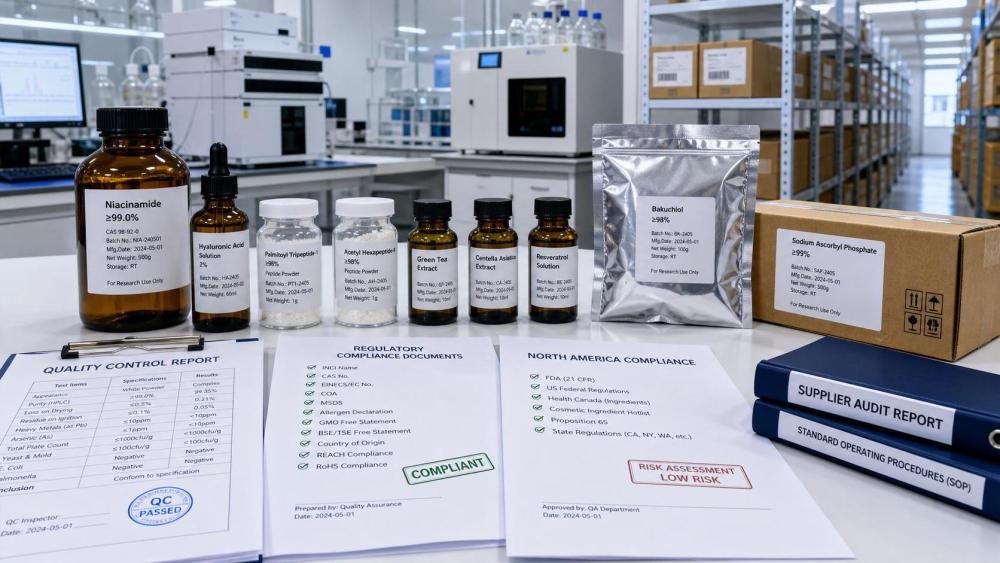
For procurement teams, sourcing cosmetic active ingredients North America is no longer just about price.
It now sits at the intersection of cost pressure, compliance exposure, lead time volatility, and supplier concentration.
That shift matters because premium actives increasingly define product claims, brand positioning, and final margin.
In practical terms, every purchasing decision affects formulation stability, launch timing, and regulatory confidence.
The market for cosmetic active ingredients North America also feels tighter than before.
Inflation, currency swings, transportation costs, and stricter documentation demands have reshaped supplier negotiations.
More importantly, buyers are expected to protect both cost and compliance at the same time.
This article breaks down where cost is moving, where compliance risk hides, and how to source more confidently.
Why cosmetic active ingredients North America are getting harder to buy well
From recent market changes, the biggest signal is that active ingredients are becoming strategic rather than interchangeable.
Peptides, ferments, botanical extracts, retinol derivatives, and barrier-support actives now drive premium claims.
That means sourcing cosmetic active ingredients North America requires more technical validation than commodity buying.
A low quote can look attractive, yet hidden quality variation may raise total cost later.
That later cost often appears as reformulation work, failed stability tests, delayed launch, or claims review issues.
In North America, demand also favors cleaner documentation and stronger traceability.
Suppliers are now expected to support safety files, specification consistency, allergen information, and origin transparency.
This is especially true for anti-aging, brightening, and microbiome-related actives.
As a result, buyers need to evaluate commercial risk and technical risk together.
Cost drivers behind cosmetic active ingredients North America
Price movement in cosmetic active ingredients North America rarely comes from one factor alone.
It is usually a layered mix of raw material scarcity, energy cost, purification complexity, and small-batch manufacturing.
For high-end actives, production yield matters as much as feedstock price.
A peptide with difficult synthesis or a fermentation active with low output can stay expensive even in softer demand cycles.
Imported intermediates add another layer of uncertainty.
When precursor chemicals come from Asia or Europe, freight and geopolitical risk can widen landed cost fast.
In actual purchasing operations, the most common cost drivers include:
- High purification standards for active content and impurity control.
- Low manufacturing scale for novel or premium cosmetic ingredients.
- Cold-chain or special storage requirements for unstable molecules.
- Documentation packages bundled into supplier pricing.
- Minimum order quantities that exceed immediate formulation demand.
This also means the cheapest offer may not produce the best total procurement outcome.
A better benchmark is total delivered value across quality, paperwork, lead time, and formulation fit.
Compliance risks that can quietly damage purchasing decisions
Compliance is where many sourcing decisions for cosmetic active ingredients North America become unexpectedly expensive.
A supplier may pass a commercial review, yet fail under documentation or claim support scrutiny.
That gap often appears late, when launch deadlines are already locked.
In North America, the pressure is not only about ingredient legality.
It also covers labeling support, safety substantiation, contamination controls, and claim defensibility.
For imported cosmetic active ingredients North America, data quality becomes even more important.
If the COA, SDS, TDS, residual solvent data, or microbiological limits are inconsistent, risk rises fast.
More obvious warning signs include:
- Incomplete batch traceability.
- Unclear INCI naming or mismatch across documents.
- Limited evidence for efficacy claims used in sales materials.
- Shifting specifications without formal change notification.
- No clear statement on residual allergens, heavy metals, or restricted substances.
These are not minor paperwork details.
They can trigger reformulation, relabeling, audit findings, or distributor rejection later in the chain.
Supplier reliability and sourcing risks in the regional market
Supplier risk in cosmetic active ingredients North America often hides behind polished presentations and short-term availability.
The real test is whether the supplier can repeat quality and timing over multiple purchase cycles.
This matters more for actives with tight concentration windows or sensitive performance profiles.
A small deviation in purity or solvent system can affect texture, stability, or efficacy perception.
More noticeably now, concentration risk is increasing.
Some high-value cosmetic active ingredients North America still depend on a narrow set of qualified producers.
When one producer faces inspection, raw material shortage, or shipping delay, buyers feel it quickly.
A simple supplier risk screen should cover:
- Manufacturing location and backup site readiness.
- Historical lead time consistency and fill rate.
- Change control discipline for raw materials and processes.
- Responsiveness to technical and regulatory questions.
- Capacity support for scaling from pilot to commercial volumes.
In practice, dual sourcing is not always possible for specialty actives.
When that happens, stronger contracts and safety stock logic become essential.
How to compare cosmetic active ingredients North America suppliers beyond unit price
A disciplined sourcing framework makes cosmetic active ingredients North America easier to compare fairly.
It also reduces the chance of overpaying for branding or underestimating hidden technical costs.
One useful approach is to score suppliers across four dimensions.
This structure is especially helpful when sourcing anti-aging actives with strong claim pressure.
It creates a clearer discussion between procurement, formulation, quality, and regulatory teams.
That internal alignment usually improves negotiation quality as well.
Practical buying strategies for better margin protection
The best buying strategy for cosmetic active ingredients North America depends on risk tier, not only annual spend.
A high-cost peptide and a mid-cost botanical may require different supplier and inventory logic.
Still, several tactics work consistently across categories.
- Lock specifications before commercial negotiation starts.
- Request multi-batch samples, not a single qualification batch.
- Model landed cost with storage, testing, and rejection risk included.
- Use quarterly supplier reviews for price, quality, and lead time.
- Build secondary options early for critical cosmetic active ingredients North America.
- Separate marketing claims from evidence-backed regulatory support.
This is where market intelligence becomes valuable.
Reliable insight on price direction, supplier behavior, and compliance shifts helps buyers act before problems become urgent.
For teams managing premium formulations, that timing advantage often protects both launch plans and margin.
A smarter way to source in a volatile market
The market for cosmetic active ingredients North America will likely stay complex.
Costs remain uneven, documentation expectations keep rising, and supplier reliability is under closer scrutiny.
That makes reactive buying increasingly expensive.
A stronger approach is to treat cosmetic active ingredients North America as a risk-managed category.
When price analysis, compliance checks, and supplier evaluation move together, decisions become more durable.
That is also where specialized intelligence platforms such as FFAI can support better sourcing discipline.
Better visibility into cost signals, technical documentation, and formulation-linked risk leads to cleaner negotiations.
In a market where actives define both product claims and profit, informed sourcing is no longer optional.
Related News
- How to interpret active matter on a surfactant specification sheetOct 14, 2026Prof. Elian Thorne
- What Quality Checks Should You Run on Fragrance Ingredient Suppliers?Oct 14, 2026Prof. Elian Thorne
- How to assess a flavor chemistry manufacturer's batch consistencyOct 13, 2026Prof. Elian Thorne
- What drives fragrance ingredients price changes in bulk orders?Oct 12, 2026Prof. Elian Thorne
Related News
- 00
0000-00
Can biomimetic peptides in cosmetics reduce the look of wrinkles? - 00
0000-00
How to assess a bio-based thickener manufacturer's batch consistency - 00
0000-00
Verifying halal status of hydrocolloid ingredients in the Middle East - 00
0000-00
How to interpret active matter on a surfactant specification sheet - 00
0000-00
How Do You Test Hydrocolloid Viscosity After Changing a Thickener?
Prof. Elian Thorne
Weekly Insights
Stay ahead with our curated technology reports delivered every Monday.