





Custom formulas create more variables than standard spec sheets can show
OEM seasoning projects often fail at the verification stage, not because the supplier cannot produce a custom blend, but because the buyer approved a formula before clarifying how that blend must behave in production, storage, and finished food applications. In 2026, this matters even more for garlic-based seasoning systems. Buyers are under pressure to shorten development cycles, hold flavor consistency across regions, and reduce waste from storage losses or rework.
For purchasing teams, a custom garlic formula is not only a flavor decision. It is a specification package that affects raw material selection, process stability, packaging, shelf life, and complaint risk. A sample that performs well in a bench test can still create problems later if moisture pickup, aroma fade, particle segregation, or color drift were not discussed before the OEM order was placed.
The practical question is simple: what should a buyer verify before signing off? The answer starts with understanding that “custom” can refer to far more than taste intensity. It can involve granulation, flowability, anti-caking strategy, target application, packaging format, and storage controls.
Start with the use case, not the sample approval
Many procurement problems begin when a buyer requests a custom powder based on a single tasting session. That approach may be enough for an early R&D screen, but it is too narrow for OEM purchasing. Garlic formulations behave differently in snack coatings, soup bases, instant noodles, dry rubs, frozen prepared foods, and sauce premixes. The same flavor profile can require different physical properties depending on whether the powder is blended dry, dispersed in oil, exposed to steam, or filled into sachets on high-speed lines.
Before asking for a final quotation, buyers usually benefit from documenting several operating conditions:
- How the powder will be used: direct seasoning, compound blend ingredient, or base note in a larger formula
- Whether the process includes heat, frying, baking, retorting, or long holding times
- Target shelf life of the finished food, not only of the seasoning itself
- Expected climate during storage and distribution
- Packaging format: bag, sachet, drum, liner, or bulk carton
- Whether the product must remain free-flowing after repeated opening and closing
Without this context, OEM suppliers may quote against a generic profile, while the buyer assumes the formula has been optimized for a specific process. Those mismatched assumptions are expensive later.
What should be written into the formula brief
A useful OEM brief for garlic seasoning should cover sensory, physical, and handling requirements together. Flavor is only one dimension. If the formula is being customized, buyers should define what must stay stable lot after lot and what can vary within reasonable tolerance.
For example, if the application is a dry coating for fried snacks, particle size and adhesion may matter almost as much as aroma. If the application is a soup or seasoning sachet, rapid dispersion and low lumping risk may be more important. A custom garlic powder formula may also include carriers, salt, sugar, starches, spices, or anti-caking components, so purchasing should verify which attributes belong to the garlic input itself and which come from the total blend design.
Questions that belong in the brief include:
- Is the target profile fresh, roasted, pungent, sweet, or rounded?
- Should the garlic note lead the formula or support other seasonings?
- What color range is acceptable?
- What particle size or mesh expectation fits the production line?
- What moisture condition is acceptable at delivery?
- Does the buyer need a free-flowing powder over the full shelf period after opening?
- Are there restricted ingredients or allergen control requirements in the blending environment?
These points reduce the risk of approving a sample that tastes right but performs poorly in filling, mixing, or warehousing.
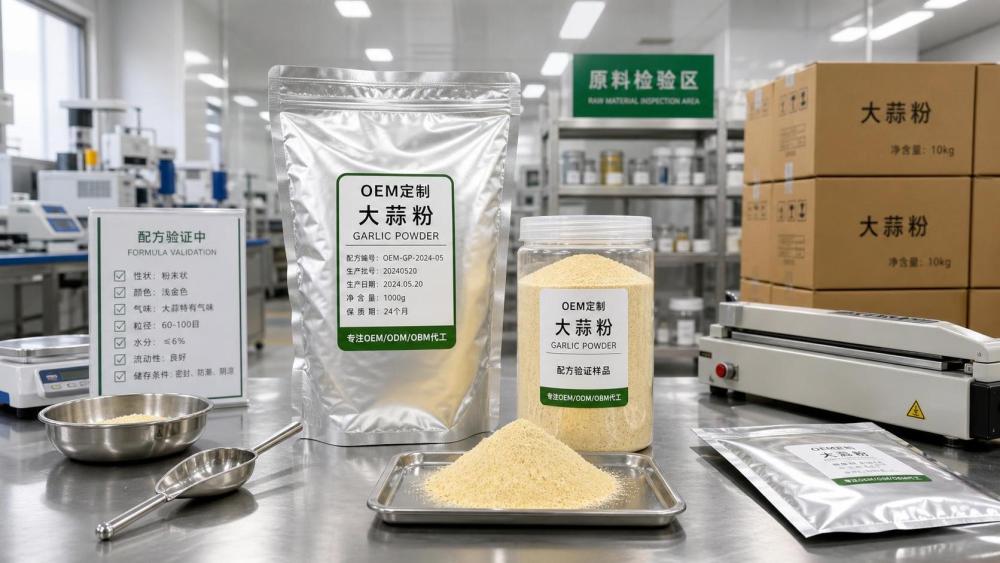
Storage is not a side issue: aroma and moisture control should be verified early
Garlic powders are especially sensitive to storage conditions because aroma retention and moisture control are directly linked to commercial usability. When buyers review an OEM proposal, they should not treat storage guidance as a routine footer on the specification sheet. It should be part of supplier evaluation.
Garlic aroma can weaken when packaging protection is inadequate or when inventory sits too long in warm, humid conditions. Moisture pickup may lead to caking, poor flow, and uneven dosing. Even if food safety remains acceptable, handling losses can rise: clumps in hoppers, extra sieving, line stops, inaccurate sachet fills, and more leftover material after partial use.
That is why buyers should ask how the formula is protected against moisture exposure during normal storage and transport, especially if the product will move through coastal climates, non-air-conditioned warehouses, or mixed seasonal conditions. A supplier’s reply should be concrete. Procurement teams typically need clarity on:
- Recommended storage environment and sealing practice after opening
- How packaging design supports aroma retention
- Whether moisture-sensitive ingredients in the blend increase caking risk
- How long the powder remains operationally usable once a bulk pack is opened under plant conditions
- What signs indicate that product performance, not just appearance, may have changed
This is also where sample evaluation can mislead buyers. Fresh lab samples often show stronger aroma and better flow than material kept in a warehouse for weeks after customs clearance and internal transfer.
Packaging format affects quality more than many buyers expect
Procurement teams often focus on formula composition and overlook the packaging configuration. Yet for garlic-based powders, packaging can change the real delivered value of the order. A technically sound blend may still underperform if the pack size does not match consumption speed at the customer’s plant.
Large bulk formats can lower unit packaging cost, but if the user opens a bag and consumes it slowly in a humid room, caking and aroma loss may appear before the material is fully used. Smaller packs may improve preservation after opening but increase handling time and packaging waste. There is no universal answer; the right format depends on throughput, storage discipline, and environmental control at the receiving site.
When evaluating OEM terms, buyers should compare not only price per kilogram but also likely in-use loss. A cheaper bulk pack is not necessarily the better commercial option if a meaningful share becomes difficult to dispense accurately near the end of use.
Supplier verification should go beyond the certificate pack
Certificates and standard documents remain important, but they do not answer every procurement risk in custom seasoning orders. For OEM projects, buyers should also test how clearly the supplier manages formula control, change communication, and lot consistency.
A useful verification process often includes these checkpoints:
- Whether the supplier can separate formula approval from pilot and commercial release stages
- Whether retained samples are kept for comparison if disputes arise
- How ingredient substitutions are controlled if upstream raw materials shift
- What version control system is used for custom formulas and artwork
- How the supplier handles deviations in color, odor, flowability, or moisture tendency
This matters because custom formulas are more exposed to small changes than commodity items. A minor shift in raw garlic source, drying intensity, or carrier ratio may alter pungency, color, or handling behavior even when the product name remains the same.
Commercial buyers should define acceptance around performance, not only composition
It is common to write purchase terms around ingredients, microbiological criteria, and shelf life. Those are necessary, but for custom garlic systems they may be incomplete. The receiving plant often experiences quality as a performance issue: Does it flow? Does it disperse? Does the aroma still meet target after storage? Does it behave consistently in the customer’s process?
For that reason, an acceptance framework can be stronger when it includes operational checks such as:
- Appearance after defined storage conditions
- Flow condition at the point of use
- Ease of blending into the customer’s base formula
- Sensory comparison against approved control sample
- Packaging integrity on arrival
These are not exotic demands. They simply align incoming inspection with the way the ingredient will actually be used. If a powder passes a paper specification but fails on the line, the buyer still absorbs cost through delay, labor, and possible product holds.
Common OEM mistakes that create avoidable disputes
Approving the strongest sample instead of the most stable one
A highly aromatic sample can win internal tasting panels, yet the same profile may fade faster if the formulation or packaging is not suited to real distribution conditions. Stability may deserve more weight than first-impact intensity.
Ignoring plant humidity during qualification
If the receiving facility runs in a humid environment, caking risk should be discussed before commercial launch. A powder that handles well in a climate-controlled lab may perform differently on a busy factory floor.
Comparing unit price without adjusting for use loss
Two OEM offers can look similar in formula profile while differing in granulation, packaging, or moisture sensitivity. Those differences may change how much product is actually usable.
Leaving post-opening handling undefined
Once a bag is opened, accountability often becomes unclear. Buyers should establish what storage and resealing conditions are assumed in the supplier’s shelf-life statement and what happens if real usage conditions are harsher.
A practical review framework before placing the order
What 2026 buyers should keep in view
Custom seasoning procurement is moving toward tighter specification discipline. Buyers are being asked to manage flavor intent, operational stability, and storage resilience at the same time. Garlic formulas make that balancing act visible because aroma impact is easy to notice, while moisture-related deterioration can remain hidden until the product reaches production.
The stronger purchasing position is not built by asking for the lowest quote or the most intense sample. It comes from verifying how the custom formula will survive transport, storage, opening, and actual use. When those checks are done before the OEM order, the conversation shifts from reactive complaint handling to controlled commercial execution.
Related News
- How to interpret active matter on a surfactant specification sheetOct 14, 2026Prof. Elian Thorne
- What Quality Checks Should You Run on Fragrance Ingredient Suppliers?Oct 14, 2026Prof. Elian Thorne
- How to assess a flavor chemistry manufacturer's batch consistencyOct 13, 2026Prof. Elian Thorne
- What drives fragrance ingredients price changes in bulk orders?Oct 12, 2026Prof. Elian Thorne
Related News
- 00
0000-00
Can biomimetic peptides in cosmetics reduce the look of wrinkles? - 00
0000-00
How to assess a bio-based thickener manufacturer's batch consistency - 00
0000-00
Verifying halal status of hydrocolloid ingredients in the Middle East - 00
0000-00
How to interpret active matter on a surfactant specification sheet - 00
0000-00
How Do You Test Hydrocolloid Viscosity After Changing a Thickener?
Prof. Elian Thorne
Weekly Insights
Stay ahead with our curated technology reports delivered every Monday.