





FMCG ingredient price trends rarely move in isolation. They reflect shifts in feedstock availability, regulatory pressure, freight conditions, energy costs, and changing consumer preferences across food, beauty, and household care.
That is why FMCG ingredient price analysis matters well beyond budgeting. It helps reveal which sourcing risks are temporary, which are structural, and which may reshape formulation, supplier strategy, or product positioning.
Across preservatives, thickeners, fragrance compounds, cosmetic actives, and surfactants, the most useful cost signals are not always the loudest ones. The real value lies in reading price movement in context.
Why price signals matter more than headline volatility
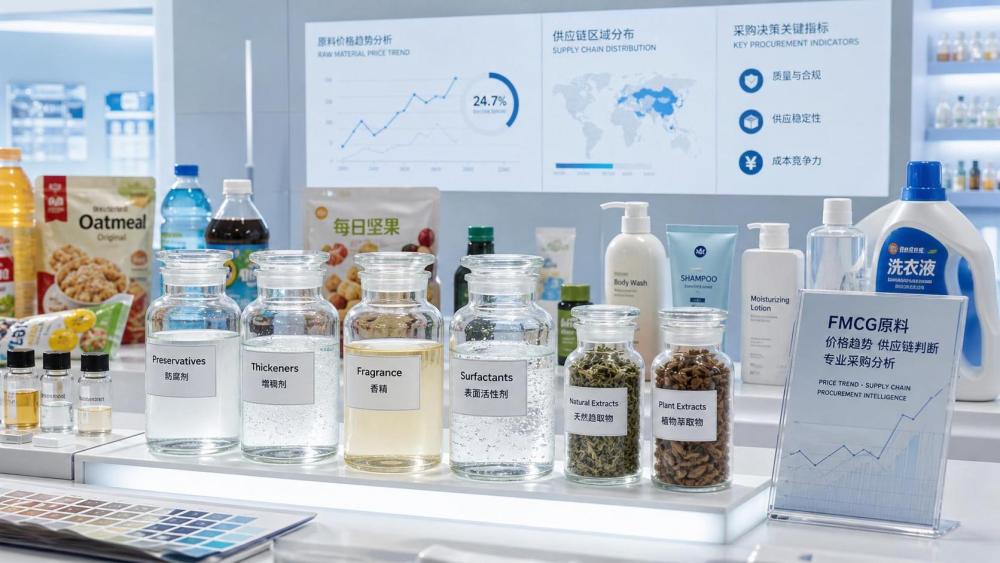
A sudden increase in an FMCG ingredient price may look alarming. Yet not every increase deserves the same response, and not every decline creates a true buying opportunity.
Some movements come from short shipping delays or currency shifts. Others point to deeper changes, such as tighter upstream chemistry, lower crop yields, stricter compliance requirements, or a permanent demand reset.
For ingredients used at low dosage, a large percentage jump may have little effect on product economics. For high-load or performance-critical materials, even a modest price change can alter margin models quickly.
This is especially true in global FMCG supply chains, where formula performance, shelf life, sensory quality, and safety must remain stable while costs move underneath.
The ingredient groups worth tracking closely
A practical view of FMCG ingredient price trends starts with category logic. Each group behaves differently because each one depends on a different mix of raw materials, processing intensity, and compliance burden.
Preservatives and antioxidants
These ingredients protect shelf life, logistics flexibility, and product stability. Price pressure here often links to petrochemical inputs, fermentation capacity, purity standards, and food safety regulation.
When a preservative cost rises, the issue is rarely just ingredient spend. Reformulation can trigger retesting, shelf-life validation, and region-specific compliance review.
Thickeners and natural pigments
Hydrocolloids such as xanthan gum, as well as natural color systems, are exposed to crop cycles, fermentation economics, energy costs, and clean-label demand.
An FMCG ingredient price increase in this group can affect mouthfeel, viscosity control, visual appeal, and label claims at the same time.
Flavors, fragrances, and essential oil extracts
This category is more complex than many sourcing models assume. Natural extracts depend on harvest conditions and geography, while aroma chemicals depend on synthesis routes and specialty intermediates.
A stable quoted price may still hide risk if olfactory profile, concentration, or regional documentation changes. That makes total value more important than line-item cost alone.
High-end cosmetic actives
Peptides, biotech actives, and anti-aging compounds often carry the highest unit prices. Their cost structure reflects R&D intensity, manufacturing yield, claimed efficacy, and regulatory file quality.
In this segment, FMCG ingredient price movement often signals supply concentration more than commodity inflation. A small change in supplier availability can have an outsized market effect.
Surfactants for washing and personal care
Surfactants sit close to energy markets, oleochemical chains, and environmental regulation. Their pricing also reacts to shifts toward mildness, biodegradability, and sulfate-free systems.
Because these materials often make up a meaningful formula share, their price trend can move finished-product cost more directly than many specialty additives.
How to tell a meaningful FMCG ingredient price shift from market noise
Useful sourcing judgment comes from separating visible price movement from commercial relevance. Four questions usually make that distinction clearer.
The strongest signal is usually a combination of price movement and reduced flexibility. If alternatives shrink while lead times expand, the market is sending a more serious warning.
Why context matters in food, beauty, and home care
The same FMCG ingredient price increase has different implications across categories. A fragrance component in premium personal care behaves differently from a preservative in packaged bakery or a surfactant in laundry.
Food applications often carry strict taste, shelf-life, and label constraints. Beauty formulas add efficacy claims, sensory expectations, and delicate compatibility issues. Home care emphasizes cleaning performance, foam, stability, and cost scale.
That is where intelligence platforms such as FFAI become useful. Price tracking gains value when it is connected to chemistry, compliance, and application behavior rather than treated as a standalone procurement metric.
A thickener is not only a cost line. It shapes texture. A preservative is not only a safety input. It affects export readiness. A peptide is not only expensive. It may define premium credibility in the final product.
Practical ways to use FMCG ingredient price intelligence
In practice, the best decisions combine market data with formulation consequences. That prevents overreaction to volatility and underreaction to structural change.
- Map ingredients by cost impact and replacement difficulty, not by price alone.
- Track whether the quoted FMCG ingredient price includes the same purity, origin, and documentation standard.
- Review dosage sensitivity. Some premium actives are costly but commercially manageable because inclusion levels stay low.
- Separate temporary logistics distortion from true upstream scarcity before changing supplier strategy.
- Compare ingredient inflation against the value it creates in shelf life, sensory quality, claims, or product differentiation.
This approach is particularly important when evaluating clean-label pigments, natural aroma inputs, amino acid surfactants, or biotech cosmetic actives. These markets can reprice quickly because perception and regulation both influence demand.
What usually deserves closer attention next
Three areas tend to deserve more scrutiny than the visible spot price. The first is concentration risk, especially in specialty actives and fragrance intermediates.
The second is regulatory exposure. GRAS status, CPNP alignment, purity thresholds, and export documentation can change the real availability of supply faster than public price indexes suggest.
The third is application resilience. An ingredient with stable cost but unstable performance can create a larger hidden loss than a higher-priced but technically dependable alternative.
For many categories, the most informative FMCG ingredient price view is therefore multi-layered: current quote, lead time, substitute readiness, compliance status, and formulation impact.
From price tracking to better sourcing judgment
Price monitoring becomes far more useful when it supports a repeatable evaluation framework. That means identifying which ingredients are strategic, which are flexible, and which need earlier action.
A sound next step is to review current formulas against three filters: exposure to volatile inputs, dependence on specialized compliance files, and the availability of technically equivalent substitutes.
From there, FMCG ingredient price data can be used more intelligently. It helps shape negotiation timing, alternate source qualification, reformulation priorities, and longer-term cost planning.
In a market where taste, texture, efficacy, safety, and sustainability are all under pressure, the better question is not whether prices moved. It is which movements change the business meaning of sourcing decisions.
Related News
- How to interpret active matter on a surfactant specification sheetOct 14, 2026Prof. Elian Thorne
- What Quality Checks Should You Run on Fragrance Ingredient Suppliers?Oct 14, 2026Prof. Elian Thorne
- How to assess a flavor chemistry manufacturer's batch consistencyOct 13, 2026Prof. Elian Thorne
- What drives fragrance ingredients price changes in bulk orders?Oct 12, 2026Prof. Elian Thorne
Related News
- 00
0000-00
Verifying halal status of hydrocolloid ingredients in the Middle East - 00
0000-00
How to interpret active matter on a surfactant specification sheet - 00
0000-00
What Quality Checks Should You Run on Fragrance Ingredient Suppliers? - 00
0000-00
How to assess a flavor chemistry manufacturer's batch consistency - 00
0000-00
What drives fragrance ingredients price changes in bulk orders?
Prof. Elian Thorne
Weekly Insights
Stay ahead with our curated technology reports delivered every Monday.