





Food Additive Solutions Pricing: What Drives Cost Beyond the Quote
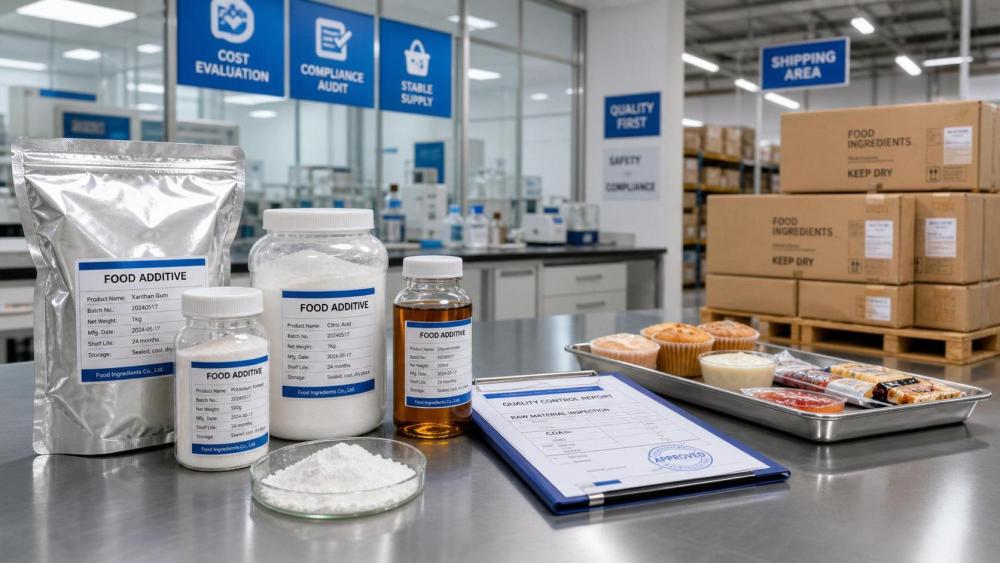
Food additive solutions pricing often looks straightforward at first glance.
A supplier submits a number, procurement compares bids, and approval moves forward.
In practice, that number rarely tells the full cost story.
For preservatives, thickeners, pigments, flavors, surfactants, and cosmetic actives, hidden cost drivers shape margin far beyond invoice value.
That is why food additive solutions pricing deserves a broader financial review.
The best decision is not always the lowest quoted price.
It is the option that protects shelf life, supports claims, reduces waste, and keeps production stable.
This matters even more in global FMCG markets where compliance, freight, and reformulation costs move quickly.
A smart review of food additive solutions pricing helps turn an approval into a defendable business decision.
Why the quoted unit price is only the starting point
A low price per kilogram can look attractive in a spreadsheet.
But food additive solutions pricing should be assessed against effective use level, processing performance, and commercial risk.
Two additives may differ sharply in dosage.
The cheaper product may require more material to deliver the same result.
That changes the real cost per batch, not just the line item price.
This pattern is common with hydrocolloids, antioxidants, flavor systems, and preservation blends.
The stronger signal is performance-adjusted cost.
When food additive solutions pricing is reviewed this way, the discussion shifts from purchase price to total economic value.
Key questions behind the quote
- What is the actual dosage needed to reach the target effect?
- How stable is the ingredient under heat, pH, light, and storage pressure?
- Will it reduce returns, spoilage, or production loss?
- Does it create extra validation or reformulation work?
- Can the supplier deliver consistently across regions and seasons?
Raw material volatility has a direct impact on food additive solutions pricing
Many ingredient categories depend on unstable upstream inputs.
Natural pigments rely on crop yield, harvest timing, and extraction efficiency.
Essential oils depend on geography, weather, and labor availability.
Synthetic flavors and preservatives often track petrochemical or energy costs.
That means food additive solutions pricing can move even when end demand appears stable.
Recent procurement cycles show another layer.
Suppliers with stronger sourcing networks often quote higher prices, yet offer better continuity during tight markets.
That premium can prevent emergency substitutions and rushed logistics.
In actual business terms, supply assurance often justifies a higher food additive solutions pricing level.
Common upstream cost triggers
- Crop failures or poor seasonal yield
- Energy and solvent price changes
- Freight disruptions and port congestion
- Currency swings in sourcing regions
- Tighter purity or traceability requirements
Compliance and documentation costs are easy to underestimate
Regulatory readiness adds real cost, even when it is not visible in the quote.
GRAS support, allergen statements, residual solvent data, microbiological controls, and country-specific registrations require time and specialist work.
For cosmetic actives, CPNP-related preparation and safety file support also matter.
This is where food additive solutions pricing can separate low-service suppliers from strategic partners.
A lower-cost source may appear efficient until documentation gaps delay import clearance or customer audits.
That delay can cost more than the original savings.
Better food additive solutions pricing analysis should therefore include compliance labor, approval lead time, and risk exposure.
What to review before approval
- Specification completeness and revision control
- Audit readiness and traceability depth
- Regional labeling implications
- Time needed for internal QA and regulatory review
- Cost of any failed approval cycle
Performance in the formula changes the real economics
An additive is not bought to sit in inventory.
It is bought to protect product quality, sensory appeal, and manufacturing consistency.
That makes formula behavior central to food additive solutions pricing.
For example, a premium antioxidant that survives high-temperature baking may outperform a cheaper option that degrades early.
A more efficient thickener may deliver the same mouthfeel at a lower inclusion rate.
A cleaner flavor system may reduce masking agents elsewhere in the formula.
These differences reshape total formulation cost.
When finance reviews food additive solutions pricing, it helps to ask what cost disappears if performance improves.
Value areas often missed in cost comparison
- Lower use rate per finished unit
- Longer shelf life and lower write-offs
- Better texture, aroma, or appearance retention
- Fewer customer complaints and returns
- Reduced need for secondary corrective ingredients
Supplier reliability can outweigh a lower quote
Food additive solutions pricing should always include service reliability.
Late shipments, inconsistent batches, weak technical support, or short notice price changes create hidden financial pressure.
Those problems spread quickly across planning, production, and customer commitments.
A supplier with a slightly higher quote may still be the lower-risk option over twelve months.
This is especially true for specialized actives, clean label pigments, and customized flavor systems.
In these categories, replacement cycles are slower and switching costs are higher.
That makes reliability part of the real food additive solutions pricing equation.
A simple decision framework
How to evaluate food additive solutions pricing more accurately
A practical review model keeps decisions grounded.
Start with quoted cost, then build a wider total-cost view.
This usually gives a more realistic picture of food additive solutions pricing.
It also makes approvals easier to defend internally.
- Convert the quote into cost per effective dosage.
- Add logistics, quality review, and regulatory handling cost.
- Estimate the value of shelf-life extension or performance gain.
- Stress-test the supplier against disruption scenarios.
- Compare replacement difficulty if the source fails.
- Document the expected commercial outcome, not only purchase savings.
From a market intelligence perspective, this approach fits modern ingredient buying better.
Ingredient categories are becoming more technical, more regulated, and more reputation-sensitive.
As a result, food additive solutions pricing should be reviewed as a business resilience issue, not just a sourcing task.
Final take: approve for total value, not headline price
The most useful view of food additive solutions pricing goes beyond the quote.
It considers raw material volatility, compliance burden, formulation efficiency, supply reliability, and downstream financial impact.
That broader lens helps prevent false savings.
It also supports cleaner approvals, stronger supplier choices, and better product economics over time.
In real purchasing decisions, the right food additive solutions pricing is the one that delivers stable performance and lower total risk.
That is the number worth signing off on.
Related News
- How rheological thickeners for shampoo affect suspension stabilityOct 03, 2026Prof. Elian Thorne
- When does OEM ingredient sourcing support make custom formulations viable?Sep 29, 2026Prof. Elian Thorne
- What to check in a transdermal penetration supplier for skincareSep 26, 2026Prof. Elian Thorne
- How farnesene market pricing affects renewable ingredient sourcingSep 26, 2026Prof. Elian Thorne
Related News
- 00
0000-00
How to assess color stability from a natural food colors manufacturer - 00
0000-00
When does amino acid surfactant powder improve cleanser mildness? - 00
0000-00
How to verify a cosmetic nanotechnology supplier's safety documentation - 00
0000-00
How rheological thickeners for shampoo affect suspension stability - 00
0000-00
How to assess recombinant collagen ingredients for cream stability
Prof. Elian Thorne
Weekly Insights
Stay ahead with our curated technology reports delivered every Monday.