





Food Additive Solutions Suppliers: 7 Checks Before Supplier Shortlisting
Shortlisting food additive solutions suppliers is no longer just about price or product range.
For procurement teams, the real challenge is balancing compliance, sensory performance, supply stability, and cost efficiency across global markets.
This guide outlines seven essential checks to help you evaluate food additive solutions suppliers more confidently, reduce sourcing risks, and build a stronger, more resilient ingredient supply strategy.
Why Supplier Evaluation Has Become More Complex
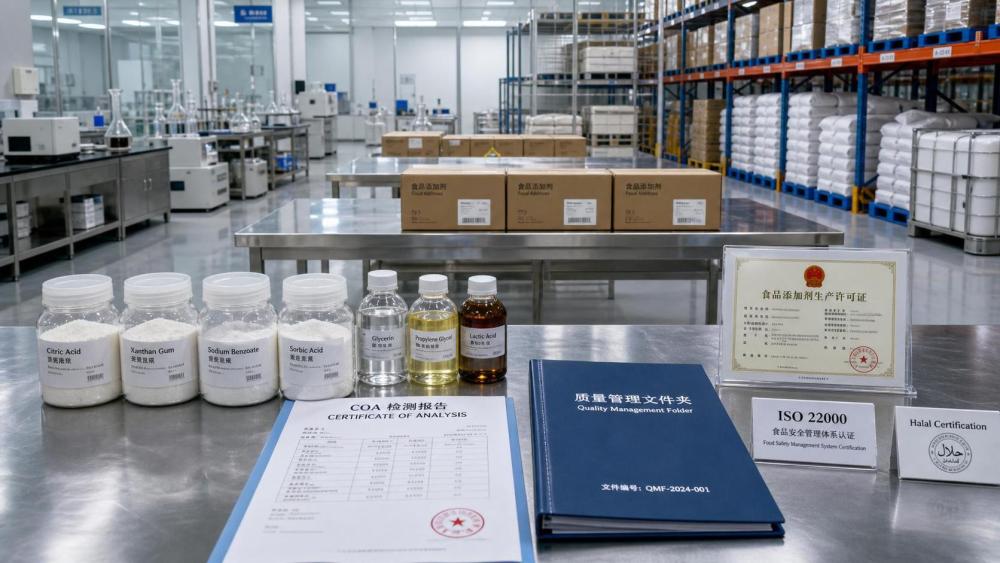
Food additive solutions suppliers now sit at the center of product quality, labeling claims, and market access.
A weak supplier can trigger reformulation delays, customs issues, customer complaints, or margin erosion.
A strong supplier does more than ship ingredients.
They help you protect shelf life, improve texture, stabilize flavor, and meet changing regulatory expectations.
That is why supplier shortlisting needs a wider lens.
From recent market shifts, the clearest signal is this: technical fit and compliance discipline now matter as much as commercial terms.
Check 1: Verify Regulatory and Documentation Strength
Start with compliance.
Reliable food additive solutions suppliers should provide complete and current technical documents without delay.
That usually includes specifications, COA formats, allergen statements, GMO status, origin details, and relevant certifications.
For cross-border sourcing, this check becomes even more critical.
Ask whether the supplier understands FDA, EFSA, local labeling rules, and destination-specific restrictions.
In practice, fast documentation is not enough.
The documents must also be internally consistent.
- Check issue dates and revision control.
- Review additive naming against local label language.
- Confirm usage limits for target applications.
- Look for gaps between sales claims and technical files.
Food additive solutions suppliers with mature compliance systems usually respond with precision, not vague assurances.
Check 2: Assess Application Performance, Not Just Ingredient Specs
A specification sheet cannot tell the full story.
Food additive solutions suppliers may offer identical headline purity, yet perform very differently in real formulations.
This matters for preservatives, antioxidants, thickeners, pigments, and flavor systems.
For example, a thickener may pass lab tests but fail under shear, acid, or freeze-thaw conditions.
A flavor additive may smell right at bench scale but flatten after thermal processing.
Shortlisting should include application trials tied to your actual product format.
- Test under real pH and temperature conditions.
- Measure shelf-life impact, not only day-one performance.
- Review sensory changes after processing and storage.
- Compare dosage efficiency across suppliers.
The best food additive solutions suppliers support this stage with sample plans, formulation advice, and troubleshooting depth.
Check 3: Review Supply Continuity and Geographic Risk
Supply continuity deserves its own score.
Many food additive solutions suppliers look competitive until freight delays, raw material shortages, or plant issues appear.
A low-cost source becomes expensive when production plans slip.
Ask direct questions about manufacturing footprint, backup sites, safety stock, and lead-time variability.
Also review whether one upstream region dominates their critical raw materials.
This is especially important for natural pigments, essential oils, fermentation-derived ingredients, and specialty gums.
Stable food additive solutions suppliers are usually transparent about constraints and contingency plans.
Check 4: Understand Cost Beyond the Quoted Price
Quoted price is only one layer of total cost.
Food additive solutions suppliers should be compared on usable cost in formula, not price per kilogram alone.
A higher-priced option may need lower dosage, reduce waste, or improve process yield.
That can create a better cost position over time.
You should also consider freight, customs, packaging formats, MOQ pressure, and inventory carrying costs.
From a decision standpoint, the right question is simple: what does this supplier cost after formulation reality and operational friction are included?
- Calculate cost-in-use by finished product batch.
- Estimate quality loss or rework risk.
- Factor in payment terms and order flexibility.
- Review exposure to currency swings.
This check often separates attractive quotes from commercially sound food additive solutions suppliers.
Check 5: Test Technical Service and Problem-Solving Speed
Technical support is easy to undervalue during early sourcing.
It becomes critical when a formula separates, a color fades, or microbial results drift.
Strong food additive solutions suppliers help solve issues before they become customer-facing failures.
Look at response time, technical depth, and ownership.
Do they explain root causes clearly?
Can they suggest alternatives when a raw material is tight?
Do they understand processing, packaging, and shelf-life interactions?
Suppliers with real application knowledge tend to reduce development cycles and lower hidden sourcing risk.
Check 6: Examine Quality Systems and Traceability
Quality systems should be reviewed beyond certificates on a slide deck.
Food additive solutions suppliers need consistent process control, batch traceability, and disciplined change management.
Ask how they handle deviations, recalls, complaints, and specification changes.
A supplier that cannot explain these routines clearly may create future audit pressure.
Traceability is especially relevant when claims around natural origin, clean label, or special processing are involved.
In real procurement work, change notification discipline is often a decisive signal.
Good food additive solutions suppliers warn early.
Weak ones explain after the fact.
Check 7: Match the Supplier to Your Business Direction
The final check is strategic fit.
Not all food additive solutions suppliers are built for the same growth path.
Some are strong in commodity pricing.
Others bring value through innovation, premium positioning, or cleaner label reformulation support.
This is where market intelligence matters.
FFAI closely tracks the ingredient forces shaping food preservation, rheology, flavor delivery, and safety expectations across global FMCG markets.
That perspective helps connect supplier capability with future formulation demands, not only current purchase orders.
If your roadmap includes natural pigments, texture upgrades, clean-label preservation, or more differentiated sensory performance, shortlist food additive solutions suppliers that can grow with those needs.
A Practical Shortlisting Framework
To make decisions easier, build a weighted scorecard before final supplier discussions.
That keeps emotional bias and last-minute price pressure from distorting supplier selection.
- Compliance and documentation readiness
- Application performance in target products
- Supply resilience and lead-time stability
- Total landed and usable cost
- Technical support quality
- Quality systems and traceability
- Strategic fit with innovation goals
When food additive solutions suppliers are measured across these seven checks, shortlisting becomes faster, clearer, and more defensible.
The most effective sourcing decisions usually come from combining technical evidence, commercial realism, and long-term market awareness.
Use that approach, and your next supplier shortlist will be more than a vendor list.
It will be a stronger foundation for product stability, margin protection, and future growth.
Related News
- What drives fragrance ingredients price changes in bulk orders?Oct 12, 2026Prof. Elian Thorne
- How minimum order quantities shape private label ingredient sourcing costsOct 10, 2026Prof. Elian Thorne
- What drives personal care ingredient price volatility in sourcingOct 08, 2026Prof. Elian Thorne
- What drives micelles price differences in cosmetic formulations?Oct 07, 2026Prof. Elian Thorne
Related News
- 00
0000-00
What drives fragrance ingredients price changes in bulk orders? - 00
0000-00
How to assess a food antioxidants distributor’s traceability practices - 00
0000-00
How minimum order quantities shape private label ingredient sourcing costs - 00
0000-00
What drives personal care ingredient price volatility in sourcing - 00
0000-00
What drives micelles price differences in cosmetic formulations?
Prof. Elian Thorne
Weekly Insights
Stay ahead with our curated technology reports delivered every Monday.