





Food Thickeners Price Guide: why quotes rarely tell the full story
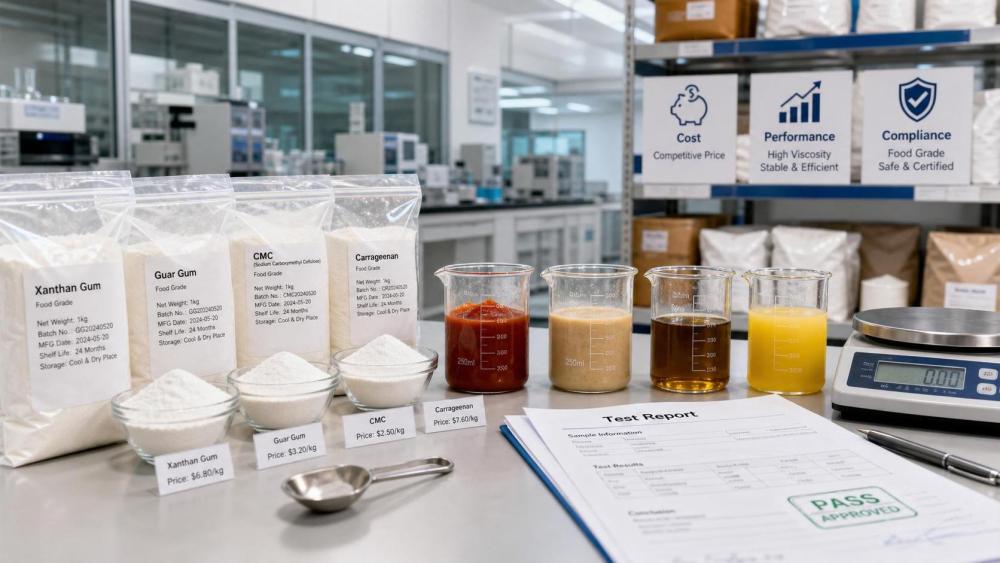
Understanding food thickeners price starts with a simple reality: the cheapest quote can become the most expensive option after reformulation, waste, delays, or compliance trouble.
In food, beverage, personal care, and broader FMCG applications, thickeners shape texture, suspend particles, improve stability, and influence sensory quality.
That is why price needs to be read alongside rheology, dosage, purity, origin, and documentation.
At FFAI, thickener markets are usually viewed as part science, part supply chain, and part compliance discipline.
A hydrocolloid may look like a commodity on paper, yet its real value appears in heat tolerance, pH behavior, mouthfeel, and batch-to-batch consistency.
So when teams compare food thickeners price, the useful question is not only “How much per kilogram?” but also “How much performance per finished product?”
What usually moves food thickeners price up or down?
Several cost drivers sit behind the same product name, and this is where many first-pass comparisons go wrong.
Raw material source is one of the biggest factors.
Xanthan gum, guar gum, pectin, carrageenan, CMC, starch derivatives, and gellan gum all respond to different agricultural or fermentation economics.
Weather patterns, crop quality, energy prices, and freight costs can shift food thickeners price even when demand remains steady.
Purity and functional strength matter just as much.
A higher-priced grade may deliver target viscosity at a lower inclusion rate, which reduces total formula cost.
That is especially common in sauces, dairy alternatives, fillings, desserts, and drinkable systems requiring controlled flow behavior.
Regulatory status adds another layer.
Grades supported by stronger documentation, tighter contaminant control, or region-specific declarations often carry a premium.
In practice, that premium may protect export continuity.
FFAI often tracks these issues through the same lens used for preservatives, flavor systems, and other sensitive functional ingredients: safety, traceability, and market access.
The cost drivers worth checking before comparing offers
- Botanical, marine, synthetic, or fermentation origin
- Viscosity range and actual dose required in the target formula
- Particle size, dispersibility, and hydration speed
- Tolerance to heat, acid, salt, shear, and freeze-thaw cycles
- Clean label positioning and labeling restrictions by market
- Certificates, audit records, and export documentation quality
- Order volume, contract length, and shipment format
Is higher food thickeners price always linked to better performance?
Not always, and this is where a smarter comparison helps.
A more expensive grade can outperform a cheaper one, but only if its technical profile matches the application.
For example, a premium pectin may be justified in acidic fruit systems where clarity and gel behavior are critical.
The same grade may be unnecessary in a low-cost savory sauce where texture tolerance is wider.
More common mistakes happen when buyers compare unlike grades using only unit price.
Two xanthan gum quotes may look close, yet one hydrates faster, resists pH swings better, or creates a cleaner mouthfeel.
Those differences affect mixing time, rework risk, and consumer perception.
The better way to review food thickeners price is to normalize cost against usable output.
That means checking cost-in-use, not just cost-on-invoice.
This kind of table often reveals that a mid-priced offer is the most economical once process and compliance costs are included.
Which applications create the biggest gap in food thickeners price?
Application fit creates wider pricing gaps than many teams expect.
A thickener used in spoonable yogurt has different demands from one used in bakery filling, beverage suspension, meat systems, or plant-based desserts.
Texture is only part of the story.
Some systems need gloss, some need gel strength, some need syneresis control, and others need clean flavor release.
That is why food thickeners price often rises for specialized grades designed around narrow performance windows.
There is also a cross-category effect in FMCG innovation.
FFAI’s coverage of flavors, preservatives, natural pigments, and surfactant systems shows that ingredient selection is rarely isolated.
A thickener may need to work with acidic preservatives, volatile aroma compounds, or clean label color systems.
When compatibility requirements rise, so does the value of well-characterized grades.
Where premium pricing tends to make sense
- Low-dosage systems where every basis point affects formula economics
- Export products facing strict documentation or contaminant scrutiny
- High-shear or high-heat processing lines with limited tolerance for failure
- Clean label launches where substitution options are narrow
- Products sold on mouthfeel, creaminess, or premium sensory cues
What are the most common mistakes when comparing food thickeners price?
The first mistake is assuming the same ingredient name means the same commercial value.
It rarely does.
The second mistake is ignoring hidden operating costs.
A low quote can lead to longer hydration times, higher scrap, unstable finished texture, or a second approval cycle.
The third mistake is treating documentation as an afterthought.
For globally traded ingredients, origin statements, microbiological limits, residual solvent status, and market-specific declarations are part of cost control.
This is especially relevant in the regulatory climate FFAI monitors, where “absolute safety” and supply chain proof are becoming commercial requirements, not optional extras.
One more blind spot is contract structure.
Spot buying may look attractive during short-term dips, but it can expose production planning when crops tighten or freight disrupts lead times.
A quick screening checklist
- Compare price per usable batch, not price per bag alone
- Request pilot-scale evidence under real process conditions
- Check lead time stability across at least two recent quarters
- Review documentation before commercial approval, not after
- Verify whether substitute grades are available during shortages
How should you build a smarter shortlist before negotiating?
A strong shortlist begins with a clear technical brief.
Target viscosity, pH range, temperature profile, label expectations, and storage conditions should be fixed before quote comparison.
Without that baseline, food thickeners price discussions drift into guesswork.
Then narrow the field using three layers: functionality, documentation, and supply resilience.
This approach is more useful than ranking suppliers by quote alone.
In actual buying cycles, it helps to score each option against a weighted matrix.
For example, a specialized thickener for premium dessert systems may deserve higher weight on sensory performance than on base unit price.
By contrast, a standard industrial sauce application may prioritize continuity and cost-in-use.
Useful negotiation points beyond the quoted food thickeners price
- Price break by annual volume commitment
- Locked lead time or buffer stock arrangement
- Technical support during reformulation or scale-up
- Alternative grade approval for supply disruption scenarios
- Specification alignment to avoid overpaying for unused performance
The most practical takeaway is this: food thickeners price becomes meaningful only when tied to application success, compliance readiness, and supply confidence.
Shortlist with that lens, and negotiations become more grounded.
The next step is to map required texture performance, request comparable trial data, and build a side-by-side cost-in-use review before final approval.
Related News
- How to interpret active matter on a surfactant specification sheetOct 14, 2026Prof. Elian Thorne
- What Quality Checks Should You Run on Fragrance Ingredient Suppliers?Oct 14, 2026Prof. Elian Thorne
- How to assess a flavor chemistry manufacturer's batch consistencyOct 13, 2026Prof. Elian Thorne
- What drives fragrance ingredients price changes in bulk orders?Oct 12, 2026Prof. Elian Thorne
Related News
- 00
0000-00
Verifying halal status of hydrocolloid ingredients in the Middle East - 00
0000-00
How to interpret active matter on a surfactant specification sheet - 00
0000-00
What Quality Checks Should You Run on Fragrance Ingredient Suppliers? - 00
0000-00
How to assess a flavor chemistry manufacturer's batch consistency - 00
0000-00
What drives fragrance ingredients price changes in bulk orders?
Prof. Elian Thorne
Weekly Insights
Stay ahead with our curated technology reports delivered every Monday.