





Why does formulation development so often get stuck in endless trials?
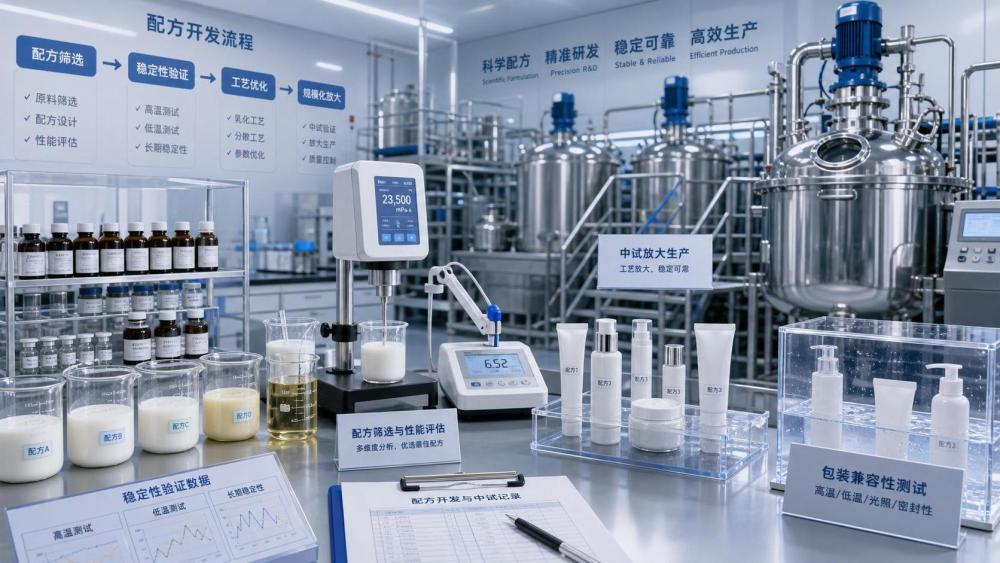
Formulation development rarely slows down because one experiment fails. It usually stalls because the team starts with unclear success criteria.
A lab formula may look promising, yet still carry hidden risks in mixing order, thermal stability, odor drift, microbial control, or packaging interaction.
That problem appears across food, home care, fragrance, and cosmetic actives. The chemistry changes, but the project pattern is familiar.
One team optimizes sensory performance. Another focuses on cost. A third worries about regulatory readiness. If these targets are not aligned early, formulation development becomes reactive.
In practical terms, fewer trials come from building a stronger decision frame before bench work expands. That means defining acceptable ranges, not ideal outcomes.
For example, a thickener system for a dairy drink needs viscosity limits, process shear tolerance, pH stability, and supply consistency. Without that frame, every test creates new debate.
This is where intelligence-led formulation development becomes useful. FFAI often highlights how molecular behavior, compliance pathways, and commercial constraints interact long before production starts.
The main lesson is simple. Trial reduction starts earlier than the first trial. It starts with better assumptions, sharper screening logic, and realistic scale-up thinking.
What should be locked down before the first serious round of experiments?
A surprising amount of rework comes from testing too broadly. Early formulation development should narrow options, not generate endless possibilities.
The most effective teams confirm a few non-negotiables before investing in deep lab cycles. These decisions save both time and scale-up effort.
- Target performance windows, such as viscosity, release profile, color retention, foam behavior, or skin feel.
- Process boundaries, including shear, temperature, hold time, filling conditions, and cleaning compatibility.
- Compliance filters, especially GRAS relevance, CPNP implications, labeling limits, and export restrictions.
- Raw material variability, such as active purity, moisture sensitivity, odor differences, and seasonal supply shifts.
- Commercial thresholds, including ingredient cost ceilings, yield targets, and acceptable scrap rates.
In actual projects, this pre-work matters even more when ingredients are expensive or fragile. Anti-aging peptides, essential oils, antioxidants, and specialty surfactants all punish vague planning.
A peptide may deliver strong efficacy on paper, yet lose value if it cannot survive pH shifts or penetrate the intended structure. A flavor note may score well in the lab, then collapse after heat exposure.
Good formulation development therefore begins with a structured screen: what must work, what may flex, and what cannot be tolerated.
That discipline is especially relevant in sectors covered by FFAI, where sensory performance and molecular stability must coexist with safety and shelf-life demands.
How can teams cut iteration without becoming too conservative?
Reducing trials does not mean reducing learning. It means designing trials that answer the right questions faster.
A common mistake is changing several variables at once. That creates activity, but not clarity. More useful formulation development isolates the few factors most likely to affect failure.
For a preservative system, that could be water activity, pH, packaging permeability, and process heat. For a fragrance base, it may be volatility, solvent balance, oxidation exposure, and deposition behavior.
A practical decision table helps keep the project grounded.
Another useful habit is to define a kill criterion. If a candidate fails a critical threshold, stop expanding it. That protects time for better options.
In other words, smarter formulation development is not about saying yes faster. It is often about saying no earlier, with better evidence.
Where do scale-up delays usually begin, even when the lab result looks strong?
Scale-up delays usually begin when the lab process is treated as a smaller version of production. It rarely is.
Mixing energy, vessel geometry, transfer time, aeration, and order of addition all behave differently at larger volumes. Small deviations can change the final structure.
This matters especially in formulation development involving hydrocolloids, emulsions, volatile aroma systems, and high-value actives.
Take xanthan gum or other rheology modifiers. A bench sample may hydrate perfectly under controlled agitation. In production, poor wetting can cause fisheyes, uneven viscosity, and filling issues.
With essential oils or fragrance accords, losses may appear during heating, open transfers, or long residence times. The formula passes sensory review in development, then misses target after scale-up.
A more reliable approach is to create a scale-up readiness checklist before pilot batches begin.
- Map critical process parameters to each sensitive ingredient.
- Document the exact order of addition and dispersion method.
- Simulate worst-case conditions, not only ideal lab settings.
- Check packaging compatibility before final approval.
- Review analytical methods for in-process release decisions.
In practice, scale-up moves faster when formulation development and process development are treated as one conversation. Separating them creates handoff risk.
That is also why FFAI places value on linking chemistry, regulation, and commercial reality. A formula is only successful when all three survive production conditions.
How do compliance and cost affect formulation development much earlier than expected?
Many teams treat compliance and cost as late-stage filters. That is one of the most expensive assumptions in formulation development.
A formula can be technically elegant and still become unusable if regional rules, claims language, or raw material documentation do not align.
The same applies to pricing. A premium active may justify itself in a luxury anti-aging product, but not in a mass FMCG format with tight margin control.
More nuanced formulation development asks several questions early.
- Does the ingredient have the documentation needed for target markets?
- Can efficacy claims be supported without creating legal exposure?
- Will the formula tolerate supplier substitution if cost changes?
- Does the ingredient create a real premium, or only a higher bill?
This is especially relevant in categories monitored closely by FFAI, from antioxidants in baked systems to cosmetic actives facing strict safety expectations.
When compliance insight, molecular behavior, and market pricing are reviewed together, formulation development becomes more selective and less wasteful.
What does a faster, lower-risk formulation development workflow actually look like?
The strongest workflow is not the one with the most meetings. It is the one with the fewest unresolved assumptions.
A practical path usually starts by translating business goals into technical limits. Then each experiment must answer a decision, not just collect data.
It helps to think of formulation development as a gated sequence.
- Screen ingredients for fit, compliance, and supply reliability.
- Run focused bench trials against critical failure modes.
- Confirm pilot behavior under realistic process stress.
- Validate cost, claims, stability, and packaging together.
- Freeze only the variables that truly control performance.
That approach keeps flexibility where it helps and control where it matters. It also reduces the familiar cycle of late surprises followed by emergency reformulation.
If the goal is better formulation development, the next step is not more experimentation by default. It is a cleaner decision architecture.
Start by listing the top five failure risks for the formula, then match each risk to one measurable test and one go or no-go threshold.
That single exercise often cuts unnecessary trials, sharpens pilot planning, and shortens the path from lab concept to commercial reality.
For teams navigating preservatives, thickeners, fragrances, surfactants, or high-end actives, disciplined formulation development is less about speed alone and more about making fewer expensive mistakes.
Related News
- What drives fragrance ingredients price changes in bulk orders?Oct 12, 2026Prof. Elian Thorne
- How minimum order quantities shape private label ingredient sourcing costsOct 10, 2026Prof. Elian Thorne
- What drives personal care ingredient price volatility in sourcingOct 08, 2026Prof. Elian Thorne
- What drives micelles price differences in cosmetic formulations?Oct 07, 2026Prof. Elian Thorne
Related News
- 00
0000-00
What drives fragrance ingredients price changes in bulk orders? - 00
0000-00
How to assess a food antioxidants distributor’s traceability practices - 00
0000-00
How minimum order quantities shape private label ingredient sourcing costs - 00
0000-00
What drives personal care ingredient price volatility in sourcing - 00
0000-00
What drives micelles price differences in cosmetic formulations?
Prof. Elian Thorne
Weekly Insights
Stay ahead with our curated technology reports delivered every Monday.