





Formulation development testing starts paying off long before launch
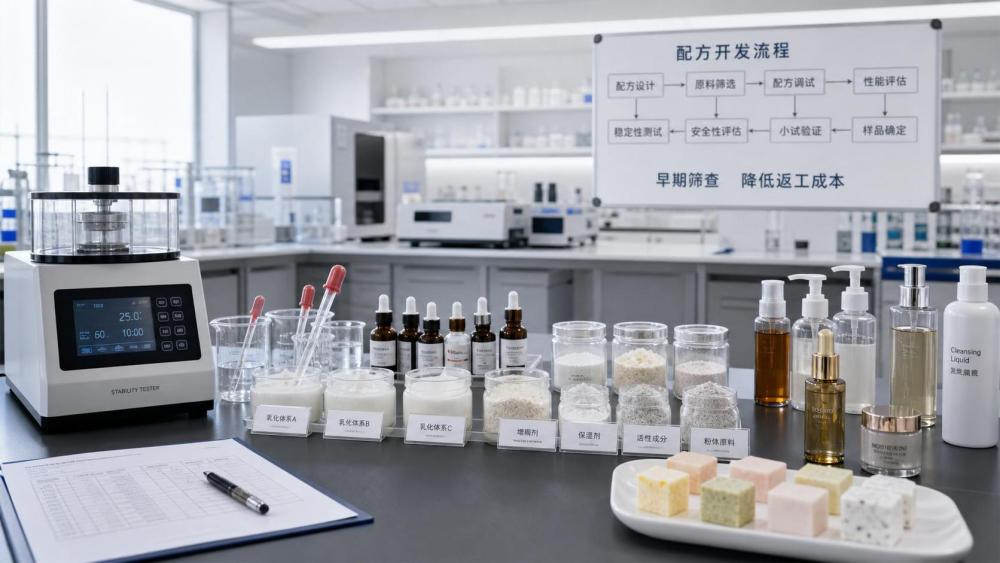
In real product pipelines, formulation development testing is where commercial risk first becomes measurable.
It helps teams see whether a promising concept will stay stable, feel right, comply globally, and survive processing without hidden tradeoffs.
That matters across food, fragrance, cosmetics, and home care, where minor molecular interactions often create major downstream cost.
A preservative can weaken flavor brightness. A peptide can lose activity in an elegant texture base. A surfactant can clean well yet damage skin feel.
This is why formulation development testing should not be treated as a late validation step.
It works best as an early decision system, especially in FMCG categories that must balance sensory appeal, safety, regulatory fit, and ingredient economics.
For FFAI, that logic sits at the center of intelligence work.
Understanding how antioxidants behave in heat, how rheology shifts texture perception, or how actives penetrate realistic systems is what prevents expensive reformulation later.
Why the same testing plan fails across different application settings
The biggest mistake is assuming one formulation development testing framework fits every formula.
In practice, the testing path changes with product stress, route of use, label claims, and how performance is judged in the market.
A baked snack faces thermal degradation and oxidation pressure.
A premium serum faces compatibility, sensory elegance, and efficacy retention.
A fine fragrance must evolve predictably over time, not merely smell attractive in a fresh lab blotter test.
The more useful question is not whether testing is needed.
It is which early data points best predict later failure in each scenario.
The context behind changing test priorities
- Processing stress: heating, freezing, shear, light exposure, and oxygen contact change ingredient behavior.
- Sensory dependency: some categories win on mouthfeel, dry-down, foam, or fragrance bloom rather than only analytical performance.
- Regulatory exposure: food, cosmetics, and cleaners face different thresholds for claims, notifications, and safety documentation.
- Cost sensitivity: high-end actives justify broader testing, while mass products need faster screens tied to reformulation risk.
When these variables are mapped early, formulation development testing becomes more selective and more valuable.
Food systems need proof under real process stress, not just bench stability
Food formulas often look acceptable at bench scale and then collapse under production realities.
That is common with antioxidants, preservatives, pigments, and thickeners, especially when heat, pH, water activity, and packaging all shift together.
In bakery or shelf-stable snacks, formulation development testing should focus on thermal survival and sensory persistence.
An antioxidant that performs in a mild emulsion may not protect flavor notes after high-temperature processing.
In dairy-style or spoonable products, texture usually becomes the make-or-break variable.
Hydrocolloids can produce richness at low dosage, yet small shifts in ion balance or mixing order may change viscosity curves completely.
More useful testing includes accelerated storage, freeze-thaw cycling, rheology mapping, and sensory checkpoints tied to actual consumption conditions.
This is where FFAI’s focus on clean-label color, texture engineering, and shelf-life chemistry becomes practical rather than theoretical.
Fragrance development lives or dies on interaction, diffusion, and time
Fragrance formulas are often misjudged because teams overvalue the opening impression.
Good formulation development testing asks how the composition behaves in carrier systems, on substrate, and through storage.
A fragrance in a personal care base may lose lift because surfactants bind volatile notes.
An essential oil blend in a home product may drift in character after light exposure or container interaction.
In these cases, stability data alone is incomplete.
Useful judgment also requires evaporation profile checks, compatibility screening, odor evolution review, and residue behavior on intended surfaces.
This is especially relevant in premium scent positioning, where top, heart, and base transitions create brand value.
Formulation development testing should therefore connect analytical chemistry with emotional performance, not separate them.
Cosmetic actives demand tighter proof because elegance and efficacy must coexist
High-end cosmetic compounds create a different testing burden.
The formula must preserve active integrity, support delivery, remain pleasant to use, and meet regional compliance expectations.
A peptide may be scientifically attractive, yet incompatible with pH, preservative choice, or emulsion structure.
A strong anti-aging story can also fail if tackiness, odor, or instability erodes repeat use.
In practical formulation development testing, early work should check compatibility matrices, viscosity drift, active retention, packaging interaction, and claim-support pathways.
Where cross-border launch is possible, GRAS-adjacent thinking in food and CPNP-style discipline in cosmetics both reinforce one lesson.
Regulatory fit is easier to design in early than to retrofit after claims have been drafted.
That is why FFAI links transdermal pharmacology, compliance intelligence, and formulation economics instead of viewing them as separate tracks.
Cleaning systems usually fail when laboratory performance is detached from user conditions
Surfactant-based systems often show impressive cleansing in controlled testing.
The harder question is whether that performance survives dilution, water hardness, contact time, and repeated use expectations.
For shampoos and fabric care, formulation development testing should examine foam quality, rinse profile, residue, scalp or fabric feel, and compatibility with fragrance or conditioning components.
A cheaper surfactant system may lower input cost while increasing complaint risk through harshness or instability.
An amino acid surfactant system may look expensive upfront yet support stronger market positioning and better long-term value.
Here, formulation development testing is not only about cleaning power.
It is about confirming whether performance, skin comfort, and premium narrative can stay aligned.
Different scenarios change the decision criteria
A side-by-side view makes the differences clearer.
Where early testing is often misread or underused
Several errors appear repeatedly across industries.
- Treating supplier specifications as enough, without testing in the final base system.
- Optimizing for initial cost while ignoring reformulation time, packaging changes, and claim revision expense.
- Using accelerated data without checking whether the chosen stress model matches real distribution conditions.
- Assuming adjacent categories share the same sensory threshold or compliance pathway.
- Waiting too long to connect molecular performance with commercial positioning.
Formulation development testing is underused when it only confirms what a team hopes is true.
It becomes powerful when it is designed to expose fragility early.
A more workable approach to scenario-fit testing
A practical route starts with sharper scoping, not more tests for their own sake.
Define the actual stress environment first.
Then build formulation development testing around the few variables most likely to trigger rework.
- Map process conditions, shelf-life goals, and usage context before selecting test methods.
- Screen incompatibilities early between actives, preservatives, surfactants, pigments, and fragrance systems.
- Use sensory and functional checkpoints together, especially in categories shaped by perception.
- Check likely export or notification requirements while claims are still flexible.
- Compare ingredient premium against total reformulation risk, not only cost per kilogram.
That approach fits the broader FFAI view of formula work.
The strongest development choices usually come from joining sensory science, molecular behavior, compliance foresight, and market logic early.
When the next project enters screening, start by separating the real application scenarios.
Then define which early signals would justify continuing, reformulating, or stopping before scale makes correction expensive.
Related News
- How to interpret active matter on a surfactant specification sheetOct 14, 2026Prof. Elian Thorne
- What Quality Checks Should You Run on Fragrance Ingredient Suppliers?Oct 14, 2026Prof. Elian Thorne
- How to assess a flavor chemistry manufacturer's batch consistencyOct 13, 2026Prof. Elian Thorne
- What drives fragrance ingredients price changes in bulk orders?Oct 12, 2026Prof. Elian Thorne
Related News
- 00
0000-00
How to interpret active matter on a surfactant specification sheet - 00
0000-00
What Quality Checks Should You Run on Fragrance Ingredient Suppliers? - 00
0000-00
How to assess a flavor chemistry manufacturer's batch consistency - 00
0000-00
What drives fragrance ingredients price changes in bulk orders? - 00
0000-00
How to assess a food antioxidants distributor’s traceability practices
Prof. Elian Thorne
Weekly Insights
Stay ahead with our curated technology reports delivered every Monday.