





Functional Additives Selection Guide: Performance, Stability, and Cost Trade-Offs
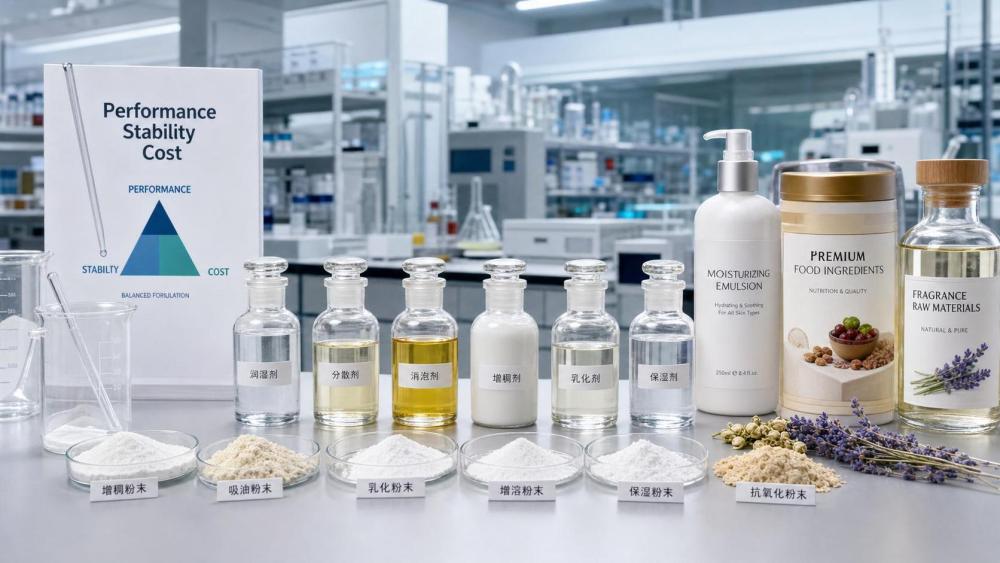
Selecting functional additives is rarely a one-variable decision. Performance matters, but so do processing stress, label expectations, regulatory limits, and target cost.
That is why functional additives selection often becomes a trade-off exercise. The best option on paper may fail during heating, storage, transport, or scale-up.
In practical formulation work, teams need a faster way to compare options. A structured framework reduces trial cycles and improves decision quality.
This guide looks at functional additives across food, fragrance, cosmetics, and adjacent formulation-driven categories. The focus is simple: balance performance, stability, and cost with fewer surprises.
Why functional additives selection is getting harder
Recent market changes have raised the bar. Products now need stronger efficacy claims, cleaner labels, better sensory quality, and tighter cost control at the same time.
This is especially visible in antioxidants, preservatives, thickeners, fragrance systems, cosmetic actives, and surfactants. Each category comes with different failure modes.
A hydrocolloid may pass bench tests but lose texture under shear. A peptide may look effective yet degrade in the final formula. A flavor carrier may lift aroma but increase volatility loss.
As a result, functional additives must be screened beyond the headline benefit. The real decision sits at the intersection of technical fit and business reality.
Start with the actual performance target
A common mistake is evaluating functional additives by category reputation. A better approach is defining the exact function required in the finished product.
Ask what success really means. Is the target oxidation control, microbial suppression, viscosity build, fragrance retention, skin feel, foam profile, or anti-aging support?
Then quantify the target. Vague language slows selection. Clear metrics improve comparison across suppliers and chemistries.
- For antioxidants, define induction time, color retention, or peroxide value limits.
- For preservatives, define challenge test goals and expected shelf-life conditions.
- For thickeners, define viscosity curve, mouthfeel, shear recovery, and freeze-thaw tolerance.
- For cosmetic actives, define concentration window, claim support, and compatibility range.
- For surfactants, define detergency, foam behavior, mildness, and residue profile.
This step sounds basic, but it changes everything. It stops teams from paying for performance they do not need.
Evaluate stability under real process conditions
Performance without stability is not real performance. Functional additives should be tested under the exact thermal, pH, oxygen, light, and shear conditions they will face.
In food systems, heat can destroy fragile antioxidants or distort flavor notes. In cosmetics, actives may hydrolyze, oxidize, or separate when paired with the wrong base.
Even a strong additive can become unreliable if the matrix is hostile. That is why processing stability must be checked early, not after supplier shortlisting.
- Map the full process window, including temperature peaks and holding times.
- Check pH tolerance across production and shelf-life stages.
- Review oxygen, moisture, light, and metal ion exposure.
- Test compatibility with emulsifiers, solvents, salts, and packaging.
- Measure performance after accelerated aging, not only fresh mixing.
This also helps explain supplier claims. Two functional additives may look similar in a brochure yet behave very differently after processing.
Do not separate efficacy from sensory impact
In actual commercial products, technical performance and sensory acceptance move together. Functional additives that solve one problem can create another.
A preservative system may protect shelf life but add off-notes. A thickener may improve body yet leave a sticky finish. A surfactant may clean well but feel harsh.
For fragrance and flavor applications, release profile matters as much as intensity. Consumers notice the full sensory journey, not the laboratory parameter alone.
This is where cross-functional evaluation becomes useful. Sensory teams, formulation teams, procurement, and regulatory reviewers should align before final selection.
Build regulatory fit into the first screening round
Regulatory fit is often treated as a final checkpoint. That usually costs time. With functional additives, compliance needs to be part of the initial decision model.
Requirements vary by application and market. Food systems may need GRAS support or additive usage verification. Cosmetic formulas may require region-specific notification and claims discipline.
Label strategy also matters. A technically excellent additive may conflict with clean label positioning, natural sourcing preferences, or biodegradability goals.
- Confirm legal status in target countries before pilot expansion.
- Check purity, residual solvents, allergens, and restricted substances.
- Review documentation depth, not only certificate availability.
- Align additive choice with claim language and brand positioning.
For many businesses, regulatory readiness is not a side issue. It is part of the real cost and timeline equation.
Use total cost, not just purchase price
One of the biggest errors in functional additives selection is comparing price per kilogram in isolation. Smart decisions use total delivered value.
A higher-priced additive may reduce dosage, improve yield, simplify preservation, or cut rework. A cheaper option may trigger instability, complaint risk, or higher usage.
This is especially true for premium cosmetic actives, amino acid surfactants, natural pigments, and specialized flavor systems. The unit price rarely tells the whole story.
A total cost view keeps teams from making cheap decisions that become expensive later.
A practical scoring model for functional additives
When options multiply, simple scoring helps. It keeps decisions transparent and makes trade-offs easier to explain across departments.
A useful model scores each additive against weighted criteria. The weight should match the business case, not a generic template.
- Performance against target function
- Stability in process and storage
- Sensory impact in the finished product
- Regulatory and documentation readiness
- Total cost of use
- Supply consistency and scale reliability
For example, shelf-stable food products may give heavier weight to oxidation control and heat tolerance. Prestige skincare may weight claim support and purity more heavily.
The point is not mathematical perfection. The point is faster, clearer comparison when every option brings a different strength.
Common selection mistakes to avoid
Some issues appear again and again in functional additives projects. Avoiding them can save several development rounds.
- Choosing by supplier reputation instead of matrix-specific evidence.
- Testing only fresh samples and skipping accelerated stability work.
- Ignoring sensory penalties created by technically strong additives.
- Using purchase price as the main decision metric.
- Leaving compliance review until the end of the project.
- Missing interactions between additives inside complex formulas.
These mistakes often look small early on. Later, they show up as reformulation delays, claim risk, or unexpected cost escalation.
Make the final choice with a trade-off mindset
The best functional additives are not always the strongest, the cheapest, or the newest. They are the ones that fit the product, process, market, and margin together.
That means selection should move from isolated data points to a balanced decision model. Performance, stability, sensory quality, compliance, and total cost all need a seat at the table.
In real business settings, this trade-off mindset leads to better launches and fewer late-stage surprises. It also helps teams explain why one additive wins over another.
If you are reviewing functional additives for a new formula or portfolio upgrade, start with measurable targets, stress-test stability, and compare total value instead of headline cost.
That approach turns additive selection from a reactive task into a smarter technical decision process.
Related News
- How to interpret active matter on a surfactant specification sheetOct 14, 2026Prof. Elian Thorne
- What Quality Checks Should You Run on Fragrance Ingredient Suppliers?Oct 14, 2026Prof. Elian Thorne
- How to assess a flavor chemistry manufacturer's batch consistencyOct 13, 2026Prof. Elian Thorne
- What drives fragrance ingredients price changes in bulk orders?Oct 12, 2026Prof. Elian Thorne
Related News
- 00
0000-00
Verifying halal status of hydrocolloid ingredients in the Middle East - 00
0000-00
How to interpret active matter on a surfactant specification sheet - 00
0000-00
What Quality Checks Should You Run on Fragrance Ingredient Suppliers? - 00
0000-00
How to assess a flavor chemistry manufacturer's batch consistency - 00
0000-00
What drives fragrance ingredients price changes in bulk orders?
Prof. Elian Thorne
Weekly Insights
Stay ahead with our curated technology reports delivered every Monday.