





Two incoming lots can meet the same purchasing specification and still produce noticeably different seasoning blends. One may deliver a sharp opening aroma; another may taste muted after cooking or leave a persistent sulfurous finish. For quality teams, the useful comparison is not simply whether the powders look alike. It is whether each lot performs acceptably at the approved inclusion rate, under the preparation and storage conditions that matter to the finished product.
A defensible evaluation separates three decisions: whether the ingredient meets safety and identity requirements, whether its sensory profile matches the approved reference, and whether any difference matters in the intended application. Passing one gate does not establish the others. The strongest supplier evaluations connect incoming inspection with controlled sensory work and a documented lot-release decision.
Define consistency against the finished blend
“Typical garlic flavor” is too vague for a purchasing specification. A seasoning developer may want immediate pungency in a snack coating, rounded savory character in a soup base, or a restrained background note in a herb blend. Those targets require different acceptance criteria.
When evaluating garlic powder within a seasoning flavor profile, identify its intended role before comparing suppliers: dominant note, supporting aromatic, or background savory component. A reference that works for one role may be unsuitable for another. Broad flavor-profile guidance can support that discussion, but lot approval requires evidence from the actual formulation.
Create a brief sensory description of an approved production lot. Include aroma before preparation, flavor after the relevant preparation step, and any unacceptable attributes. Useful descriptors might include fresh-like pungency, cooked character, sweetness, bitterness, mustiness, scorched notes, and lingering sulfurous character. Train assessors to use those terms consistently rather than treating each descriptor as self-explanatory. ISO 13299 provides general guidance for establishing sensory profiles.[1]
The reference also needs a lifecycle. Record its lot number, opening date, storage conditions, and replacement procedure. Keep sealed portions where practical and monitor whether the reference itself has changed. Otherwise, an aging benchmark can make successive incoming lots appear increasingly different for the wrong reason.
Read the specification as a performance document
A certificate of analysis is useful only when its results connect to defined requirements. Request the test method, reporting basis, acceptance limit, and lot identity for each critical attribute. “Pass” without a method or specification offers little help when investigating a flavor complaint.
Use physical measurements to investigate a sensory difference, not to explain it automatically. A particle-size shift may justify checking dispersion under the production mixing conditions. A darker appearance may prompt questions about processing or storage history. Neither observation, by itself, establishes that the lot is stronger, weaker, safer, or unacceptable.
Ask suppliers to distinguish measured lot results from typical product information. A technical data sheet may describe the grade generally; the lot certificate should identify what was actually tested. Where a property is guaranteed through process control rather than tested on every batch, that distinction should be explicit.
Build a comparison that does not introduce its own variation
The following is a practical evaluation framework, not a universal release protocol. Sample quantities, assessor numbers, and acceptance rules should be established for the product and the consequences of an incorrect decision.
Control sampling and preparation
Follow an approved sampling procedure that addresses the lot’s packaging configuration and potential nonuniformity. Retain identifiable samples from the candidate and reference, and record any damaged packaging, unusual clumps, or inconsistent appearance. Microbiological sampling should follow its own approved plan; do not assume a sensory sample is suitable for that purpose.
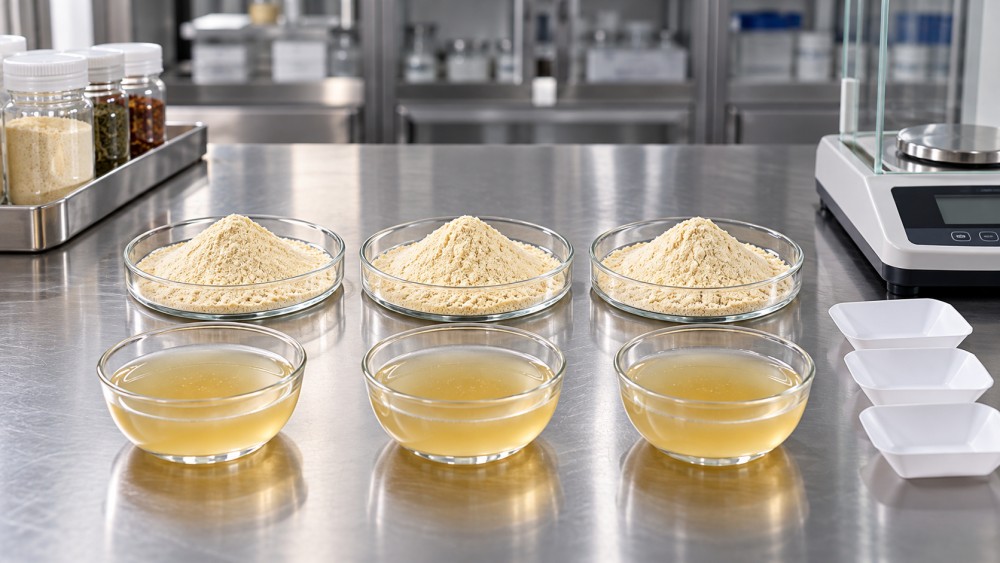
For sensory preparations, hold ingredient mass, carrier composition, mixing sequence, temperature, and holding time constant. Weigh additions rather than measuring by volume. If the blend requires hydration or cooking, specify that step closely enough for another operator to reproduce it. Record deviations before assessors see the samples.
Assess only materials cleared for the intended sensory procedure under the site’s safety rules. Do not use tasting as a way to investigate a suspected safety failure.
Separate difference testing from acceptability
Use coded samples and a balanced serving order so supplier identity and sample position do not drive the result. Begin with a controlled carrier if it helps identify the ingredient’s character, then test the actual seasoning blend. A carrier comparison can reveal a difference that disappears in the finished formulation; the reverse can also occur.
A triangle test can help answer whether assessors can distinguish samples under specified conditions. ISO 4120 describes the method.[2] It does not, on its own, establish whether the difference is commercially important or which sample is preferred. Select the test design and statistical decision rule before testing rather than interpreting an informal tasting as a formal result.
For release decisions, pair difference testing where appropriate with descriptive assessment in the target application. Ask whether the candidate is weaker, harsher, more cooked, or otherwise outside the approved profile. A detectable difference may still be acceptable; an undesirable off-note should not be dismissed simply because overall intensity is similar.
Challenge the lot under relevant use conditions
The most useful comparison reproduces the preparation steps that could affect the purchasing decision. Avoid a large test matrix with little connection to production. Select conditions from actual product instructions, process settings, and foreseeable handling.
- Dry snack coatings: Compare the seasonings on the same substrate using the same oil level, application method, and holding interval. Assess coating uniformity as well as aroma and aftertaste.
- Instant soups or sauces: Standardize water temperature, mixing, and the interval between preparation and tasting. Compare the finished product rather than relying only on the dry blend.
- Cooked applications: Match the relevant time-temperature sequence. A satisfactory uncooked comparison is not sufficient evidence for performance after cooking.
- Products held before consumption: Include a relevant holding point if customers normally store or hold the prepared food. Establish that interval from the application, not convenience.
Test candidates at the approved formula level before making adjustments. Increasing the dose immediately can hide a material difference and turn supplier evaluation into reformulation. If an adjustment is proposed, treat it as a separate development exercise: recheck the complete flavor balance, mixing behavior, ingredient declaration where affected, and finished-product cost.
Maintain a distinction between immediate approval and shelf-life evidence. A satisfactory freshly prepared sample supports only the conditions tested. Any claim about flavor retention through storage needs an appropriate stability study using the relevant formulation, packaging, and storage conditions.
Keep food safety approval independent of sensory approval
A normal smell and acceptable flavor do not establish microbiological safety. Codex guidance for low-moisture foods addresses the persistence of pathogens and the importance of controlling contamination in these environments.[3] The FDA’s risk profile for spices also documents pathogen concerns associated with this ingredient category.[4] These sources support a hazard-based review, not an assumption that every lot presents the same risk.
For each supplier, identify the applicable hazards and where they are controlled. Review treatment documentation, the scope of any validation, post-treatment handling, packaging controls, and traceability. If a supplier describes material as “treated,” clarify the process and its supporting evidence. Do not interpret that word as a complete safety assurance.
Likewise, a negative laboratory result should be interpreted within the sampling plan and wider control system, rather than treated as proof that every part of a lot is free of contamination. U.S. facilities subject to the relevant provisions of 21 CFR Part 117 must address applicable preventive controls and supply-chain requirements; obligations depend on the facility, ingredient, and hazard analysis.[5]
Route unresolved safety documentation through the site’s hold-and-release procedure. Flavor approval should never override that hold.
OEM supplier evaluation: make change control visible
For an OEM seasoning program, evaluate the supplier’s ability to reproduce the agreed blend, not just submit a satisfactory development sample. Ask how incoming ingredient lots are approved, how formula revisions are controlled, and how production records connect finished batches to raw-material lots.
The most useful discussions concern deviations. What happens when a new ingredient lot meets analytical limits but misses the sensory reference? Who can authorize substitution or dosage adjustment? How is customer approval obtained when required? A clear escalation procedure is more informative than an unsupported promise of uniformity.
Agree on notification requirements for changes that could affect the product, such as ingredient source, treatment process, milling specification, manufacturing site, or packaging. Define which changes require document review and which require renewed application testing. Supplier audit findings and certification documents can support the assessment, but they do not replace product-specific acceptance criteria.
When comparing quotations, include the operational consequences of variability: additional testing, held inventory, trial batches, or formulation work. Do not assign invented savings to these factors. Use the buyer’s actual costs and rejection history where available.
Turn results into an auditable disposition
Close each evaluation with a decision linked to evidence: release against the existing specification, hold for investigation, reject, or approve for a clearly defined alternative application. Record the reference used, preparation conditions, sensory findings, analytical results, and authorization.
If a difference is acceptable only in a cooked sauce but not a dry coating, preserve that restriction in the purchasing and production systems. If no cause has been established, record the uncertainty rather than attributing it to origin, age, or processing without support. Reliable lot comparison comes from repeatable conditions and explicit acceptance boundaries—not from expecting every delivery to be indistinguishable in every possible use.
Sources
- [1] ISO 13299:2016, Sensory analysis — Methodology — General guidance for establishing a sensory profile.
- [2] ISO 4120:2021, Sensory analysis — Methodology — Triangle test.
- [3] Codex Alimentarius, CXC 75-2015, Code of Hygienic Practice for Low-Moisture Foods.
- [4] U.S. Food and Drug Administration, Risk Profile: Pathogens and Filth in Spices, 2017.
- [5] U.S. Code of Federal Regulations, Title 21, Part 117, particularly §117.135 and Subpart G, addressing preventive controls and supply-chain programs.
Related News
- China Records 543 New Cosmetic Ingredients, Including 167 in 2026Nov 12, 2026Prof. Elian Thorne
- Australia and New Zealand Weigh Wider Steviol Glycoside Use in Griddle ProductsNov 11, 2026Prof. Elian Thorne
- China Announces Risk-Based Cosmetic Change Reviews and Shorter TimelinesNov 10, 2026Prof. Elian Thorne
- How to assess product database coverage in an ingredient intelligence platformNov 08, 2026Prof. Elian Thorne
Related News
- 00
0000-00
China Records 543 New Cosmetic Ingredients, Including 167 in 2026 - 00
0000-00
How to check a fragrance raw material specification for IFRA compliance - 00
0000-00
Australia and New Zealand Weigh Wider Steviol Glycoside Use in Griddle Products - 00
0000-00
How does pH affect plant-based color ingredients in beverages? - 00
0000-00
China Announces Risk-Based Cosmetic Change Reviews and Shorter Timelines
Prof. Elian Thorne
Weekly Insights
Stay ahead with our curated technology reports delivered every Monday.