





A seasoning package can look intact while its contents become harder to dose or lose their expected flavor. Moisture pickup, aroma loss, and poor reclosure can develop through different pathways, so a single description such as “high-barrier packaging” is not enough for technical approval. The practical question is whether the complete pack preserves flowability and flavor through distribution, storage, and the period after opening.
For garlic powder, selection should begin with the product’s moisture sensitivity and intended use, then move to material performance, seals, closures, and validation. A laminate datasheet is useful evidence, but it does not establish the shelf life of a filled package. Packaging references distinguish material barrier properties from overall package performance, which also depends on construction, processing, and use conditions.[1]
Define the product failure before comparing packaging
“Moisture protection” needs an operational definition. A manufacturer feeding powder into an automated dosing system may reject material that bridges in a hopper, even if its flavor remains acceptable. A foodservice user may tolerate minor lumps but reject a seasoning that requires noticeably higher addition rates to achieve the expected flavor.
For products such as garlic powder, the intended seasoning application helps define what aroma protection must accomplish. A dry blend evaluated by smell alone may perform differently when dispersed into a sauce, dressing, or cooked formulation. Packaging acceptance should therefore connect retained flavor to a relevant use test, rather than treating the aroma of the opened container as the only endpoint.
Establish a baseline for incoming powder before assessing packaging. Relevant measurements may include moisture content, water activity, particle-size distribution, bulk density, flow behavior, and sensory characteristics. Moisture content measures the amount of water present; water activity describes its thermodynamic availability. They are related but not interchangeable, and their relationship depends on the food and temperature.[2]
Avoid specifying a universal moisture or water-activity limit without product evidence. Instead, identify the change associated with unacceptable caking, dosing variation, or sensory deterioration. That creates a defensible performance target for the package and separates packaging failures from variability already present in the ingredient.
Separate moisture ingress from aroma deterioration
Water vapor can permeate packaging materials or enter through defective seals and closures. Its effect on a powder depends on the surrounding humidity, temperature, exposure time, and the product’s moisture sorption behavior. Moisture gain may promote particle adhesion and loss of flowability, but the failure point must be established for the actual formulation.[1][2]
Aroma protection involves additional mechanisms. Volatile compounds may permeate outward, interact with packaging polymers, or change during storage. Oxygen exposure can also contribute to deterioration in susceptible foods. A material with strong moisture resistance should not automatically be assumed to provide equivalent oxygen or aroma protection.[1]
These distinctions matter when interpreting supplier data. Water vapor transmission rate, or WVTR, describes moisture transmission under stated test conditions. Oxygen transmission rate, or OTR, describes oxygen transmission. Neither is a direct measurement of retained seasoning flavor. ASTM F1249 addresses water vapor transmission through plastic film and sheeting using a modulated infrared sensor; ASTM D3985 addresses oxygen transmission using a coulometric sensor.[3][4]
Request the temperature, humidity conditions, test method, material thickness, and units for every reported barrier value. Comparing figures generated under different conditions can produce a misleading ranking. Also distinguish a flat-film result from evidence on the formed, sealed package. Product contact, creasing, seals, and closures introduce variables absent from a film specimen.
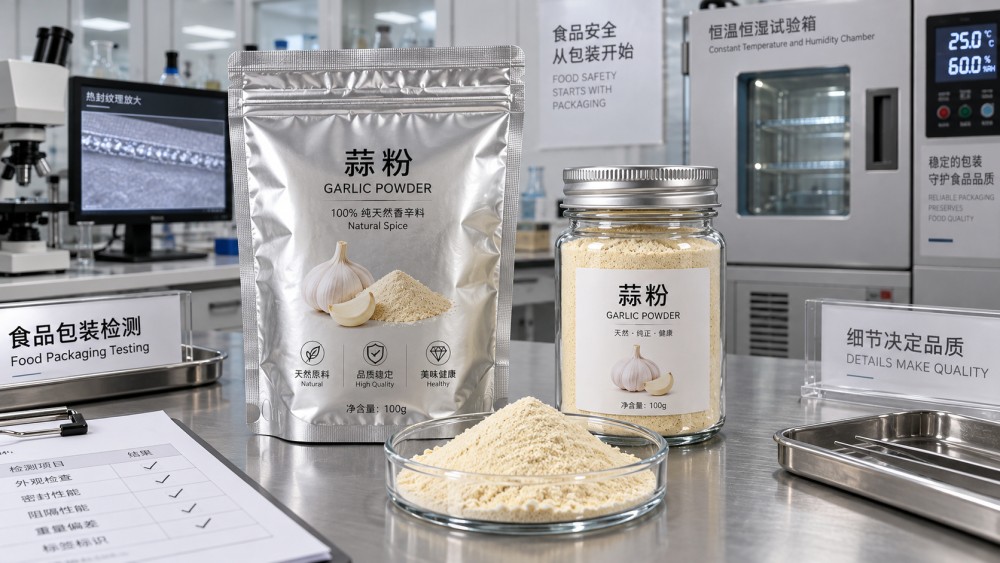
Compare structures against the actual handling route
There is no universally best format. The preferred structure depends on unopened storage duration, transport stresses, pack size, opening frequency, and the ability of the packing line to produce repeatable seals. The following options are candidates for evaluation, not guaranteed performance rankings.[1]
Material names alone are insufficient procurement specifications. “Multilayer pouch” does not identify the barrier layer, thickness, sealant, or converting quality. “Plastic jar” says little about resin, wall thickness, closure design, or initial sealing system. Request a controlled construction specification and an agreed process for notifying the buyer of changes.
For bulk supply, treat mechanical protection and environmental protection as separate functions. An outer sack may survive pallet handling while its liner remains poorly closed. Conversely, a suitable liner can be punctured by rough handling or nearby hardware. Qualification should examine the assembled pack rather than accepting each component independently.
Make seals and reclosure part of the specification
Seal contamination is a practical concern during powder filling. Product caught in the sealing area can interfere with seal formation. Qualification should therefore use representative filling conditions, including dust levels and production speeds, rather than relying only on clean laboratory samples.
Seal strength and leak integrity answer different questions. ASTM F88/F88M provides methods for measuring the seal strength of flexible barrier materials. ASTM F2096 describes detection of gross leaks in packaging by internal pressurization. These methods can support a validation program, but neither result alone proves adequate aroma retention or shelf life.[5][6]
For a pouch, establish the working range for sealing temperature, pressure, and dwell time using the actual laminate and equipment. Examine startup packs and packs produced during routine line interruptions. For rigid containers, evaluate the initial seal, cap application, liner compatibility, and reclosure after product has contacted the neck or closure surfaces.
A zipper or screw cap should be assessed as a use feature, not assumed to recreate the protection of an unopened seal. If the ingredient will be opened repeatedly, include that behavior in the trial. A smaller pack may cost more per unit of product yet reduce exposure and the amount discarded after opening.
Validate storage and distribution with filled packs
A useful study follows the product through its intended route: packing, transport, warehouse storage, and customer use. Select environmental conditions that represent credible exposure, including demanding conditions justified by the distribution route. Do not assign a shelf life merely because the material is described as high barrier.
Accelerated testing can help screen alternatives, but elevated temperature or humidity may alter product behavior and package performance. Its relationship to normal storage needs justification. Maintain real-time samples when establishing a commercial shelf-life claim, and document the limits of any extrapolation.[1]
A comparative study should include:
- A common product baseline: use comparable powder from a controlled lot and document initial condition.
- Representative package production: use intended equipment, fill weight, closure settings, and headspace practice.
- Unopened and opened-use conditions: assess original barrier protection separately from repeated access.
- Product and package endpoints: measure moisture-related changes, flowability, relevant sensory performance, and package integrity.
- Defined acceptance criteria: agree what constitutes failure before reviewing the results.
Use unopened units at planned intervals so that sampling does not repeatedly disturb every test pack. Where sensory comparison is important, use a consistent preparation method and coded samples. Instrumental analysis of selected volatile compounds may help explain changes, but it should support rather than automatically replace application-level evaluation.
Interpret the pattern of results. Moisture gain concentrated in damaged packs points toward a different corrective action than gradual gain across intact packs. Flavor decline without comparable moisture change warrants investigation of oxygen exposure, volatile loss, product variability, or interactions with packaging. Changing the film without identifying the failure pathway can leave the underlying problem unresolved.
Control the environment after opening
Warehouse and dispensing practices are part of the protection system. Keep packs closed between uses and away from steam, washdown spray, and other avoidable moisture sources. Where product moves between cool and warm environments, assess condensation risk before opening. Suitable controls depend on local temperature and humidity rather than a universal storage instruction.[1][2]
In production areas, consider how long an opened liner remains exposed, whether the dispensing station sits near a wet process, and whether utensils are kept dry. If partial packs are common, define a closure method and a supported opened-use period. A folding instruction for a liner should not be treated as equivalent to a validated heat seal.
Moisture-barrier packaging is not a substitute for ingredient safety controls. FDA’s Bad Bug Book discusses the ability of Salmonella to survive in dry environments and foods. Low moisture should therefore not be interpreted as proof of pathogen absence.[7] Ingredient approval, sanitation, and any required hazard-control measures need separate assessment from packaging quality.
Purchase against measurable requirements
A useful request for quotation describes the required outcome and the evidence needed to support it. Include the fill size, unopened storage target, intended opened-use pattern, distribution conditions, and acceptable product changes. Ask suppliers to identify the proposed construction, relevant test conditions, seal or closure requirements, and any limitations of their data.
Food-contact suitability also requires separate documentation for the intended market and use. In the United States, FDA guidance explains that food-contact substances require an applicable regulatory basis, which may include relevant regulations or an effective food contact notification. A generic “food grade” statement is not a substitute for checking the applicable conditions and restrictions.[8]
Compare total operating consequences rather than unit pack price alone. Include line compatibility, rejected seals, handling damage, storage losses, and waste from partly used packs. The preferred package is the one that meets defined moisture and flavor criteria under credible use conditions, with repeatable production controls and evidence proportionate to the risk.
Sources
- Robertson, G. L. Food Packaging: Principles and Practice. Third edition. CRC Press, 2013. Reference for packaging barriers, food–package interactions, package systems, and shelf-life assessment.
- Barbosa-Cánovas, G. V., Fontana, A. J., Schmidt, S. J., and Labuza, T. P., editors. Water Activity in Foods: Fundamentals and Applications. Blackwell Publishing, 2007.
- ASTM F1249, Standard Test Method for Water Vapor Transmission Rate Through Plastic Film and Sheeting Using a Modulated Infrared Sensor.
- ASTM D3985, Standard Test Method for Oxygen Gas Transmission Rate Through Plastic Film and Sheeting Using a Coulometric Sensor.
- ASTM F88/F88M, Standard Test Method for Seal Strength of Flexible Barrier Materials.
- ASTM F2096, Standard Test Method for Detecting Gross Leaks in Packaging by Internal Pressurization (Bubble Test).
- U.S. Food and Drug Administration. Bad Bug Book: Foodborne Pathogenic Microorganisms and Natural Toxins Handbook. Second edition, 2012. Chapter on Salmonella species.
- U.S. Food and Drug Administration. Determining the Regulatory Status of Components of a Food Contact Material.
Related News
- Wissen Research: Global Cosmetics Market to Reach $497.2 Billion by 2031Nov 13, 2026Prof. Elian Thorne
- China Records 543 New Cosmetic Ingredients, Including 167 in 2026Nov 12, 2026Prof. Elian Thorne
- Australia and New Zealand Weigh Wider Steviol Glycoside Use in Griddle ProductsNov 11, 2026Prof. Elian Thorne
- China Announces Risk-Based Cosmetic Change Reviews and Shorter TimelinesNov 10, 2026Prof. Elian Thorne
Related News
- 00
0000-00
Wissen Research: Global Cosmetics Market to Reach $497.2 Billion by 2031 - 00
0000-00
Can biomimetic peptides improve skin firmness? - 00
0000-00
China Records 543 New Cosmetic Ingredients, Including 167 in 2026 - 00
0000-00
How to check a fragrance raw material specification for IFRA compliance - 00
0000-00
Australia and New Zealand Weigh Wider Steviol Glycoside Use in Griddle Products
Prof. Elian Thorne
Weekly Insights
Stay ahead with our curated technology reports delivered every Monday.