





A batch of seasoning can meet its recipe weights and still fail because one incoming ingredient has changed. Weak aroma, hard lumps, damaged liners, or an unexplained difference in particle size can affect blending and finished-product consistency. More seriously, an acceptable appearance does not establish microbiological safety. Before releasing garlic powder to production, quality teams need separate evidence for identity, physical condition, flavor performance, and the food-safety controls relevant to its intended use.
The practical question is not simply whether a delivery passes a laboratory test. It is whether the material matches the approved specification, whether its hazards have been controlled, and whether it will perform predictably in the factory’s actual seasoning system.
Set acceptance criteria around the finished application
A useful incoming specification starts with where the seasoning will go. A powder added to a snack coating after the product’s final heat treatment has a different exposure pathway from an ingredient entering a process with a validated microbial reduction step. Do not assume that a customer’s cooking instructions or an unspecified downstream heating stage provides adequate control. The process needs evidence appropriate to the ingredient, hazard, and operating conditions. Codex addresses this distinction in its guidance for low-moisture foods.[1]
Separate the specification into safety requirements and functional requirements. Safety requirements may cover pathogen controls, relevant chemical contaminants, foreign material, and allergen cross-contact. Functional requirements cover characteristics such as aroma, color, particle-size distribution, moisture, and flow. A material can satisfy one group while failing the other.
For seasoning development, garlic powder should be evaluated in relation to the complete flavor profile and intended use, rather than treated as an interchangeable source of garlic flavor. A strong salt-and-acid blend, a mild herb seasoning, and an oil-based coating may reveal different performance differences. Establish an approved reference and a repeatable application test before a purchasing change creates a production dispute.
Avoid copying limits from an unrelated ingredient specification. Define test methods, reporting units, acceptance criteria, and responsibilities explicitly. “Fine powder,” “normal aroma,” and “microbiologically acceptable” are difficult to enforce unless the supplier and receiving factory share a clear interpretation.
Verify the lot before opening the bags
Receiving checks should establish that the delivered material is the material that was approved. Match the purchase order, ingredient description, supplier, manufacturing site where specified, lot code, and certificate of analysis. Check manufacturing or packing dates against the agreed shelf-life rules. A certificate bearing a different lot number is not evidence for the shipment in front of the receiver.
Review what the certificate actually reports. A numerical result, a statement of compliance, and a reference to periodic monitoring provide different levels of information. Quality staff should know which tests are performed on every lot, which are verified periodically, and which results come from supplier declarations. Where supplier controls are relied upon, their verification should be determined by the hazard analysis and applicable requirements. The US preventive-controls framework includes supplier approval and verification provisions where a supply-chain-applied control is required.[3]
- Packaging: Look for punctures, failed seals, wet patches, pest evidence, and contamination on surfaces that could enter the opening area.
- Identification: Confirm that every sampling unit remains traceable to its lot, including deliveries containing several production lots.
- Composition: Confirm whether the ingredient is pure dehydrated garlic or contains declared carriers, processing aids, or anticaking ingredients.
- Change status: Check for changes in origin, processing site, treatment, formulation, or packaging that require review under the supplier agreement.
Hold discrepancies for assessment rather than allowing production urgency to turn incomplete paperwork into automatic acceptance. If an outer bag is damaged but the liner appears intact, follow a documented inspection and disposition process; neither automatic rejection nor automatic release fits every situation.
Sample for the decision, then check physical condition
A convenient scoop from the top of one bag may miss differences within a shipment. Build the sampling plan around the lot structure, packaging, test purpose, and risk. Use clean equipment and suitable containers, prevent cross-contamination, and record the sampling locations. Microbiological samples require handling that does not introduce contamination or compromise the test.
Compositing can be useful for some quality measurements, but it can also conceal variation. Decide whether the question is average composition, bag-to-bag consistency, or the presence of a localized problem before combining samples. Follow the laboratory’s instructions for microbiological sampling and submission.
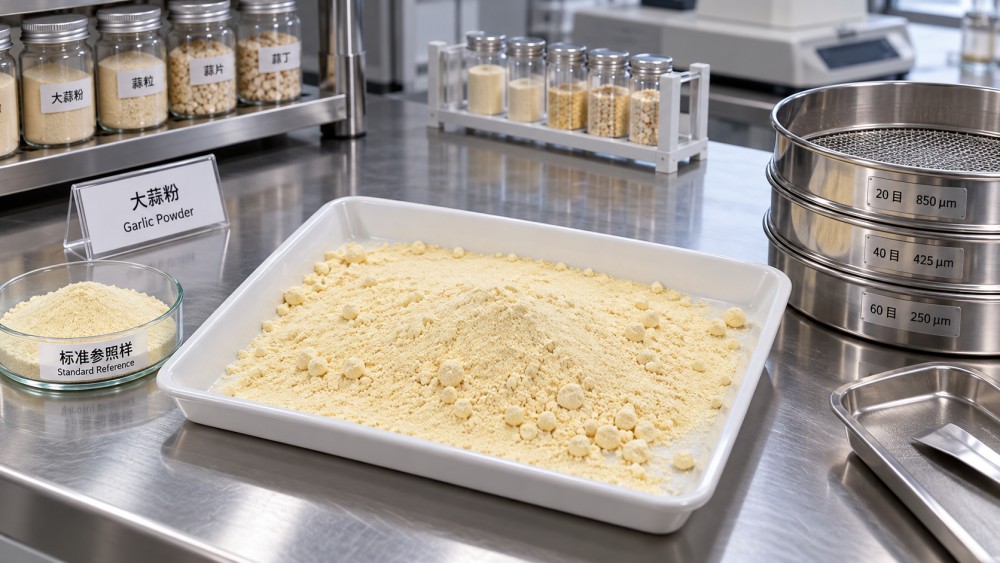
Spread a representative portion on a clean inspection surface under consistent lighting. Compare color with an approved reference and look for unusual dark particles, fibers, insects, or other extraneous material. Color alone does not identify the cause of a difference: raw-material variation and processing conditions may both contribute. An unexplained shift should trigger investigation, not an unsupported diagnosis.
Assess lumps separately from overall flow. Record whether agglomerates break under a defined light pressure or remain hard. Do not simply crush them and report the powder as acceptable. Investigate whether the condition reflects handling, moisture exposure, or another change, then determine whether it affects safety, dosing, or dispersion.
Particle size deserves a defined method. A sieve profile provides more useful information than a single description such as “fine.” Differences in particle size and bulk behavior can change feeder output and may contribute to segregation within a blend. If the factory doses volumetrically, check bulk density using a consistent procedure; an unchanged feeder setting does not necessarily deliver an unchanged ingredient mass.
Use moisture and water activity for different questions
Moisture content describes how much water a sample contains under the selected analytical method. Water activity describes water availability and is more directly relevant to whether microorganisms can grow under particular conditions. The measurements are related, but they are not interchangeable. Codex guidance for low-moisture foods emphasizes that conditions preventing growth do not necessarily eliminate pathogens already present.[1]
Specify the moisture method and reporting basis. Results obtained using different procedures may not be directly comparable. For water-activity measurements, follow the instrument procedure, allow appropriate equilibration, and control measurement temperature. Opening a cold sample in a humid room can also alter its condition before testing.
Do not adopt a universal acceptance limit merely because the ingredient is a dry powder. Limits should reflect the product specification, packaging, expected storage, and hazard assessment. Where a result differs sharply from the supplier’s value, investigate sampling, methods, transport exposure, and package integrity before deciding which result represents the lot.
For production planning, assess the material under realistic handling conditions. A powder that passes a brief laboratory flow check may behave differently after an opened liner has stood near a humid mixing area. Define how opened bags are resealed, identified, stored, and returned to use.
Review microbial controls without treating testing as a guarantee
Dried spices and seasonings require attention to pathogens even when they look clean and remain dry. FDA’s risk profile for spices identifies Salmonella as a relevant hazard, while Codex explains the persistence and control challenges associated with low-moisture foods.[1][2] An incoming inspection should therefore examine the control system, not rely on appearance, aroma, or moisture results as substitutes for microbiological evidence.
If a microbial reduction treatment is specified, establish who performs it, which material it covers, and what documentation connects the delivered lot to that treatment. Evidence should address the actual process and ingredient conditions. A general statement that material is “treated” or “sterilized” does not, by itself, demonstrate an effective control.
Finished-lot testing has a role, but a negative result describes the sample tested; it does not prove every part of a lot is free from contamination. Codex guidance supports combining preventive controls, hygienic handling, appropriate supplier assurance, and verification rather than relying on end-product testing alone.[1]
Keep microbial indicators in their proper role. Aerobic counts, yeast and mold results, or hygiene indicators may help assess consistency or investigate deviations, but they do not replace a pathogen-specific control where the hazard assessment requires one. Agree on the analytical method, sample quantity, laboratory competence, and release rules before results arrive.
Chemical hazards also need a risk-based review. Depending on origin, processing, intended market, and supplier history, this may include pesticide residues or other relevant contaminants. Allergen cross-contact needs separate consideration when shared facilities handle allergenic ingredients. Applicable legal limits and labeling obligations depend on the destination market; Codex hygiene guidance is a reference framework, not a replacement for local law.[3][4]
Confirm flavor and blending performance before release
Use sensory checks only under an approved procedure and appropriate safety conditions. Do not taste quarantined raw material to decide whether it is safe. For suitable samples, compare against a controlled reference using consistent preparation, concentration, temperature, and assessment timing.
A dry sniff can identify obvious differences, but it does not reproduce every application. Evaluate the ingredient in a relevant model blend or product base. Where hydration is part of use, standardize the hydration time; where the powder enters an oil coating or a heated product, reproduce those conditions closely enough to answer the production question.
Record specific observations such as weak garlic character, excessive cooked notes, bitterness, or a musty odor rather than “good” or “bad.” Investigate off-notes instead of masking them with a higher dose. Increasing addition rates can change the recipe balance without resolving the underlying quality deviation.
A small mixing trial can also reveal poor dispersion or visible agglomerates. When changing grade or supplier, examine whether the intended mixing sequence and addition point remain suitable. A laboratory blend is useful screening evidence, but it does not establish uniformity throughout a full-scale mixer.
Make the release decision traceable
A workable release record connects the lot identity, sampling record, inspection findings, laboratory results, supplier evidence, and authorized disposition. Distinguish food-safety failures from functional deviations. A minor color variation may be assessed against an approved application standard; a missing required safety-control record cannot be resolved by an acceptable flavor trial.
Where conditional use is permitted, document its scope, authorization, traceability, and any restrictions before production starts. Do not dilute a nonconforming lot into another batch as an informal corrective action. Trend repeated changes in caking, aroma, sieve results, or documentation quality so that supplier review occurs before another delivery interrupts the line.
The release decision should answer two separate questions: is there sufficient evidence that the ingredient meets the required safety controls, and does it meet the agreed conditions for this seasoning application? Production should proceed only when both answers are supported.
Sources
- [1] Codex Alimentarius, CXC 75-2015, Code of Hygienic Practice for Low-Moisture Foods.
- [2] US Food and Drug Administration, Risk Profile: Pathogens and Filth in Spices, 2017.
- [3] US Code of Federal Regulations, Title 21, Part 117, particularly Subparts C and G on hazard analysis, preventive controls, and supply-chain programs.
- [4] Codex Alimentarius, CXC 42-1995, Code of Hygienic Practice for Spices and Dried Aromatic Herbs.
Related News
- Wissen Research: Global Cosmetics Market to Reach $497.2 Billion by 2031Nov 13, 2026Prof. Elian Thorne
- China Records 543 New Cosmetic Ingredients, Including 167 in 2026Nov 12, 2026Prof. Elian Thorne
- Australia and New Zealand Weigh Wider Steviol Glycoside Use in Griddle ProductsNov 11, 2026Prof. Elian Thorne
- China Announces Risk-Based Cosmetic Change Reviews and Shorter TimelinesNov 10, 2026Prof. Elian Thorne
Related News
- 00
0000-00
Wissen Research: Global Cosmetics Market to Reach $497.2 Billion by 2031 - 00
0000-00
Can biomimetic peptides improve skin firmness? - 00
0000-00
China Records 543 New Cosmetic Ingredients, Including 167 in 2026 - 00
0000-00
How to check a fragrance raw material specification for IFRA compliance - 00
0000-00
Australia and New Zealand Weigh Wider Steviol Glycoside Use in Griddle Products
Prof. Elian Thorne
Weekly Insights
Stay ahead with our curated technology reports delivered every Monday.