





In emulsion-based skincare, texture stability is often treated as a sensory topic first: spreadability, cushion, richness, quick break, non-tack afterfeel. For technical evaluators, that framing is too narrow. Texture stability is a systems question. It determines whether a formula survives transport, filling, temperature cycling, long-term storage, and repeated consumer use without phase drift, viscosity collapse, syneresis, graininess, or unacceptable batch-to-batch variation.
That is why interest in functional additives for skincare has moved beyond marketing language and into formulation risk management. In practice, these additives do not simply “improve feel.” They change interfacial behavior, water structuring, electrolyte tolerance, droplet mobility, polymer network strength, and the way actives coexist inside the emulsion. The key question is not whether an additive can thicken or smooth a cream on day one. The real question is whether it stabilizes texture across the full life of the product, under realistic processing and storage conditions.
Why texture stability deserves technical attention
In a modern skincare emulsion, instability rarely comes from one obvious failure point. More often, it is cumulative. A peptide complex adds salts. A botanical extract brings residual solvents or color bodies. A preservative system shifts pH tolerance. A sensory powder changes internal friction. A polymer chosen for elegant flow loses efficiency in the presence of surfactants or electrolytes. Each decision looks manageable alone; together they can push the system past its structural margin.
For a technical team, this matters because texture is not a cosmetic detail layered on top of efficacy. It affects dose uniformity, packaging compatibility, pump evacuation, consumer perception of freshness, and even the credibility of a high-value active system. Premium anti-aging positioning is particularly exposed here: when a formula claims advanced efficacy but develops stringiness, separation, or late-stage thinning, the failure is read by the market as both technical and commercial.
What functional additives are actually doing inside an emulsion
Functional additives used to support texture stability generally work through one or more of four mechanisms.
- Continuous-phase structuring: hydrocolloids, associative thickeners, and polymeric rheology modifiers increase the viscosity or yield stress of the water phase, slowing droplet movement and reducing creaming or sedimentation.
- Interfacial stabilization: co-emulsifiers, polymeric emulsifiers, and some amphiphilic materials strengthen the oil-water interface, making droplets less likely to coalesce under shear or heat stress.
- Network formation: fatty alcohols, waxy structuring agents, lamellar-phase builders, and gel networks create a three-dimensional matrix that immobilizes dispersed phases and contributes to cream body.
- Compatibility buffering: chelators, pH adjusters, electrolyte-tolerant polymers, and dispersion aids help maintain the operating window when actives, pigments, extracts, or salts would otherwise destabilize the system.
The important point is that the same additive may help one stability pathway while weakening another. A thicker formula is not automatically a more stable one. Some high-viscosity systems still suffer from poor droplet stability, weak freeze-thaw resistance, or irreversible texture collapse after consumer shear. Likewise, a very elegant low-viscosity serum emulsion may remain structurally robust if its interface and polymer architecture are properly designed.
The common evaluation mistake: treating viscosity as the whole answer
One of the most persistent oversimplifications in skincare development is the assumption that viscosity equals stability. It does not. Viscosity is only one observable output, and often a misleading one if measured without context. Two emulsions can show similar Brookfield readings yet behave very differently in filling lines, in pumps, or after four weeks at elevated temperature. One may have a useful yield stress and recover after shear; the other may look acceptable initially but lose structure quickly once its internal network is disrupted.
Technical evaluation therefore needs to consider rheology as a profile, not a single number. Shear thinning, thixotropic recovery, elastic contribution, and temperature response are often more informative than a single ambient-viscosity checkpoint. This is especially relevant for functional additives that are sold on “rich texture” or “instant thickening” claims. Those claims may be directionally true while still hiding weak recovery behavior or sensitivity to formulation complexity.
When formulators say an additive “stabilizes texture,” technical teams should ask: stable against what, exactly? Heat? Electrolytes? Freeze-thaw? High active loading? Fragrance? Airless pump shear? A claim without a stress condition is not yet a technical conclusion.
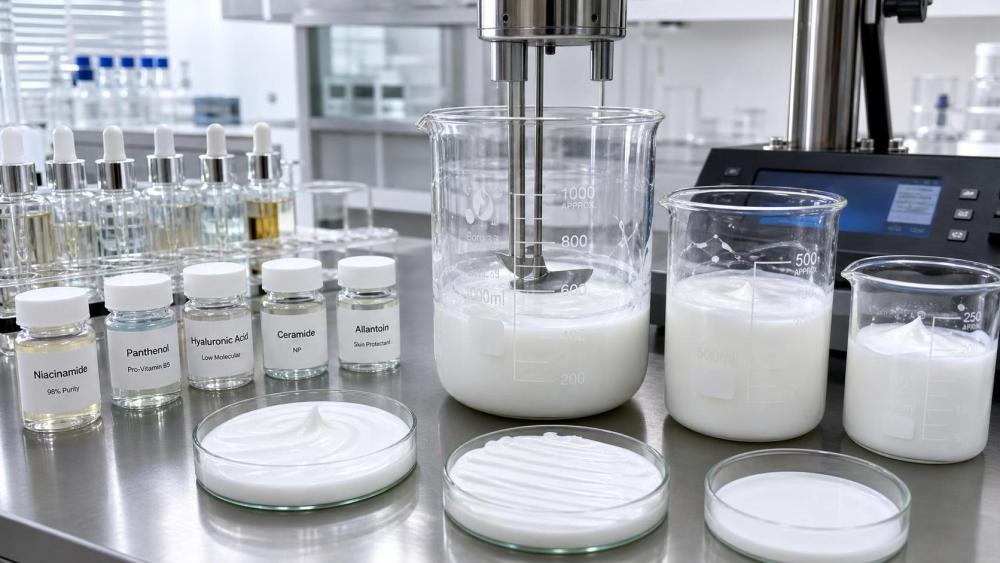
How active ingredients complicate texture control
High-value skincare formulas increasingly combine peptides, niacinamide, acids, ferments, botanical extracts, sunscreens, silicones, powders, and fragrance systems in one emulsion platform. Each class changes the formulation environment.
Electrolyte-containing actives are a frequent source of hidden instability. They can reduce the efficiency of certain carbomers or other anionic thickeners, causing delayed thinning. Low-pH systems may narrow the usable range of polymeric stabilizers or alter the behavior of emulsifier packages. Some plant extracts carry inconsistent solids, sugars, or trace ions from batch to batch, which may not trigger immediate failure in pilot samples but can shift long-term rheology. Encapsulated actives add another layer: the wall material or carrier system may compete for water, alter dispersion, or be damaged by high shear during manufacturing.
This is where additive selection becomes a business decision as much as a formulation decision. A technically elegant additive that performs only in narrow pH or low-electrolyte conditions may be a weak platform choice if the product roadmap includes active-rich line extensions. Conversely, a less glamorous but more tolerant stabilizing system can reduce redevelopment cycles, change controls, and scale-up surprises.
The role of emulsion architecture, not just additive choice
Functional additives do not work in isolation. Their effect depends heavily on emulsion type and microstructure. Oil-in-water lotion systems, gel-creams, lamellar creams, multiple emulsions, and silicone-heavy hybrids each impose different demands on the stabilizing package.
For example, lamellar structures are often favored when brands want a biomimetic skin feel and a richer sensorial profile without excessive wax loading. But lamellar systems can be sensitive to processing sequence, cooling rate, and active incorporation order. In those cases, the additive is only part of the answer; the manufacturing window becomes equally important. A robust additive can still fail in a poorly controlled process, while a moderate additive can perform well when the process preserves the intended structure.
Technical evaluators should therefore resist supplier comparisons based only on simple benchmark formulas. A material that performs well in a generic oil-in-water cream may not translate well into an active-dense gel-cream or a low-energy “cold process” platform. Comparative screening should be done in a system that resembles the intended commercial architecture.
What to check when screening functional additives
At the ingredient review stage, the useful questions are usually more operational than promotional. A few parameters often separate platform-ready materials from lab-only performers.
- Electrolyte tolerance: critical for peptide blends, niacinamide systems, mineral-rich extracts, and some preservation strategies.
- pH operating range: especially important for acid-based skincare, vitamin C derivatives, and microbiome-oriented concepts.
- Shear response and recovery: relevant to manufacturing, filling, and end-user dispensing.
- Thermal robustness: needed when the formula will face hot-fill steps, elevated storage, or unstable logistics conditions.
- Compatibility with surfactants, silicones, oils, and fragrances: many texture issues emerge only after full formula assembly.
- Impact on sensory drift over time: a formula can remain “stable” visually while becoming stringy, draggy, or soapy in application.
- Batch variability risk: particularly relevant for bio-based polymers, natural gums, and complex extract-associated systems.
For global supply chains, procurement should add another layer: manufacturing consistency, regional regulatory support, impurity documentation, microbiological control, and change-notification discipline. Even when a functional additive is not a headline active, weak documentation can delay market entry or complicate customer audits.
Claims that are directionally true, but incomplete
Several market narratives around texture stabilization deserve more careful reading.
“Natural thickeners are automatically safer or more future-proof.” Not necessarily. Some natural-origin materials fit clean-label and biodegradability expectations well, but they may also show wider lot-to-lot variability, microbial sensitivity, or narrower process tolerance. Their value is real, but it should be assessed alongside robustness and control strategy.
“Polymer-free systems are simpler.” Sometimes, but not by default. Removing synthetic rheology modifiers may increase reliance on waxes, gums, emulsifier networks, or process precision. The formula may become more sensitive, not less.
“A stronger thickener solves instability.” Often it only masks it. If interfacial weakness or incompatible active loading is the root problem, increasing viscosity can delay visible failure without improving long-term structure.
“Sensorial elegance and stability are a trade-off.” This is too absolute. There is a trade space, but advanced additive selection and emulsion design can often deliver both. The limiting factor is usually not concept feasibility; it is development discipline, ingredient fit, and cost tolerance.
Testing logic should mirror commercial reality
For technical evaluators, a practical screening program should combine instrumental and application-relevant stress testing. Standard accelerated conditions remain useful, but they should not be the only gate. Products fail in transit, on warehouse shelves, in consumer bathrooms, and after repeated package actuation. Those are not edge cases; they are the commercial environment.
A more decision-useful approach is to build a matrix around the intended business scenario:
Where possible, panel-based sensory checks should be linked back to rheological observations rather than treated as separate judgments. A formula described as “breaking thinner after four weeks” or “developing drag” is often signaling structural changes that instrumentation can help explain.
Cost, compliance, and platform strategy are now part of the same decision
In the current FMCG and beauty environment, additive selection is no longer just a lab optimization exercise. Cost pressure, sustainability positioning, documentation requirements, and cross-market compliance all shape which stabilizing technologies are realistic. A highly specialized additive may enable a superior sensory profile, but technical teams should ask whether the supply base is resilient, whether impurity and residual solvent data are sufficient for target markets, and whether reformulation risk is acceptable if sourcing tightens.
Regulatory treatment also matters, even for materials that are not marketed as actives. Nomenclature clarity, residual monomer concerns, preservative interactions, and regional documentation expectations can become practical bottlenecks. Requirements differ by market and product type, and specific regulatory interpretation should be verified against current regional rules【待核实】. For that reason, technical and compliance review should happen earlier in additive screening than many teams are used to.
What is changing in the market
Three shifts are becoming more visible. First, formulators want multifunctional systems that can stabilize texture while supporting claims around mildness, biomimetic structure, or reduced formulation complexity. Second, tolerance is becoming more valuable than peak performance: additives that survive salts, broad pH ranges, and active-heavy formulas are gaining strategic relevance. Third, the industry is moving toward proof by system behavior rather than ingredient storytelling. Suppliers increasingly need to show how a material performs in realistic formulations, not just in simplified demos.
That last point matters for buyers and R&D evaluators. The future advantage is unlikely to come from the loudest texture claim. It will come from identifying which functional additive can preserve emulsion integrity while still fitting the product roadmap, process capability, regulatory footprint, and cost structure of the business.
In other words, texture stability in skincare emulsions is not solved by choosing the thickest or most fashionable material. It is solved by understanding how the additive changes the physical system, where that system is vulnerable, and whether the formulation remains resilient once real-world complexity is added. That is the level at which functional additives stop being formulation accessories and become core technical infrastructure.
Related News
- How to interpret active matter on a surfactant specification sheetOct 14, 2026Prof. Elian Thorne
- What Quality Checks Should You Run on Fragrance Ingredient Suppliers?Oct 14, 2026Prof. Elian Thorne
- How to assess a flavor chemistry manufacturer's batch consistencyOct 13, 2026Prof. Elian Thorne
- What drives fragrance ingredients price changes in bulk orders?Oct 12, 2026Prof. Elian Thorne
Related News
- 00
0000-00
Can biomimetic peptides in cosmetics reduce the look of wrinkles? - 00
0000-00
How to assess a bio-based thickener manufacturer's batch consistency - 00
0000-00
Verifying halal status of hydrocolloid ingredients in the Middle East - 00
0000-00
How to interpret active matter on a surfactant specification sheet - 00
0000-00
How Do You Test Hydrocolloid Viscosity After Changing a Thickener?
Prof. Elian Thorne
Weekly Insights
Stay ahead with our curated technology reports delivered every Monday.