





A supplier offers a lower aroma ingredient price per kilogram for a full drum than for several smaller packs. The discount looks attractive, but your production schedule may not consume the drum before its quality becomes uncertain. Larger orders usually reduce unit prices when they lower production, packing, testing, or handling costs—but they only reduce procurement costs when those savings exceed inventory, financing, and material-loss costs.
The practical decision is therefore not simply which quantity earns the best price break. It is which order size delivers the lowest cost per usable kilogram while meeting production needs. For synthetic aroma chemicals and essential oil extracts, that requires comparing equivalent specifications, understanding the supplier’s pricing thresholds, and checking whether forecast consumption supports the commitment.
Where volume discounts actually come from
Some supplier costs change with every kilogram produced; others arise each time an order, batch, or package is processed. Larger quantities spread those fixed costs across more material. However, the savings are rarely proportional: doubling an order does not necessarily double the discount.
The strongest price breaks often occur at operational boundaries: a full container, a standard pallet, or an efficient production lot. Ask which boundary drives each quoted tier. Increasing an order slightly may produce no saving until the next threshold is reached.
Volume has less influence when raw-material availability dominates the price. A scarce botanical extract may remain expensive despite a large order. An uncommon synthetic material may require a dedicated campaign, making the minimum viable production quantity more important than the buyer’s preferred delivery size.
Separate order quantity from annual commitment
A purchase order, a delivery, and an annual volume agreement are not interchangeable. Each gives the supplier a different level of certainty and creates a different inventory burden for the buyer.
Minimum order quantity is an acceptance threshold, not necessarily a discount threshold. Establish whether it applies per ingredient, grade, order, or shipment. A supplier may accept a small release against an annual agreement while requiring a larger quantity for an isolated purchase.
Request separate quotations for three structures where demand justifies the comparison:
- Spot purchases: Individual orders priced when placed, offering flexibility but limited forward price certainty.
- One bulk delivery: A larger immediate receipt that may capture packing and freight efficiencies while transferring inventory exposure to your warehouse.
- Committed volume with scheduled releases: An agreed quantity delivered over time, potentially combining planning benefits with smaller receipts.
Scheduled releases are not automatically cheaper. The supplier may charge for storage, reserve stock at your expense, or require payment before release. Confirm ownership, invoicing dates, cancellation rights, maximum holding periods, and minimum remaining shelf life at each delivery.
Also ask whether releases come from one reserved batch or future production batches. That distinction affects remaining shelf life, batch consistency, and the value of staged delivery.
Normalize the quotes before comparing price tiers
A lower price is meaningful only when the material and commercial basis remain comparable. The same ingredient name—or even the same CAS number—does not establish identical odor performance, purity, origin, or suitability for an application.
For synthetic aroma chemicals, compare assay, relevant isomer profile, odor specification, and any limits on impurities that matter to the formulation. For essential oils and extracts, botanical identity, plant part, extraction method, origin, and compositional limits can affect both price and performance.
Dilution creates another trap. A neat material and a solution in a carrier should not be compared solely by their delivered price per kilogram. Convert them to a consistent concentration basis where technically appropriate, then account for the carrier’s effect on the formula. Concentration normalization alone cannot establish sensory equivalence.
Use the same basis for the commercial comparison:
- Net material weight and packaging type.
- Delivery location, shipping terms, currency, and payment timing.
- Freight, insurance, duties, and nonrecoverable taxes.
- Required certificates, testing, and application-specific documentation.
- Manufacturing date, remaining shelf life, and quote validity.
Keep material price and delivered cost in separate columns. Otherwise, a discount can disappear into freight surcharges, repacking fees, or less favorable payment terms without being obvious.
Calculate the cost of usable material, not just purchased material
The relevant denominator is the quantity that can actually enter production within specification. Material left in containers, rejected after deterioration, or written off after a formulation change still carries a procurement cost.
Effective cost per usable kilogram = total attributable procurement cost ÷ kilograms expected to be usable.
For each order option, include material spend, inbound logistics, receiving and testing, incremental storage, financing, and foreseeable disposal costs. Estimate usable quantity after expected handling and quality losses. Avoid double-counting discarded material: its purchase cost is already included in the original spend.
Compare the options over the same demand period. If a bulk purchase extends beyond that period, record the residual stock and assess whether it has a credible production use. Do not treat surplus inventory as a saving simply because it remains on the balance sheet.
Find the break-even point for the larger order
Start with the purchasing and logistics savings associated with buying the same expected requirement through the bulk option rather than smaller releases. Then subtract the additional costs created by holding more stock.
Net bulk benefit = comparable acquisition savings − additional carrying, handling, testing, and expected loss costs.
Use your finance team’s approved carrying-cost assumptions. Warehousing, insurance, capital, and obsolescence may already be combined in an internal rate; adding them again would overstate the penalty. Payment timing also matters: earlier payment can outweigh part of the unit-price discount.
Run the comparison against the normal production forecast and a credible lower-demand scenario. If the larger order works only when every forecast launch and production run occurs on schedule, the apparent saving depends heavily on demand certainty.
Shelf life can set the practical purchasing ceiling
Aroma ingredients differ in stability. Some remain suitable for long storage under specified conditions; others are more sensitive to oxygen, light, heat, moisture, or repeated opening. Essential oils are not uniformly unstable, and synthetic ingredients are not uniformly stable. Decisions need material-specific information.
Nominal shelf life is only the starting point. A supplier may deliver material well after manufacture, and an unopened-container shelf-life statement may not describe performance after repeated dispensing. Ask for remaining shelf life at receipt and available guidance on storage and use after opening.
A useful purchasing limit is the quantity expected to be consumed during the usable storage window: the remaining period after allowing for receiving tests, quarantine, internal release, and a justified buffer before expiry or retest. A retest date should not be treated as permission to extend use automatically; extension requires an appropriate quality assessment.
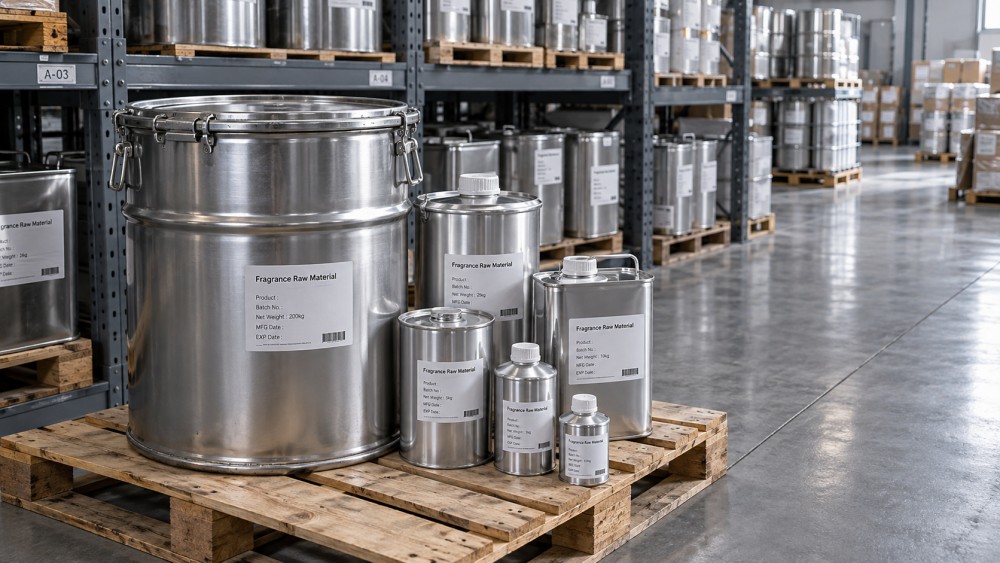
Container size belongs in this decision. One large drum may reduce packaging costs but require frequent opening or decanting. Multiple sealed packs may cost more per kilogram while limiting exposure and simplifying dispensing. Check suitable container materials, temperature conditions, and any supplier-specified protective measures before assuming the largest pack is economical.
Where sensory quality is critical, a satisfactory assay alone may not establish acceptability. Quality teams should define which analytical and odor checks govern release after extended storage, without assuming that every stored batch needs the same testing regime.
Negotiate around the supplier’s cost drivers
“What is your best price?” provides less useful information than a structured request for the quantities you can realistically use. Ask for tiers corresponding to your current release size, a standard full pack, and a supported annual commitment.
Require each tier to show what changes: packaging, lead time, payment terms, freight basis, manufacturing arrangement, or contractual obligation. This distinguishes an operational saving from a discount that mainly transfers inventory risk to you.
- Provide a demand range. Separate firm requirements from forecast upside so the supplier can price certainty rather than an inflated estimate.
- Ask about production timing. Joining a planned campaign may offer better economics than requesting a dedicated run, without requiring the same immediate receipt volume.
- Compare packing alternatives. Request the cost of standard packs versus smaller sealed units, including filling charges and delivery implications.
- Price staged releases explicitly. Identify reservation fees, storage charges, invoice timing, and minimum release quantities.
- Define price validity. Establish which orders or releases receive the agreed price and whether adjustments require an agreed trigger.
Do not exchange a clear discount for an unclear obligation. Take-or-pay terms, cancellation charges, nonreturnable stock, and mandatory release deadlines can turn a flexible forecast into a fixed liability. Record those obligations alongside the unit price in the approval comparison.
Choose the order size the forecast can support
Bulk purchasing is strongest when consumption is repeatable, the specification is established, storage conditions are suitable, and the discount remains worthwhile under slower demand. Smaller orders are often more defensible during formulation trials, product launches, uncertain approvals, or periods of specification change.
A split approach can suit uneven demand: commit only the dependable base requirement and purchase uncertain upside separately. The extra unit cost on that flexible portion should be compared with the cost of owning surplus stock, not with the bulk quote alone.
Before approving a larger order, record the projected inventory depletion date, minimum remaining shelf life at receipt, total cash commitment, and break-even savings. Give residual stock an identified production use rather than an assumed future market. If the supplier’s next discount tier pushes inventory beyond a credible consumption window, negotiate the delivery structure instead of buying more material.
Related News
- China Records 543 New Cosmetic Ingredients, Including 167 in 2026Nov 12, 2026Prof. Elian Thorne
- Australia and New Zealand Weigh Wider Steviol Glycoside Use in Griddle ProductsNov 11, 2026Prof. Elian Thorne
- China Announces Risk-Based Cosmetic Change Reviews and Shorter TimelinesNov 10, 2026Prof. Elian Thorne
- How to assess product database coverage in an ingredient intelligence platformNov 08, 2026Prof. Elian Thorne
Related News
- 00
0000-00
China Records 543 New Cosmetic Ingredients, Including 167 in 2026 - 00
0000-00
How to check a fragrance raw material specification for IFRA compliance - 00
0000-00
Australia and New Zealand Weigh Wider Steviol Glycoside Use in Griddle Products - 00
0000-00
How does pH affect plant-based color ingredients in beverages? - 00
0000-00
China Announces Risk-Based Cosmetic Change Reviews and Shorter Timelines
Prof. Elian Thorne
Weekly Insights
Stay ahead with our curated technology reports delivered every Monday.