





How to Compare Cosmetic Active Ingredients by Claim, Stability, and Cost
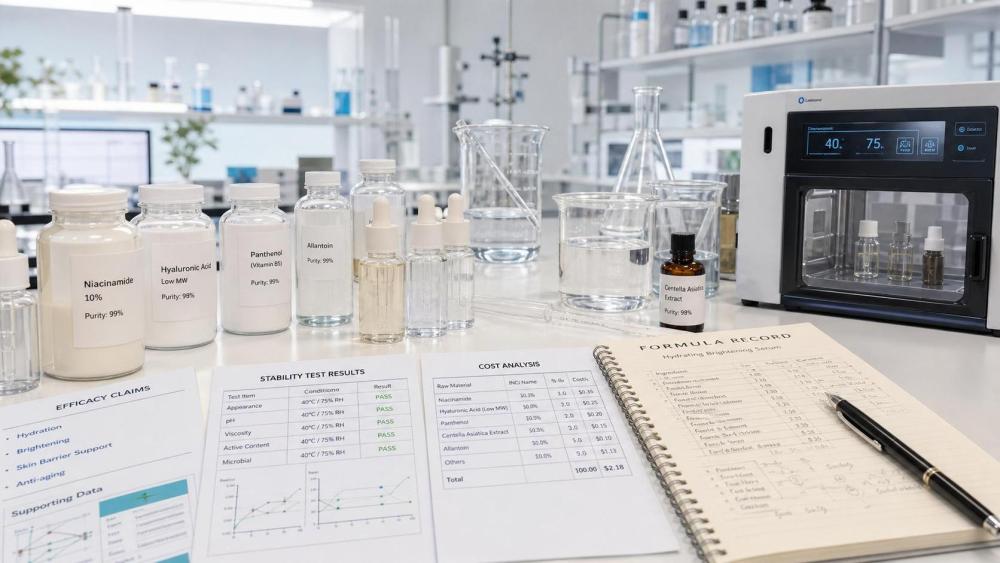
Choosing cosmetic active ingredients is rarely a simple performance question.
A strong marketing claim may fail in a real formula.
A stable ingredient may cost too much at use level.
A low-cost active may create regulatory or sensory problems later.
That is why comparing cosmetic active ingredients needs a broader framework.
For technical evaluation, three factors usually decide the outcome.
They are claim credibility, formulation stability, and total cost efficiency.
When these are reviewed together, ingredient selection becomes clearer and faster.
This also helps teams reduce reformulation risk and avoid weak launch claims.
Start with the claim, not the story
Many cosmetic active ingredients look impressive in supplier brochures.
Still, evaluation should begin with the exact claim your product must support.
For example, “anti-aging” is too broad for serious comparison.
A better question is whether the active supports wrinkle reduction, firmness, hydration, brightening, or barrier repair.
The narrower the claim, the easier it is to compare cosmetic active ingredients fairly.
Check the strength of evidence
Not all evidence carries the same weight.
In vitro screening is useful, but it is only an early filter.
Ex vivo data adds relevance, especially for skin interaction.
Human clinical or instrumental studies usually matter most for final selection.
Ask whether the tested concentration matches the intended formulation dose.
Also check treatment duration, sample size, skin type, and control design.
A peptide with robust clinical support may justify a higher price.
A plant extract with vague data may not survive a technical review.
Match the claim to the mechanism
Good cosmetic active ingredients connect claim language with a believable mechanism.
Niacinamide supports barrier function and tone correction through a well-known pathway.
Certain peptides target signaling linked to firmness or wrinkle appearance.
Pro-xylane style materials are often positioned around matrix support and hydration.
If the mechanism is unclear, the claim becomes harder to defend.
Evaluate formulation stability under real conditions
This is where many promising cosmetic active ingredients lose practical value.
An ingredient can test well on paper and still fail during development.
Real selection must reflect the full formulation environment.
Review the main stability stress points
- pH sensitivity: Some acids, vitamins, and peptides need narrow pH windows.
- Heat exposure: Processing temperature may degrade fragile actives.
- Oxidation risk: Antioxidant support or airless packaging may be necessary.
- Light sensitivity: Transparent packs can reduce shelf performance.
- Electrolyte compatibility: Certain systems destabilize gels or emulsions.
- Preservative interaction: Some cosmetic active ingredients affect preservation balance.
Ascorbic acid is a classic example.
It offers strong brightening appeal, but stability can be difficult.
A derivative may be easier to formulate, even with a softer claim profile.
That trade-off often matters more than brochure potency.
Consider delivery system fit
Some cosmetic active ingredients perform better with encapsulation or carrier support.
That can improve stability, penetration, or sensory profile.
However, it also changes cost, supply complexity, and quality control needs.
In practice, a simpler active with stable performance may win.
Compare cost beyond price per kilogram
Cost comparison is often where decisions become distorted.
The cheapest cosmetic active ingredients are not always the most economical choice.
A better metric is effective cost in use.
Use a practical cost model
Look at price per kilogram, but never stop there.
- Required use level in the final formula.
- Potency relative to benchmark actives.
- Need for stabilizers, chelators, or special packaging.
- Expected process loss or degradation over shelf life.
- MOQ, lead time, and supply continuity risk.
- Claim value that supports premium pricing downstream.
For example, a peptide may be expensive per kilogram.
Yet if it works at a very low dosage, the formula impact may stay manageable.
By contrast, a botanical extract may look affordable.
If it needs high loading and extra odor masking, the real cost climbs quickly.
Factor in commercial efficiency
Technical value and commercial value should be reviewed together.
Some cosmetic active ingredients help create a clear premium story.
Others improve formula economics but add little market differentiation.
The right choice depends on brand position, channel, and margin target.
Add regulatory and supply filters early
A technically strong ingredient can still be the wrong choice.
This happens when compliance or sourcing risks appear too late.
Early screening makes the cosmetic active ingredients shortlist much stronger.
Questions worth asking upfront
- Is the INCI clear and accepted in target markets?
- Are there claim restrictions in the EU, US, or Asia?
- Does the supplier provide safety, traceability, and technical dossiers?
- Is the source natural, synthetic, biotech, or recombinant?
- Can the material support clean label or sustainability positioning?
- Is supply secure enough for scale-up and multi-region launch?
From recent market shifts, supply resilience matters more than before.
This is especially true for fermentation actives, specialty peptides, and rare extracts.
A great lab choice can become a launch delay if supply is unstable.
Build a simple scoring matrix for cosmetic active ingredients
A structured scorecard helps teams avoid subjective decisions.
It also makes supplier comparison faster and easier to explain internally.
The weight can change by project.
A prestige serum may prioritize claim strength.
A mass moisturizer may prioritize stability and cost efficiency.
Common comparison mistakes to avoid
Even experienced teams can misread cosmetic active ingredients during shortlisting.
- Comparing brochure claims without checking tested dosage.
- Ignoring pH or temperature limits until pilot stage.
- Using price per kilogram as the only cost metric.
- Overvaluing novelty when benchmark actives already fit the brief.
- Skipping regional compliance review for export markets.
- Choosing actives that sound premium but weaken sensory performance.
More often than not, the best selection is the one with fewer hidden compromises.
A practical decision path
In real projects, a simple sequence works well.
- Define the exact product claim and target user benefit.
- Screen cosmetic active ingredients by evidence quality.
- Remove options with poor stability in your base system.
- Calculate true cost in use, not purchase price alone.
- Check regulatory fit and supplier support documents.
- Score finalists with a weighted matrix and bench test them.
This path keeps decisions grounded in evidence and execution reality.
It also helps balance innovation with launch discipline.
Conclusion
The smartest way to compare cosmetic active ingredients is to avoid single-factor thinking.
A credible claim matters, but only if the ingredient stays stable.
A stable ingredient matters, but only if the cost works in market context.
When claim, stability, cost, compliance, and supply are reviewed together, selection becomes more reliable.
That is usually where better formulas and better launch outcomes begin.
If you are reviewing new cosmetic active ingredients, start with a scorecard, test under real conditions, and let commercial reality shape the final choice.
Related News
- How to interpret active matter on a surfactant specification sheetOct 14, 2026Prof. Elian Thorne
- What Quality Checks Should You Run on Fragrance Ingredient Suppliers?Oct 14, 2026Prof. Elian Thorne
- How to assess a flavor chemistry manufacturer's batch consistencyOct 13, 2026Prof. Elian Thorne
- What drives fragrance ingredients price changes in bulk orders?Oct 12, 2026Prof. Elian Thorne
Related News
- 00
0000-00
Can biomimetic peptides in cosmetics reduce the look of wrinkles? - 00
0000-00
How to assess a bio-based thickener manufacturer's batch consistency - 00
0000-00
Verifying halal status of hydrocolloid ingredients in the Middle East - 00
0000-00
How to interpret active matter on a surfactant specification sheet - 00
0000-00
How Do You Test Hydrocolloid Viscosity After Changing a Thickener?
Prof. Elian Thorne
Weekly Insights
Stay ahead with our curated technology reports delivered every Monday.