





How to Evaluate Recombinant Protein Ingredients in Bulk: Cost, Purity, and Supply Risk
Sourcing recombinant protein ingredients bulk is no longer just a price negotiation. It affects batch consistency, regulatory comfort, finished product claims, and whether your production team spends the next quarter fixing avoidable problems. For procurement teams, the hard part is not finding a supplier with a polished brochure. It is figuring out which offer will still look sensible after scale-up, QA review, customs clearance, and six months of scheduled deliveries.
If you buy recombinant proteins for food, cosmetic, or specialty active formulations, the usual shortcut, comparing only price per kilogram, breaks down fast. A lower quote can hide weak purity control, unstable expression systems, missing documentation, or a supply chain that cannot hold up under commercial volumes. This is the checklist I would use before signing any bulk purchasing agreement.
Start with the actual use case, not the catalog name
“Recombinant protein” covers a wide range of materials: enzymes, growth factors, structural proteins, peptides expressed in microbial systems, and functional actives positioned for skin care or nutrition. Two suppliers may appear to offer the same ingredient, but one is optimized for lab research and the other for industrial formulation. That difference matters more than the headline spec sheet.
Before requesting quotations, lock down a few basics internally:
- Required function in the formula: bioactivity, texture contribution, moisture retention, film-forming, anti-aging positioning, or processing aid.
- Target market: food, cosmetic, personal care, or another regulated end use.
- Expected dosage range in the finished product.
- Critical constraints: allergen status, animal-free claim, non-GMO positioning, residual host concerns, or clean label expectations.
Without this, buyers often compare materials that are not commercially interchangeable. The purchasing file looks complete, but R&D rejects the lot later because activity, solubility, or claim support does not match the formulation brief.
Read purity claims like a risk document
Purity is where many bulk deals become misleading. A supplier may advertise “high purity,” but unless the measurement method is disclosed, that phrase has almost no procurement value. Purity by SDS-PAGE, HPLC area normalization, nitrogen content, or activity-based assay can point to very different realities.
Ask for the exact specification framework, not just the number. At minimum, review:
- Analytical method used to define purity.
- Presence of host cell proteins, residual DNA, endotoxin, salts, carriers, and stabilizers where relevant.
- Lot-to-lot variation limits.
- Whether the material is lyophilized, liquid, or blended with excipients.
This is not academic detail. A cosmetic active sold at 95% purity may perform acceptably if the remaining fraction is a declared stabilizing matrix. The same number becomes a problem if the balance is process residue that changes odor, color, or compatibility in emulsion systems. For food or ingestion-linked uses, impurity review needs even tighter coordination with regulatory and safety teams.
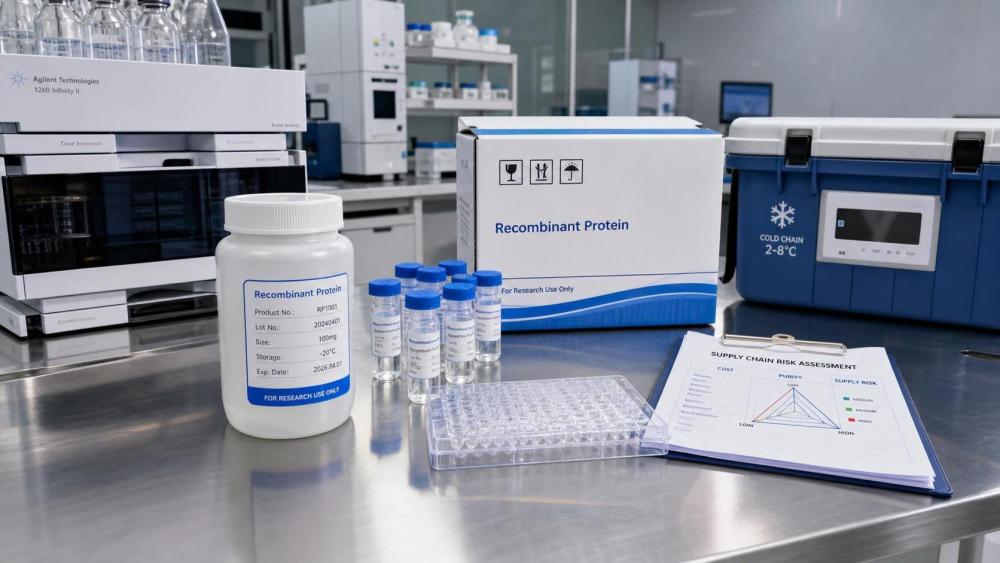
One practical note: if a quote looks unusually attractive, check whether the supplier is selling “protein content” rather than purified target protein. That distinction quietly drives major price gaps.
Cost means total usable cost, not landed price alone
Procurement teams under cost pressure sometimes accept the cheapest bulk offer and only later discover that the usage level has to be doubled to get the same effect. At that point, the apparent savings are gone.
For recombinant protein ingredients bulk, the more useful comparison is cost-in-use. Build your comparison around these questions:
- What is the effective dose in your formula, confirmed by trial work rather than brochure claims?
- How much yield loss occurs during handling, hydration, mixing, or thermal exposure?
- Does the ingredient require cold chain, special packaging, or shorter inventory turns?
- Will QA add extra incoming tests because supplier data is incomplete?
Sometimes a higher unit price buys a cleaner process: fewer deviations, faster release, lower formulation adjustment, and less write-off risk. Buyers who work closely with technical teams usually spot this earlier than buyers who negotiate in isolation.
Do not skip the expression system review
This point gets missed more often than it should. The host system, such as E. coli, yeast, fungal, or mammalian expression, can influence folding, glycosylation pattern, impurity profile, and regulatory acceptance depending on end use. It also affects cost structure and scale reliability.
A buyer does not need to act like a process scientist, but you do need enough clarity to ask the right follow-up questions. If the supplier cannot explain the expression platform, purification route, and major quality controls in clear commercial language, that is already a signal.
Also check whether the marketed claim depends on the protein’s native-like structure or biological activity. If yes, then simple identity confirmation is not enough. You need evidence that the active form survives production and shipping. The specific assay needed will depend on the ingredient and application, so keep this marked as product-specific review rather than forcing one standard across all proteins.
Documentation is part of the product
For procurement, missing paperwork is not an administrative annoyance. It is a supply risk. In practice, materials with weak documentation are the ones that get stuck in qualification, trigger extra audit rounds, or become impossible to defend when customers ask for traceability.
Depending on the market and application, you may need to review Certificate of Analysis, Safety Data Sheet, specification sheet, allergen statement, residual solvent declaration where relevant, non-animal origin statement, GMO-related declaration, TSE/BSE statement where applicable, and manufacturing site details. Regulatory expectations differ sharply by use case and geography, so any claim tied to FDA, GRAS, EU cosmetic notification, or similar frameworks should be checked against the real regulatory route for that exact ingredient and finished product. If a supplier makes broad compliance claims without product-level support, mark it as 【待核实】.
Experienced buyers usually ask for a sample document pack before sample material. It saves time.
Test supply resilience before you need it
A recombinant protein supply chain can look stable at pilot scale and become fragile at commercial scale. Fermentation capacity, purification bottlenecks, filter media availability, single-site manufacturing, and cold-storage logistics all matter. None of these show up clearly in a price sheet.
What I would want to know before committing:
- Is commercial production run routinely, or are you effectively funding scale-up?
- Does the supplier rely on one manufacturing site or one critical upstream partner?
- What is the normal lead time, and what happens during peak demand?
- Can they reserve capacity under forecast, or only sell spot volumes?
- How often have specs, process, or packaging changed in the past 12 to 24 months? 【待核实 with supplier records】
A supplier that is slightly more expensive but can commit to forecast accuracy, change notification, and backup planning is often the lower-risk buy, especially for launch products or premium SKUs where out-of-stock costs more than ingredient inflation.
Samples should be tested under process reality
This sounds obvious, but many teams still test samples only in simplified bench conditions. Then the first production batch behaves differently because of shear, pH range, hold time, salt load, preservative system, or heating cycle.
When evaluating recombinant protein ingredients bulk, ask R&D or applications teams to test what procurement actually plans to buy: same grade, same concentration, same format, ideally from a representative lot. If the commercial offer includes a different stabilizer package from the sample, restart the comparison. Do not treat those as equivalent without evidence.
Watch for quiet failure modes: haze development, odor shift, viscosity drift, loss of activity over time, adsorption to packaging, or incompatibility with preservatives and surfactants. These issues often matter more than the original assay number.
Watch the commercial terms that usually get buried
The technical review may pass, but the contract can still create avoidable exposure. Buyers should pay close attention to:
- Spec deviation handling and replacement timelines.
- Change control notification periods for process, site, or raw material changes.
- Incoterms, especially for temperature-sensitive shipments.
- Claims support: what marketing or technical statements can be backed by supplier data.
- Liability language if the ingredient is later found unsuitable for the declared end use.
This is where procurement can protect the business before problems happen. Once a premium product launch is delayed by an undocumented change, the discount on the ingredient will feel irrelevant.
A practical buying decision is usually a three-part score
If the shortlist is down to two or three suppliers, I would score them on three things only: technical fit, usable economics, and continuity risk. Everything else feeds into one of those. A protein ingredient that is technically excellent but impossible to source reliably is not commercial-grade for most buyers. A cheap material with weak document control is not low-cost once QA and regulatory friction are counted honestly.
The cleanest purchasing decisions usually come from cross-checking procurement, QA, regulatory, and formulation views before final approval. Not because committees are elegant. Because recombinant proteins fail in cross-functional ways.
If you need one working rule, use this: buy the lowest-risk ingredient that still makes commercial sense at your real dosage and real lead time. For recombinant protein ingredients bulk, that is usually the decision that holds up after the spreadsheet is closed.
Related News
- How to interpret active matter on a surfactant specification sheetOct 14, 2026Prof. Elian Thorne
- What Quality Checks Should You Run on Fragrance Ingredient Suppliers?Oct 14, 2026Prof. Elian Thorne
- How to assess a flavor chemistry manufacturer's batch consistencyOct 13, 2026Prof. Elian Thorne
- What drives fragrance ingredients price changes in bulk orders?Oct 12, 2026Prof. Elian Thorne
Related News
- 00
0000-00
Can biomimetic peptides in cosmetics reduce the look of wrinkles? - 00
0000-00
How to assess a bio-based thickener manufacturer's batch consistency - 00
0000-00
Verifying halal status of hydrocolloid ingredients in the Middle East - 00
0000-00
How to interpret active matter on a surfactant specification sheet - 00
0000-00
How Do You Test Hydrocolloid Viscosity After Changing a Thickener?
Prof. Elian Thorne
Weekly Insights
Stay ahead with our curated technology reports delivered every Monday.