





Why Compliance, MOQ, and Lead Time Tell You More Than a Price List
A consumer ingredient supplier is rarely evaluated on one dimension in real procurement work. A quotation may look attractive, a sample may pass bench testing, and the sales team may sound responsive. None of that is enough if the supplier cannot support the regulatory burden of your target market, cannot produce at a commercial scale that matches your demand profile, or cannot ship within a lead time your business can actually absorb.
This is especially true in ingredient categories where chemistry, labeling, and safety expectations are tightly connected to brand risk: preservatives for food, thickeners for texture systems, fragrance compounds, cosmetic actives, and surfactants for personal or home care. In these sectors, supplier selection is not just vendor onboarding. It is an upstream quality and compliance decision that will show up later in formulation stability, documentation reviews, customs clearance, plant scheduling, and sometimes in product claims.
Many buyers still begin with unit price and only later ask for technical files, declaration letters, or supply planning assumptions. That sequence often creates avoidable delays. A more reliable approach is to treat compliance, MOQ, and lead time as the first screening layer. These three factors do not answer every question, but they reveal whether a supplier is built for transactional trading or for sustained supply into regulated consumer product channels.
Compliance Is Not Just About Having Documents
When buyers ask whether a supplier is “compliant,” they often mean, “Can this material legally and practically enter my intended formulation and market?” That is broader than receiving a generic COA or a specification sheet. A capable consumer ingredient supplier should be able to provide documentation that matches the use case, the geography, and the product category.
For food ingredients, the compliance discussion may involve identity standards, purity criteria, allergen status, residual solvent considerations, GMO status, or statements relevant to FDA or EU food frameworks depending on the intended market. For cosmetic ingredients, the questions shift toward INCI identity, impurity profiles, restricted substance screening, and whether the supporting dossier is sufficient for downstream regulatory notification work such as CPNP-related preparation in Europe. For fragrances and household ingredients, SDS quality, transport classification, IFRA relevance where applicable, and declaration discipline often become immediate concerns.
The important distinction is this: documents are not evidence of competence unless they are current, product-specific, and internally consistent. A supplier that sends five different versions of the same technical data sheet over two weeks is telling you something. So is a supplier that cannot clearly explain why one batch declaration differs from another, or why the specification range is broader than what your formulation tolerance allows.
Buyers should pay attention to how the supplier handles these practical compliance questions:
- Can they provide a complete and recent documentation pack without repeated follow-up?
- Do product names, CAS references, INCI names, and specification sheets align across files?
- Can they explain market-specific limitations instead of giving blanket global claims?
- Do they understand how their ingredient will be used in food, beauty, or cleaning applications rather than only at the chemistry level?
That last point matters more than many sourcing teams expect. An antioxidant that performs well in theory may still fail the commercial test if the supplier cannot clarify thermal stability under a baking process, interactions with metal ions, or packaging sensitivities. A peptide supplier may have a premium story, yet still be a weak partner if it cannot discuss storage, assay drift, or formulation constraints with water-based systems. Compliance, in practice, is the ability to support a compliant end product, not merely the existence of paperwork.
MOQ Is a Supply Model Signal, Not Just a Negotiation Point
MOQ is often treated as a pricing irritation. In reality, it is one of the clearest indicators of whether a supplier’s operating model fits your business. A low MOQ can be useful for pilot launches, regional testing, or niche formulations, but it can also mean the supplier is acting mainly as a trader with limited production control. A high MOQ is not automatically a problem either. It may reflect reactor size, blending economics, cleaning validation cycles, or import consolidation logic.
The mistake is to compare MOQ figures without context. Ten kilograms of a high-value cosmetic active and ten metric tons of a food preservative do not belong in the same decision frame. Nor does it help to force a supplier into a nominal MOQ concession if the operational reality behind it remains unchanged. A supplier may accept a smaller first order yet still schedule your production only when enough similar orders accumulate, which pushes the real delivery window far beyond the promise.
A more useful MOQ conversation asks three things at once: what is the minimum orderable quantity, what is the minimum economical production quantity, and what inventory model supports replenishment after launch? Buyers who only ask the first question often miss the actual risk.
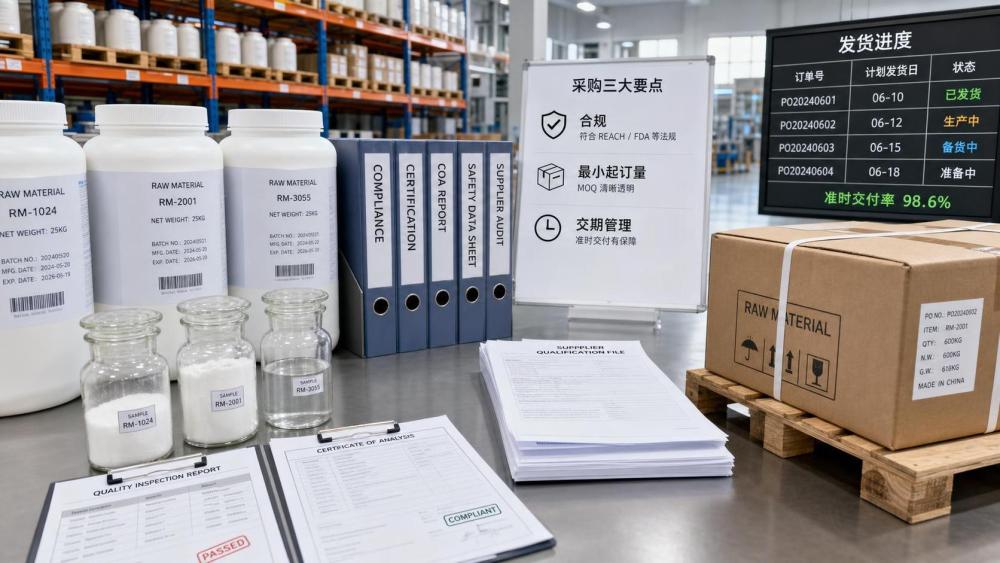
This is where category knowledge matters. Natural pigments, essential oils, fermentation-derived actives, and specialty surfactants can all have very different batch structures and shelf-life constraints. If the supplier offers a low MOQ but the product has limited shelf life, your landed inventory strategy may still become inefficient. If the MOQ is high but the material is stable and widely consumed across several SKUs, the number may be commercially workable. Procurement should evaluate MOQ against forecast volatility, warehouse conditions, formulation approval timelines, and the cost of carrying stock that cannot be redeployed.
Lead Time Should Be Read as a Reliability Pattern
Lead time is usually quoted as a number of days or weeks, but buyers should treat it as a pattern rather than a fixed metric. A stated four-week lead time can mean very different things depending on whether raw materials are stocked, whether the product is made to order, whether export documentation is prepared in-house, and whether the route depends on consolidation with hazardous or temperature-sensitive cargo.
This is particularly relevant for global ingredient flows. Food antioxidants may have steady industrial production but still face transit bottlenecks. Natural extracts may depend on harvest cycles. Fragrance ingredients can involve multi-step synthesis or blending queues. High-end actives may require tighter release testing before dispatch. If a supplier quotes an attractive lead time without explaining what portion is production, QA release, documentation, and freight, the figure is hard to trust.
A dependable consumer ingredient supplier should be able to discuss lead time in components. Not every supplier will share full internal planning details, but serious ones can usually tell you whether the material is stocked, how often it is produced, what causes exceptions, and how they handle forecast-based reservations. That level of transparency is often more valuable than a short headline number.
There is also a procurement trap here: buyers sometimes compare two suppliers only on average lead time. Variability matters more. A supplier with a six-week standard lead time and narrow deviation may be easier to plan around than one that promises three weeks and regularly slips to eight. Production teams, regulatory submission schedules, and launch calendars absorb predictable delay better than erratic delay.
How These Three Factors Interact
Compliance, MOQ, and lead time are often reviewed in separate internal workflows. That is understandable, but it can hide the real risk profile. A supplier may pass a documentation review and still be the wrong choice because its MOQ forces excess inventory on a short-shelf-life ingredient. Another may offer good MOQ flexibility but become unworkable because each order triggers long document preparation and export release cycles. Yet another may ship quickly but lack the regulatory discipline needed for audits, reformulations, or claim substantiation.
In practice, these factors should be read together. If the ingredient is strategic, highly regulated, expensive, or technically sensitive, the most useful question is not “Which supplier is cheapest?” but “Which supplier creates the fewest downstream surprises?” For procurement, surprises usually come from four places: non-aligned documents, unrealistic supply promises, MOQ structures detached from demand reality, and poor communication when conditions change.
This is where cross-functional input sharpens the decision. R&D may detect whether a broad specification range is formulation-safe. Regulatory teams can confirm whether declarations are sufficient for target markets. Supply chain can test whether lead-time assumptions fit planning cycles. Procurement then has a stronger basis to weigh price against execution risk.
Common Misreadings During Supplier Evaluation
One common mistake is assuming that a fast sample process predicts commercial performance. It often does not. Samples are easy to prioritize. Repeat supply with stable documentation and commercial batch consistency is harder.
Another is treating certifications or declarations as interchangeable across industries. A document package that is acceptable for one region or one product category may not answer the needs of another. Buyers should avoid relying on generic statements where market-specific detail is necessary.
A third misreading is to assume MOQ flexibility means a supplier is customer-centric. Sometimes it does. Sometimes it means the supplier is brokering from variable sources, which can create consistency issues later. The evaluation needs to go beyond commercial friendliness and ask how supply is actually controlled.
And there is a final one that appears often in global sourcing: taking quoted lead time at face value without checking release, labeling, document legalization where required, or freight mode assumptions. Those steps are mundane until they delay a launch.
A Practical Decision Frame
If you are comparing shortlisted suppliers, the most practical approach is to score them less on broad claims and more on proof of execution. Ask for the document set early. Test whether answers remain consistent across sales, technical, and quality contacts. Clarify whether MOQ reflects manufacturing constraints or just commercial policy. Break lead time into production, quality release, and logistics. Then look for the pattern.
A strong supplier is not always the one with the lowest price, lowest MOQ, or fastest nominal shipment. It is the one whose compliance posture matches your target market, whose order economics fit your launch profile, and whose lead-time commitments are realistic enough to plan against. In food, fragrance, cosmetic, and household ingredient sourcing, that combination is what turns a promising material into a dependable part of the business rather than a recurring exception case.
For procurement teams, that is usually the difference between buying an ingredient and securing a supply partner.
Related News
- How to interpret active matter on a surfactant specification sheetOct 14, 2026Prof. Elian Thorne
- What Quality Checks Should You Run on Fragrance Ingredient Suppliers?Oct 14, 2026Prof. Elian Thorne
- How to assess a flavor chemistry manufacturer's batch consistencyOct 13, 2026Prof. Elian Thorne
- What drives fragrance ingredients price changes in bulk orders?Oct 12, 2026Prof. Elian Thorne
Related News
- 00
0000-00
Can biomimetic peptides in cosmetics reduce the look of wrinkles? - 00
0000-00
How to assess a bio-based thickener manufacturer's batch consistency - 00
0000-00
Verifying halal status of hydrocolloid ingredients in the Middle East - 00
0000-00
How to interpret active matter on a surfactant specification sheet - 00
0000-00
How Do You Test Hydrocolloid Viscosity After Changing a Thickener?
Prof. Elian Thorne
Weekly Insights
Stay ahead with our curated technology reports delivered every Monday.