





How to Evaluate a Cosmetic Active Ingredients Manufacturer
Choosing the right cosmetic active ingredients manufacturer is a high-stakes decision for procurement and evaluation teams.
Beyond pricing, buyers must assess regulatory readiness, formulation stability, efficacy evidence, supply consistency, and innovation depth.
This guide explains how to evaluate a cosmetic active ingredients manufacturer with fewer blind spots and stronger decision confidence.
Start With Risk, Not With Price
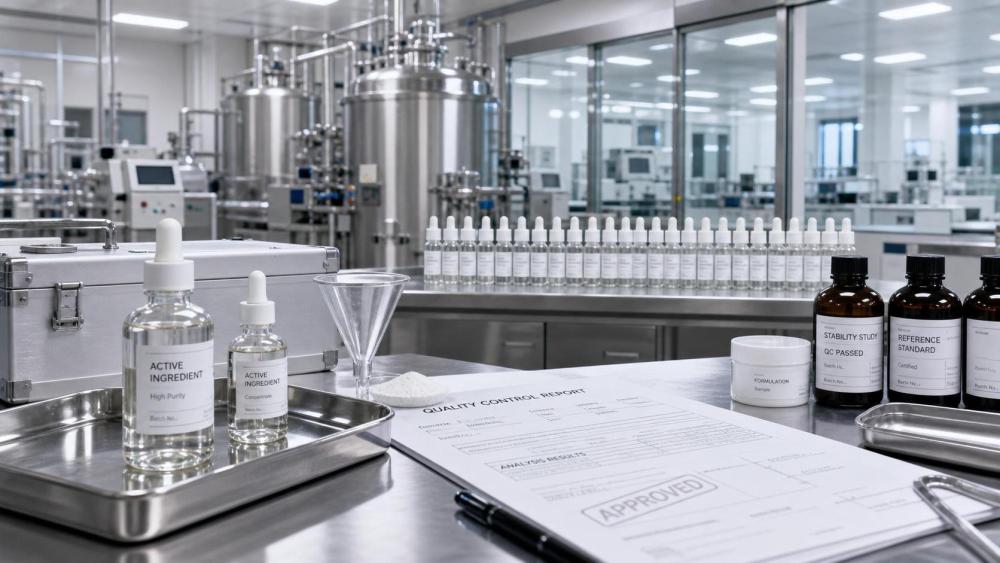
In real sourcing work, price is rarely the main problem.
The bigger issue is whether a cosmetic active ingredients manufacturer can protect product quality, compliance, and launch timing.
A low-cost supplier can become expensive fast.
Delays, failed stability tests, poor documentation, or inconsistent potency create hidden costs that are much harder to recover.
That is why supplier evaluation should begin with risk mapping.
Ask what could disrupt claims, safety, market access, or repeat purchasing.
A strong cosmetic active ingredients manufacturer helps reduce those risks before scale-up starts.
Core Questions at the Screening Stage
- Does the manufacturer provide complete technical and regulatory documents?
- Can it prove active concentration and batch-to-batch consistency?
- Is there evidence supporting efficacy, safety, and formulation compatibility?
- Can the supplier support your target regions and claim strategy?
- Is production stable enough for long-term commercial planning?
Check Regulatory Readiness Early
A cosmetic active ingredients manufacturer should not treat compliance as a last-minute file transfer.
Regulatory readiness must be built into raw material development, testing, labeling, and export support.
This matters even more for anti-aging, brightening, barrier repair, and microbiome-related actives.
These categories often face tougher claim scrutiny.
A reliable cosmetic active ingredients manufacturer should offer structured documentation, not scattered PDFs.
Documents Worth Reviewing
- INCI details, composition profile, and origin statement
- Specification sheet and certificate of analysis
- Safety data sheet and allergen information
- Residual solvent, heavy metal, and microbiological reports
- Claims support summaries and test methods
- Region-specific compliance statements for target markets
When files are incomplete or vague, that is usually a warning sign.
It may indicate weak quality systems or limited export experience.
Verify Efficacy Evidence and Scientific Depth
Many suppliers promise visible results.
Fewer can explain how the active works, under what conditions it performs, and what level actually delivers benefit.
That difference matters when evaluating a cosmetic active ingredients manufacturer for premium or science-led products.
Look past marketing language and ask for technical substance.
What Strong Efficacy Support Looks Like
- Clear mechanism of action linked to known skin biology
- In vitro, ex vivo, or clinical testing with defined endpoints
- Realistic recommended dosage range
- Evidence on pH tolerance, heat sensitivity, and solvent compatibility
- Comparison with benchmark actives or older generations
Recent market changes make this even more important.
Brands want actives that support premium claims without increasing formulation failure risk.
A capable cosmetic active ingredients manufacturer should understand skin delivery, degradation pathways, and realistic performance limits.
That is especially relevant for peptides, fermented actives, botanical isolates, and encapsulated ingredients.
Assess Quality Systems and Manufacturing Control
This is where many shortlist decisions change.
An impressive product story means little if the cosmetic active ingredients manufacturer cannot reproduce it at commercial scale.
Consistency is not a soft metric.
It directly affects claim integrity, formula performance, and complaint rates.
Areas to Review During Qualification
- GMP alignment and internal quality management procedures
- Raw material traceability and supplier approval controls
- Critical process parameters and contamination prevention
- Change control, deviation handling, and CAPA records
- Retention samples and batch history availability
- Shelf life data under realistic storage conditions
In practical terms, ask how the manufacturer controls active content variation.
Ask what happens when a batch falls near the lower specification limit.
A mature cosmetic active ingredients manufacturer answers with process logic, not generic reassurance.
Look at Formulation Fit, Not Just Ingredient Purity
High purity is valuable, but it is not the full story.
The best cosmetic active ingredients manufacturer also understands how the active behaves inside real formulas.
That includes emulsion systems, surfactants, preservatives, fragrance load, and packaging interaction.
This is often where sourcing risk becomes visible.
An active can look excellent on paper and still fail in use.
Ask for Application Support on These Points
- Recommended processing temperature and phase addition point
- pH window for stability and efficacy retention
- Compatibility with acids, alcohols, electrolytes, and common emulsifiers
- Discoloration, odor shift, or precipitation risk
- Packaging sensitivity to light, oxygen, or metal contact
More advanced suppliers also share prototype formulas and troubleshooting guidance.
That support can shorten development time and reduce reformulation costs.
Review Supply Stability and Commercial Reliability
A cosmetic active ingredients manufacturer may pass technical review and still be a weak commercial fit.
Supply continuity matters even more when the active supports hero claims or premium positioning.
Any interruption can affect both inventory and brand trust.
Commercial Factors to Compare
This also means checking whether single-site dependence creates concentration risk.
For strategic ingredients, dual-source planning is often worth discussing early.
Measure Innovation Value With Business Relevance
Innovation should be useful, not decorative.
A good cosmetic active ingredients manufacturer does more than launch trendy molecules with flashy names.
It builds ingredients that solve commercial and formulation problems.
Examples include better stability, lower use level, broader claim support, or easier preservation compatibility.
That is where real supplier value becomes visible.
Useful Signals of Innovation Strength
- Published technical papers or conference participation
- Pipeline visibility for next-generation actives
- Strong collaboration between R&D, application, and regulatory teams
- Ability to customize formats, carriers, or concentration ranges
- Clear understanding of clean beauty and premium anti-aging demand
For companies tracking global ingredient intelligence, this is where deeper market reading helps.
Specialized insight from platforms such as FFAI can make supplier comparison more grounded and less reactive.
Build a Practical Evaluation Framework
A structured scorecard keeps decisions consistent across teams.
It also makes it easier to defend supplier choices internally.
When evaluating a cosmetic active ingredients manufacturer, combine technical and commercial factors in one framework.
- Define product goals, claim priorities, and target markets.
- Screen documentation and eliminate weak compliance candidates.
- Review efficacy evidence and formulation compatibility.
- Assess manufacturing control, quality systems, and traceability.
- Compare lead times, pricing structure, and supply resilience.
- Run pilot validation before final supplier approval.
This process is simple, but it works.
It turns a cosmetic active ingredients manufacturer review into a decision model tied to business outcomes.
Final Decision: Choose a Partner, Not Just a Supplier
The best cosmetic active ingredients manufacturer is rarely the one with the lowest quote.
It is the one that combines scientific credibility, formulation support, compliance discipline, and dependable supply.
That combination protects launch plans and strengthens premium product positioning.
In competitive beauty markets, ingredient decisions shape both product performance and brand trust.
A disciplined evaluation process helps identify manufacturers that can support both today’s requirements and tomorrow’s growth.
Before making the final selection, validate claims, confirm technical fit, and pressure-test supply assumptions. That last review often makes the smartest decision obvious.
Related News
- How rheological thickeners for shampoo affect suspension stabilityOct 03, 2026Prof. Elian Thorne
- When does OEM ingredient sourcing support make custom formulations viable?Sep 29, 2026Prof. Elian Thorne
- What to check in a transdermal penetration supplier for skincareSep 26, 2026Prof. Elian Thorne
- How farnesene market pricing affects renewable ingredient sourcingSep 26, 2026Prof. Elian Thorne
Related News
- 00
0000-00
How to assess color stability from a natural food colors manufacturer - 00
0000-00
When does amino acid surfactant powder improve cleanser mildness? - 00
0000-00
How to verify a cosmetic nanotechnology supplier's safety documentation - 00
0000-00
How rheological thickeners for shampoo affect suspension stability - 00
0000-00
How to assess recombinant collagen ingredients for cream stability
Prof. Elian Thorne
Weekly Insights
Stay ahead with our curated technology reports delivered every Monday.