





Verifying supplier references for private label is often treated as a routine procurement step, yet it is one of the few moments when a buyer can test whether a supplier’s commercial presentation matches operational reality. For business evaluators, that matters far more than politeness or process compliance. A supplier may have an attractive MOQ, responsive sales staff, and acceptable samples, while still carrying hidden weaknesses in batch consistency, export documentation, formula protection, change control, or delivery discipline. References are where those weaknesses tend to surface—if the questions are designed well enough to expose them.
In private label, the risk is amplified because the supplier is not just shipping a commodity. They are often handling specifications, packaging coordination, labeling accuracy, regulatory files, and sometimes even claims support. In sectors linked to food ingredients, fragrances, personal care, and actives, a reference check should therefore do more than confirm that “they are a good company.” It should help the buyer judge whether the supplier can support a brand without creating avoidable regulatory, commercial, or reputational damage.
Why reference checks fail even when buyers do them
The biggest problem is not that buyers skip references. It is that they ask soft questions and accept soft answers. “Are you happy with them?” rarely produces useful decision-grade information. Most reference contacts prefer to stay diplomatic, especially if they still work with the supplier. That means the evaluator has to focus on verifiable operating signals rather than general satisfaction.
A useful reference conversation should help answer questions such as:
- Does the supplier perform consistently after the first few purchase orders?
- How do they behave when quality deviations occur?
- Do they manage documents accurately for the destination market?
- Are lead times stable, or only acceptable in low-pressure periods?
- Do they protect private formulations, packaging concepts, and customer data?
- Do they scale well when volumes grow?
These are not minor details. In private label, the supplier’s weak point becomes the brand owner’s problem. If an ingredient lot fails specification, if allergen labeling is inaccurate, if a fragrance profile drifts, or if a cosmetic active’s supporting documentation is incomplete, the downstream brand bears the commercial consequences.
Start before the call: reference quality matters more than reference quantity
A list of three glowing references supplied by the vendor should never be treated as neutral evidence. It is curated evidence. That does not make it useless, but it does mean buyers should examine who is missing from the list as carefully as who appears on it.
Stronger evaluators screen references before speaking to them. They look for alignment in four areas:
- Business model similarity: a distributor reference may tell you little if you are outsourcing a full private label program.
- Product complexity: a reference for simple stock-keeping units is not equivalent to one involving regulated claims, sensitive actives, or multi-component packaging.
- Geographic relevance: domestic performance does not always predict export performance.
- Scale relevance: a supplier that works well for small pilot runs may struggle once order frequency and SKU count increase.
Ask the supplier for references that match your use case as closely as confidentiality allows. If they cannot provide any comparable reference, that does not automatically disqualify them, but it changes the risk profile. In that case, the buyer should strengthen other controls: trial orders, tighter specifications, staged volume ramps, and stricter quality agreement terms.
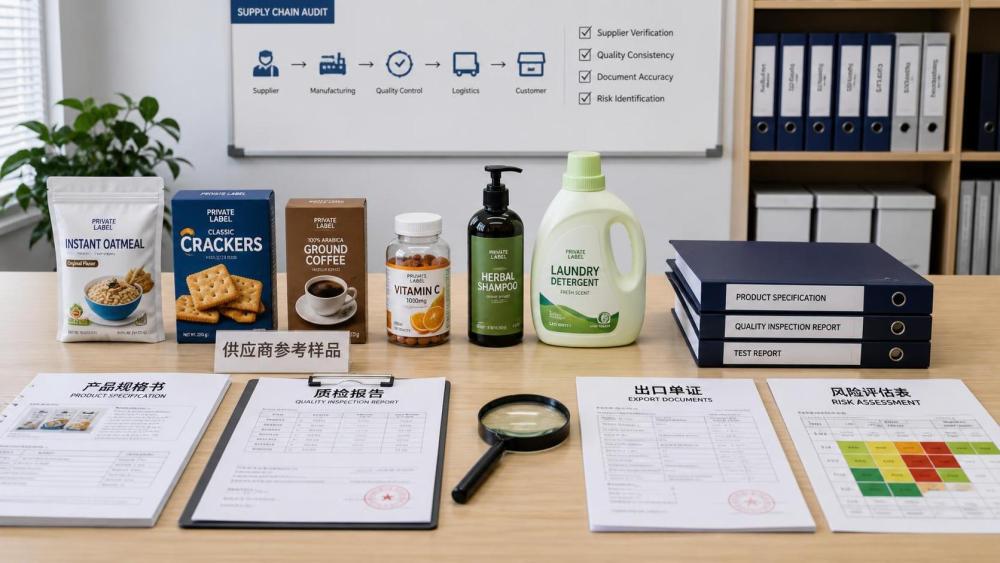
What experienced buyers ask instead of “Are they reliable?”
The most useful reference questions are specific enough that the contact must recall facts rather than offer impressions. That is how risk signals emerge.
Questions that usually produce actionable insight include:
- How long have you worked with this supplier, and what product categories do they handle for you?
- What was the original scope of cooperation, and has it expanded or narrowed over time?
- How often have shipments arrived outside the agreed lead time in the past 12 months?
- Have you experienced batch-to-batch variation? If yes, how was it detected and resolved?
- How accurate are their shipping documents, certificates, specifications, and labeling files?
- When there is a complaint, who takes ownership and how fast is containment implemented?
- Have they ever changed raw materials, processing parameters, packaging components, or subcontractors without clear prior notice?
- How do they manage confidentiality around formula details, artwork, claims, or customer-specific packaging?
- Would you trust them with a major product launch or peak-season replenishment?
These questions move the discussion from reputation to operating behavior. They also help distinguish between a supplier that is merely pleasant to work with and one that is genuinely dependable under pressure.
The warning signs are often indirect
Reference checks rarely reveal risk through dramatic accusations. More often, the warning signs are subtle. Skilled evaluators listen for hesitation, qualification, and inconsistency.
Common examples include:
- “They are good now” — suggests there were earlier control or management problems worth exploring.
- “You need to follow up closely” — often indicates weak internal project management.
- “Quality is fine for our market” — may imply the standard would not hold in stricter regulatory environments.
- “We mainly buy standard items” — not a relevant proof point for customized private label work.
- “They are very flexible” — positive on the surface, but sometimes a sign of weak change discipline.
- “They solved it in the end” — the key issue is how often “it” happens and how severe it was.
Another important signal is imbalance. If a reference praises price and communication but becomes vague on corrective action, documentation accuracy, or consistency, those gaps should not be ignored. In regulated or specification-driven categories, the hidden cost of inconsistency usually outweighs headline savings.
Private label risk is different from ordinary supply risk
Many buyers apply the same reference logic to private label that they would use for generic sourcing. That is a mistake. Private label introduces a different exposure pattern because the supplier may influence market-facing elements that customers attribute directly to your brand.
In ingredient-adjacent sectors such as food systems, fragrance compounds, cosmetic actives, and functional additives, the most material risks often include:
- Specification drift: the supplied material remains “acceptable” internally but no longer behaves the same way in the finished formula.
- Claims mismatch: marketing or technical claims are not adequately supported for the target market.
- Regulatory incompleteness: documents required by importers, customers, or authorities are delayed, inconsistent, or outdated.
- Packaging execution errors: artwork versions, labeling language, coding, or traceability marks are mishandled.
- Confidentiality leakage: customer-specific concepts, formulations, or positioning ideas migrate to other accounts.
That is why reference questions should not stop at product quality. They need to test the supplier’s governance habits: document control, version control, escalation process, and respect for customer-owned information.
Cross-check references against objective evidence
No reference should stand alone. It should be triangulated with records the supplier can provide and with signals available from your own qualification process.
Useful cross-check points include:
- audit reports or audit responses;
- sample-to-production consistency;
- certificate validity and issuing bodies;
- specification version history;
- complaint-handling procedure;
- incoterm realism and shipping track record;
- insurance coverage where relevant;
- change notification practices;
- factory versus trader role clarity.
If references describe strong quality discipline but the supplier cannot show controlled document versions, complaint CAPA records, or a clear traceability structure, the buyer should assume the process maturity is lower than claimed.
This is especially important in cross-border procurement, where a polished export-facing team may sit in front of a weaker production or subcontracting reality. A good reference call can surface this gap. An effective buyer then verifies whether the operational backbone actually exists.
Be careful with the “big customer” reference trap
Some suppliers showcase globally known customers as proof of capability. That can be useful, but it can also mislead. Large customers often receive preferential service levels, tighter controls, and more management attention than mid-sized private label buyers. The question is not whether the supplier can perform for a major account. It is whether they will perform for your account.
Business evaluators should therefore ask references about account prioritization indirectly:
- How responsive is the supplier during high-demand periods?
- Have agreed allocations ever been reduced unexpectedly?
- Do lead times deteriorate when raw material markets tighten?
- Are smaller or newer programs handled with the same rigor as established ones?
A supplier may be technically competent but commercially risky if capacity discipline is weak. In volatile markets, smaller private label programs are often where delays, substitutions, or silent deprioritization appear first.
When a supplier refuses or limits references
Not every refusal is a red flag. In sensitive categories, customer confidentiality is real, and some suppliers are contractually restricted from disclosing client names. The risk signal lies in how they handle the limitation.
A credible supplier that cannot share direct references should still be able to provide alternative confidence markers, such as:
- third-party audit summaries;
- redacted performance data;
- anonymous case examples with operational detail;
- evidence of long account tenure;
- documented quality systems and escalation workflows.
What should concern buyers is not the absence of named references by itself, but evasiveness, defensiveness, or a complete lack of substitute evidence. If a supplier cannot provide references and also cannot demonstrate disciplined systems, the evaluation should shift from trust-based qualification to control-based qualification—or stop altogether.
How to read reference outcomes in negotiation
Reference checks should influence commercial terms, not just supplier selection. If the references are positive but reveal manageable weak points, buyers can convert those findings into contract protections.
Examples include:
- shorter review cycles during onboarding;
- mandatory advance notice for material or process changes;
- approved-subcontractor disclosure requirements;
- clear CAPA response timelines;
- batch retention and traceability obligations;
- confidentiality clauses specific to formulation, packaging, and market concept data;
- service-level language around lead time and documentation accuracy.
This is where reference verification becomes commercially valuable. It does not simply tell you whether to proceed. It tells you how to proceed, under what safeguards, and at what pace.
A practical threshold for decision-making
For business evaluators, the goal is not to eliminate all uncertainty. It is to avoid the wrong kind of uncertainty. A supplier can still be a viable partner if they are new to your category or market, provided they show transparency, process discipline, and a willingness to operate within tighter controls. On the other hand, a supplier with attractive pricing and strong samples may still be a poor choice if references repeatedly hint at inconsistency, weak change control, or unreliable communication when problems occur.
The strongest use of supplier references for private label is therefore comparative rather than ceremonial. Buyers should not ask, “Did the supplier pass?” They should ask, “What type of risk does this supplier create, how visible is it, and can our business absorb it?”
That framing leads to better decisions. It also aligns reference checks with the real job of procurement evaluation: protecting continuity, compliance, margin, and brand credibility before a problem reaches the market.
Related News
- What drives fragrance ingredients price changes in bulk orders?Oct 12, 2026Prof. Elian Thorne
- How minimum order quantities shape private label ingredient sourcing costsOct 10, 2026Prof. Elian Thorne
- What drives personal care ingredient price volatility in sourcingOct 08, 2026Prof. Elian Thorne
- What drives micelles price differences in cosmetic formulations?Oct 07, 2026Prof. Elian Thorne
Related News
- 00
0000-00
What drives fragrance ingredients price changes in bulk orders? - 00
0000-00
How to assess a food antioxidants distributor’s traceability practices - 00
0000-00
How minimum order quantities shape private label ingredient sourcing costs - 00
0000-00
What drives personal care ingredient price volatility in sourcing - 00
0000-00
What drives micelles price differences in cosmetic formulations?
Prof. Elian Thorne
Weekly Insights
Stay ahead with our curated technology reports delivered every Monday.