





A surfactant specification sheet may list active matter as a simple percentage, but interpreting that figure correctly requires more than reading the number alone.
For technical evaluators, the reported value affects formulation dosing, supplier comparisons, and cost per unit of active surfactant. It also determines whether purchasing assumptions hold.
It is essential to distinguish active matter from total solids and confirm the analytical method, reporting basis, and acceptance limits before comparing different commercial grades.
The practical rule is straightforward: compare percentages only after confirming what each assay measures, then use the appropriate batch value when calculating formulation additions.
What does the active matter percentage actually represent?
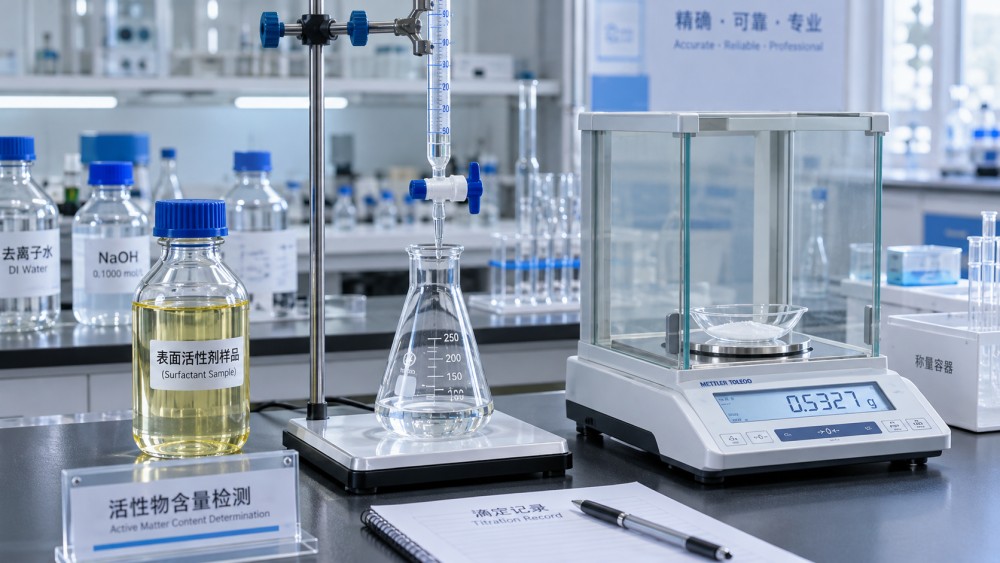
Active matter generally describes the surfactant content of a supplied material, as determined by a specified analytical method and expressed on a defined reporting basis.
A declaration of 30% active matter by mass usually indicates approximately 30 kilograms of reportable surfactant active in 100 kilograms of the supplied product.
The remaining material may include water, solvents, inorganic salts, preservatives, residual reactants, and other constituents. Its composition matters because these components also enter your formulation.
However, “reportable surfactant active” depends on the assay. A method may measure selected ionic species, calculate content from an equivalent weight, or estimate composition indirectly.
Your first task is therefore to establish the analyte: which substances count toward the percentage, which remain excluded, and how the supplier calculates the result.
For blends, establish whether the declaration represents combined surfactant content or only one component. A single percentage rarely establishes the blend’s internal composition or consistency.
Why active matter and total solids are not interchangeable
Total solids usually describes the residue remaining after a defined drying procedure. Depending on that procedure, the residue can contain surfactants and other nonvolatile substances.
Consequently, sodium chloride, sodium sulfate, nonvolatile preservatives, and residual organic material may increase measured solids without providing the intended detergency, wetting, or foaming contribution themselves.
Consider a hypothetical aqueous surfactant with 35% total solids and 30% active matter. The five percentage point difference cannot automatically be treated as additional surfactant.
Nor can that difference automatically be assigned entirely to salt. Different methods, volatility, incomplete drying, and reporting conventions can complicate a direct mass balance calculation.
For some defined nonionic grades, suppliers may estimate active content from water and other measured impurities. Such estimates require a justified composition and calculation procedure.
When only solids appear on the sheet, request a separate active matter specification or documented evidence explaining why solids reliably represent active content for that grade.
Which details must accompany the reported number?
A usable surfactant specification sheet should connect the percentage to a method, reporting basis, and acceptance criterion. Missing details create uncertainty in qualification and dosing.
Check whether the value applies to the material as supplied or to a dry basis. A dry basis result cannot directly determine an aqueous product’s addition.
Confirm whether the result is expressed as the commercial salt, a corresponding acid, or another reference substance. Different conventions can produce different percentages for related materials.
Where titration measures charge equivalents, conversion into mass percentage requires an assigned equivalent weight. That assumption becomes especially relevant for variable chain lengths and mixtures.
Also distinguish a guaranteed range from a typical value. Typical data describe expected characteristics, while specification limits define the supplier’s stated acceptance boundaries for release.
Does the analytical method fit the surfactant chemistry?
There is no universal active matter assay suitable for every surfactant. The method must match the chemical class, sample matrix, and intended measurement closely enough.
For suitable anionic surfactants, two phase titration methods such as ISO 2271 can determine anionic active matter. Applicability still depends on the material and interferences.
Cationic surfactants require an appropriate cationic assay. Amphoteric materials need particular attention because charge behavior changes with pH, affecting how an assay responds to them.
Nonionic surfactants may require composition specific analytical methods or validated indirect calculations. A water measurement alone does not establish purity when other constituents are present.
Mixed systems deserve additional scrutiny. An assay targeting one surfactant class may omit another, while interacting components can complicate extraction, endpoints, or interpretation of results.
Request the method identifier, revision, reporting convention, and known limitations. For critical substitutions, assess method comparability using representative samples before accepting apparently equivalent numerical results.
How do you calculate the correct formulation dose?
Calculate the required supplied material by dividing the target active mass by the supplied active fraction. Use percentages consistently, converting them into decimal fractions first.
Suppose a 1,000 kilogram batch requires 6% active surfactant from one ingredient. The target active mass is 60 kilograms, assuming no contribution from other ingredients.
At 30% active matter, the required addition is 200 kilograms. At 28%, it becomes approximately 214.3 kilograms, demonstrating why concentration variation affects manufacturing quantities materially.
If you add 200 kilograms of the 28% material, it contributes 56 kilograms of active surfactant. The finished batch therefore contains 5.6% from that ingredient.
When increasing the surfactant ingredient addition, adjust the remaining formula to preserve total batch mass. Also evaluate changes in salt, solvent, preservative, and water contributions.
For formulas containing several surfactants, calculate each ingredient’s active contribution separately and sum them. Matching total active content still does not guarantee equivalent finished product behavior.
How should you compare supplier prices fairly?
Price per kilogram of supplied material can be misleading when concentrations differ. Normalize comparable quotations to cost per kilogram of declared active surfactant before screening.
Assume Supplier A offers a 30% grade at $1.20 per kilogram delivered. Its normalized cost is $4.00 per kilogram of active, using the declared concentration.
Supplier B offers a 70% grade at $2.45 per kilogram delivered. Its normalized cost is $3.50 per kilogram of active, despite the higher material price.
This comparison is meaningful only when assay definitions and chemistry are sufficiently comparable. A different surfactant structure or blend can change performance at equal active loading.
Include costs associated with dilution, heating, pumping, storage, freight, and waste. More concentrated material may save transport expense while requiring additional processing capability at your site.
For an initial commercial assessment, calculate costs using both typical concentration and the guaranteed minimum. That exposes purchasing assumptions that depend on consistently favorable assay results.
How do specification limits affect batch acceptance?
A specification sheet usually states product requirements, while a certificate of analysis reports results for an identified batch. Keep these documents connected during incoming material review.
A specification of 28–32% does not establish that every delivery contains 30%. Batch adjustment requires an actual result or another qualified concentration measurement for that delivery.
If the certificate reports only “passes,” ask whether a numerical result is available. Pass status supports acceptance against limits but provides limited information for precise dosing.
Measurement uncertainty and method variability matter when results approach a boundary. Agree on sampling, rounding, retesting, and acceptance rules before a disputed shipment arrives at production.
Unexpected differences between your laboratory and the supplier may reflect sample handling, titrant standardization, method versions, or conversion factors. Investigate these before concluding the material differs.
For viscous or concentrated products, follow the supplier’s mixing and sampling guidance. Settling, phase separation, or incomplete homogenization can produce an unrepresentative sample for laboratory testing.
What can active matter tell you about performance and safety?
Active matter helps quantify an ingredient’s surfactant contribution, but it does not independently predict cleaning efficiency, foam quality, mildness, biodegradability, or compatibility with the complete formulation.
Two materials with identical active percentages may differ in chain distribution, counterions, residual salts, and secondary components. These differences can affect viscosity, solubility, and sensory properties.
In personal care development, active concentration supports dosing and exposure calculations. Product mildness and safety still require evaluation of ingredient identity, impurities, and the finished formulation.
Likewise, a higher active percentage does not automatically mean higher purity. Purity concerns the composition of the material and relevant impurities, requiring additional specifications and evidence.
Use application testing to establish whether a proposed replacement works at the selected dose. Examine relevant outcomes such as cleaning, foam, viscosity, stability, and processing behavior.
What should you request before approving a surfactant?
Resolve documentation gaps before qualification becomes a purchasing commitment. A focused request helps suppliers provide useful evidence without turning evaluation into an unfocused collection of documents.
- A current specification and representative batch certificate with numerical active matter results.
- The assay method, reporting basis, reference substance, and applicable conversion factor.
- Separate water, solids, salt, and relevant impurity information where needed.
- Sampling, storage, handling, and recommended retest guidance for the supplied grade.
- Application data supporting performance at your intended active concentration.
Prioritize clarification when a supplier substitutes solids for active matter, leaves the assay unidentified, or compares grades using inconsistent reporting conventions. These gaps prevent reliable normalization.
For supplier changes, document the accepted basis of comparison and verify representative material in your formulation. This links procurement assumptions to technical evidence and manufacturing requirements.
Make the percentage usable before making the decision
Read active matter as a measurement with conditions attached. Establish the analyte, method, reporting basis, and limits before using the percentage in formulation or supplier comparisons.
Then translate the verified value into active contribution, batch additions, and comparable cost. Review the remaining composition because it affects processing and finished product behavior too.
A well interpreted surfactant specification sheet supports three decisions: whether a batch meets requirements, how much material to add, and whether the commercial offer delivers value.