





For technical evaluators, ingredient selection for aroma chemicals is central to fragrance stability—not only in the perfume concentrate, but across manufacturing, filling, packaging, storage, and real-world use. A fragrance may smell beautifully balanced on a blotter and still fail after six months in a clear bottle, a high-surfactant body wash, or a warm shipping container.
Stability is rarely determined by one “good” or “bad” ingredient. It emerges from interactions: an aldehyde may oxidize, a citrus component may fade, a musky base note may become trapped in a cloudy emulsion, or a solvent may pull a delicate floral accord out of balance. The evaluator’s task is to identify the molecular and formulation risks early enough that the finished scent remains recognizable, compliant, and commercially viable.
Rather than selecting materials solely by odor profile or cost per kilogram, assess each aroma chemical as part of a functioning system. The most useful question is not, “Does this ingredient smell right today?” It is, “Will it still deliver the intended sensory signature in this formula, package, and market at the end of its shelf life?”
Start with the fragrance’s stability target, not the raw-material list
Aroma chemicals do not need identical stability profiles in every application. A fine fragrance in hydroalcoholic solution has different risks from a fabric softener, candle, shampoo, antiperspirant, or encapsulated laundry fragrance. Before comparing suppliers or alternatives, define the performance environment in practical terms:
- Product base: hydroalcoholic, anhydrous oil, emulsion, surfactant system, wax, powder, or water-based cleaner.
- Processing conditions: heat exposure, mixing shear, vacuum, neutralization, filling temperature, and production hold time.
- Expected shelf-life conditions: ambient storage, heat cycling, light exposure, oxygen headspace, and transport stress.
- Packaging contact: glass, aluminum, PET, HDPE, multilayer plastics, closures, liners, pumps, and dispensing systems.
- Desired sensory behavior: immediate bloom, diffusion, substantivity, dry-down clarity, malodor coverage, or scent release after use.
This framing prevents a common technical mistake: rejecting an ingredient because it is “unstable” without defining the exposure. A material that is vulnerable to alkaline hydrolysis may work well in an acidic personal-care product. A low-flash, volatile top note may be appropriate for an alcohol spray but unsuitable for a heated wax system with a long manufacturing residence time.
Read the volatility curve, not just the top–middle–base classification
Traditional fragrance language describes top, heart, and base notes. It remains useful, but it is not a complete selection tool. For stability work, evaluators should consider vapor pressure, molecular weight, polarity, boiling range, fixation behavior, and the way a material partitions between air, product base, skin, fabric, or packaging.
Highly volatile citrus, green, marine, and airy materials can create an attractive opening, yet they are often the first to weaken during storage. Their loss may make an accord feel flatter, sweeter, or disproportionately woody over time. Conversely, heavy musks, amber materials, and fixatives can preserve persistence but may suppress lift when used without enough contrast.
Build the formula around a deliberate evaporation architecture. If a bright note is business-critical, consider whether the effect can be reinforced with a more stable supporting material rather than relying on one sensitive ingredient at a high dosage. A lemon character, for example, may require a combination of natural and synthetic materials with different release rates, rather than a single citrus fraction carrying the entire opening.
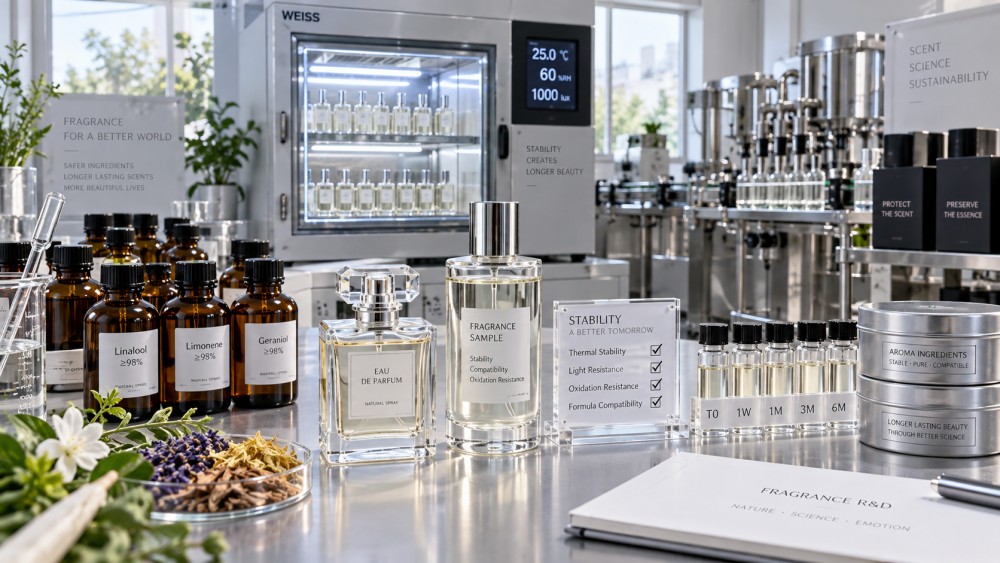
In technical review, compare the fragrance profile at several time points: immediately after dilution, after maturation, after accelerated storage, and during use on the actual substrate. The goal is not to eliminate evolution—good fragrances evolve—but to prevent unintended drift.
Oxidation risk is often the hidden cause of scent drift
Oxidation is among the most persistent threats to fragrance integrity. Materials with unsaturated bonds, reactive functional groups, or naturally variable terpene content can form oxidation products that change odor, color, and sometimes sensitization considerations. Citrus oils, certain terpenes, aldehydes, and some floral materials deserve particular attention, although risk must always be assessed ingredient by ingredient.
An oxidized formula does not always smell obviously “bad.” It may simply lose its clean brightness, gain a harsh fatty or metallic edge, or develop an unexpectedly dry, stale, or resinous dry-down. Because this drift can emerge gradually, routine evaluation only at batch release is insufficient.
When oxidation-sensitive materials are necessary, technical evaluators can reduce exposure through several coordinated decisions:
- Select grades with controlled peroxide values, freshness specifications, and clear storage guidance.
- Review whether an antioxidant is suitable for the complete fragrance system and permitted in the intended application.
- Minimize unnecessary headspace and repeated container opening during compounding.
- Use packaging that limits oxygen and light transmission where the finished product warrants it.
- Request retest dates, batch traceability, and relevant analytical documentation from suppliers.
Antioxidants can slow degradation, but they are not a substitute for thoughtful raw-material selection. A weakly protected, highly reactive material placed in a demanding product base will still create risk. The stronger approach is to combine robust ingredient choices, controlled handling, and stability testing that reflects the finished product’s actual journey.
Solubility and phase behavior decide whether the fragrance remains uniform
A clear fragrance concentrate can become hazy, separated, or uneven after addition to a consumer formula. This is especially common when nonpolar aroma materials meet water-rich systems, electrolyte-containing bases, surfactant blends, or emulsions with limited fragrance capacity.
Solubility should therefore be evaluated at the intended use level, not only in the fragrance oil. Observe the system after mixing and again after temperature cycling. A formula that appears clear immediately may later show clouding, oil rings, sediment, viscosity shifts, or an altered headspace profile as fragrance components redistribute.
Polarity matters, but simple polarity labels are not enough. The emulsifier system, surfactant type, salt concentration, pH, alcohol level, polymeric thickener, and presence of oils or silicones can all change the accommodation of aroma chemicals. In shampoo and body wash, for example, a fragrance may remain physically dispersed while still delivering an altered scent because some components preferentially associate with micelles.
Where a solubilizer, carrier, or encapsulation route is under consideration, assess sensory consequences alongside physical stability. A technically clear system may release fragrance too slowly, mute a top note, or leave a different dry-down on skin or fabric. The best choice is the one that preserves both appearance and the intended olfactory sequence.
Check chemical compatibility with the whole formula
Fragrance ingredients can encounter acids, alkalis, oxidants, reducing agents, preservatives, UV filters, active ingredients, and metal ions. These interactions may change odor character even when no visible instability is present.
Esters may be sensitive in strongly alkaline conditions. Certain aldehydic materials can react under specific conditions or become less stable in demanding systems. Some natural extracts introduce color bodies or trace constituents that are difficult to control across batches. High-water formulations may expose vulnerable materials to hydrolytic pathways that are negligible in anhydrous perfumes.
For active beauty products, the compatibility review becomes more important. A fragrance should not compromise the stability of delicate actives, and the active system should not destabilize the fragrance. Peptides, botanical extracts, acids, retinoid-adjacent systems, and antioxidant packages each create distinct formulation contexts. Technical teams should review pH range, processing temperature, oxygen exposure, and ionic environment before finalizing the scent direction.
Do not overlook trace metals. Even low levels from water, pigments, equipment, or botanical ingredients can accelerate oxidation in sensitive systems. When unexplained scent discoloration or degradation appears, raw-material purity, water quality, and contact surfaces deserve investigation alongside the fragrance formula itself.
Natural materials require a different control strategy
Natural essential oils and extracts can add authenticity, texture, and a valuable sensory irregularity that many brands seek. Yet their composition is inherently more variable than that of a defined single aroma chemical. Seasonal origin, extraction method, storage, and agricultural conditions may influence color, odor intensity, and reactive constituent levels.
This does not make natural materials unsuitable for stable fragrance development. It means they should be qualified with the right controls. Establish acceptable sensory and analytical ranges, understand the supplier’s standardization practices, and identify the constituents most relevant to oxidation, discoloration, or compliance. For signature accords, a stable synthetic support structure can help preserve the intended identity when a natural material shifts within its permitted range.
A practical distinction is useful: naturality and stability are separate selection criteria. A natural ingredient may be appropriate because it supports a clean-label or botanical story; its stability requirements should still be evaluated with the same discipline applied to any other material.
Regulatory status belongs at the beginning of ingredient selection for aroma chemicals
Compliance review should not be saved for the final approval stage. An aroma chemical that performs well technically but creates concentration limits, labeling complexity, regional restrictions, or unresolved toxicological documentation can force costly reformulation later.
For each target market and product category, evaluators should confirm the material’s applicable fragrance-use guidance, allergen disclosure implications, safety documentation, and local regulatory status. Requirements can differ between fine fragrance, rinse-off personal care, leave-on cosmetics, household products, food-contact-adjacent applications, and air-care formats.
Supplier documentation should be sufficiently specific to support decision-making: current safety data, certificate of analysis, allergen information where applicable, origin and composition statements for complex natural materials, and change-notification procedures. For global launches, compare the strictest relevant market requirements before the fragrance becomes deeply embedded in product development.
At FFAI, this intersection of molecular behavior and compliance intelligence is especially relevant. Fragrance formulation is not only a sensory exercise; it is a decision chain connecting raw-material chemistry, consumer exposure, packaging, supply continuity, and regional market access.
A useful evaluation matrix: score risk, then test the uncertain points
Technical teams often receive more candidate materials than they can fully test. A simple risk matrix can narrow the field without oversimplifying the decision. For every proposed aroma chemical, review its odor contribution, use level, volatility, oxidation sensitivity, solubility, pH tolerance, heat exposure, packaging interaction potential, regulatory status, supplier reliability, and replacement availability.
Materials with a high sensory contribution and a high technical risk should be treated as priority test items. They may still earn a place in the formula, but they should not be approved on the basis of a single fresh sample. Materials with low odor impact but high risk may be easier to replace early.
Accelerated stability testing should challenge the finished product rather than the fragrance concentrate alone. Typical programs may include elevated-temperature storage, light exposure where relevant, freeze–thaw cycling for aqueous products, compatibility checks in final packaging, and comparative sensory assessment against retained controls. Instrumental analysis can help identify chemical change, while trained sensory review establishes whether that change matters to the consumer experience.
Cost-performance should include reformulation risk
The lowest-priced ingredient is not necessarily the most economical choice. A less stable top note may require a higher dosage, additional antioxidants, more protective packaging, or a late-stage reformulation when the product fails shelf-life assessment. A higher-cost but more robust alternative may produce a lower total formulation risk.
Evaluate cost in terms of delivered sensory value at the intended shelf-life point. Ask how much material is required to maintain the desired effect after processing and storage, whether the supply chain is resilient, and whether the fragrance can be adjusted without losing its signature if availability changes. This approach is particularly important for large-volume FMCG programs, where small formulation changes can have wide operational consequences.
Selection is complete only when the scent survives reality
Better fragrance stability comes from treating aroma chemicals as active participants in a complex formulation environment. Volatility, oxidation resistance, solubility, compatibility, compliance, packaging, and commercial practicality all shape the final result.
For technical evaluators, the most reliable workflow combines early risk mapping with targeted testing: define the product environment, identify the materials most likely to drift, test in the actual base and package, and make final choices using sensory and analytical evidence together. With this discipline, ingredient selection for aroma chemicals becomes less about avoiding every vulnerable molecule and more about building a fragrance system that remains coherent, safe, and recognizable from first fill to final use.
Related News
- How to interpret active matter on a surfactant specification sheetOct 14, 2026Prof. Elian Thorne
- What Quality Checks Should You Run on Fragrance Ingredient Suppliers?Oct 14, 2026Prof. Elian Thorne
- How to assess a flavor chemistry manufacturer's batch consistencyOct 13, 2026Prof. Elian Thorne
- What drives fragrance ingredients price changes in bulk orders?Oct 12, 2026Prof. Elian Thorne
Related News
- 00
0000-00
Verifying halal status of hydrocolloid ingredients in the Middle East - 00
0000-00
How to interpret active matter on a surfactant specification sheet - 00
0000-00
What Quality Checks Should You Run on Fragrance Ingredient Suppliers? - 00
0000-00
How to assess a flavor chemistry manufacturer's batch consistency - 00
0000-00
What drives fragrance ingredients price changes in bulk orders?
Prof. Elian Thorne
Weekly Insights
Stay ahead with our curated technology reports delivered every Monday.