





A purity grade on an ingredient specification sheet is only as useful as the evidence behind it. For quality control and safety professionals, verifying that claim means checking the assay method, acceptance limits, impurity profile, and applicable standards—not just the percentage on the label. This guide explains how to use ingredient specification resources, purity grades, certificates of analysis, and supplier documentation to assess whether an ingredient meets your product’s quality and safety requirements.
Start with the material, not the grade
“Food grade,” “cosmetic grade,” and “high purity” are useful descriptions, but they do not tell you enough to release a shipment. Their meaning depends on the ingredient, the intended use, the market, and the requirements behind the supplier’s claim. A food-grade preservative may be appropriate for one application and unsuitable for another if its permitted use or residual impurity profile differs.
Before interpreting the assay, establish exactly what was purchased. Check the chemical or botanical name, relevant identifier such as a CAS number, physical form, concentration, carrier, and any stated source or manufacturing route. For mixtures, identify whether the percentage refers to the active ingredient, a group of related compounds, or the whole preparation.
This is particularly important for cosmetic active solutions. A supplier may state a high purity for a peptide raw material while delivering it as a dilute solution in water and a preservation system. Both descriptions can be accurate, but they answer different questions. The formulation team needs the concentration in the supplied material; the safety team also needs to know what else is present.
Read the assay together with its basis and method
The assay measures a defined property using a defined procedure. It is not automatically a complete accounting of every substance in the container. When comparing two specifications, check whether results are reported on an “as-is,” dried, anhydrous, or solvent-free basis. A dry-basis result removes the specified moisture contribution from the calculation; it does not mean the delivered material contains no water.
Consider a material reported as 98% assay on a dry basis with 5% water. If that water measurement is suitable for the calculation and no other correction applies, the approximate as-is assay would be 98% × 95%, or 93.1%. This is an illustration, not a substitute for the supplier’s prescribed calculation. Different compendial methods can require additional corrections or use different definitions of water and loss on drying.
The analytical method matters just as much as the basis. Chromatographic area percentage, for example, is not necessarily the same as weight percentage: different compounds can produce different detector responses. A titration may quantify a relevant chemical function without distinguishing every closely related impurity. Ask whether the method is a recognized compendial procedure or a supplier method, and whether it is suitable for the matrix and the decision being made.
If a result sits close to an acceptance limit, do not assume the printed decimal places settle the question. Confirm the rounding rules, reporting convention, and how measurement uncertainty is handled under the applicable method and quality agreement. A borderline result may warrant review or investigation; an undocumented “pass” is not an explanation.
A specification is a promise; a certificate of analysis is batch evidence
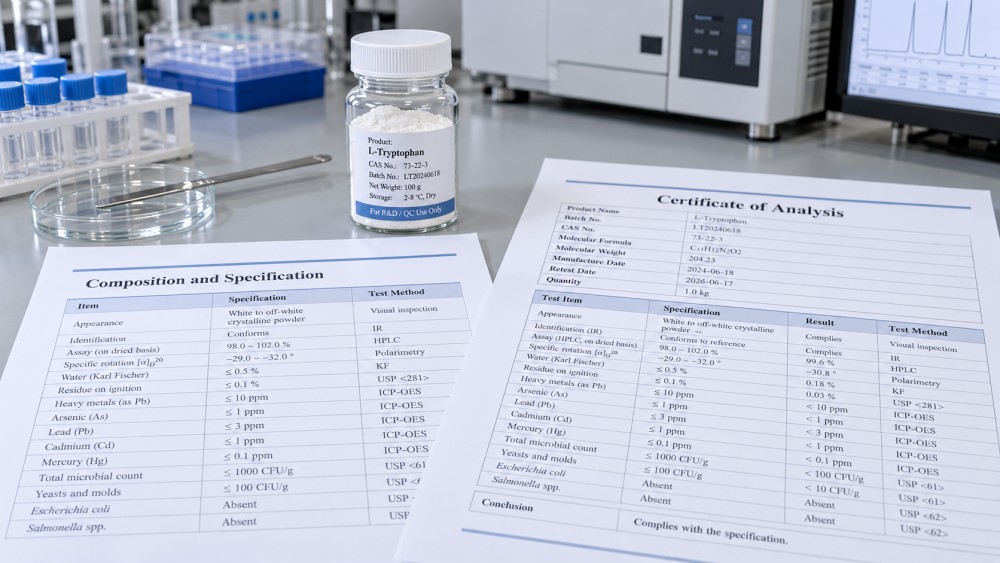
The specification sheet sets the agreed characteristics and acceptance limits for a material. The certificate of analysis, or CoA, reports information for a particular batch against those limits. Neither document replaces the other: a CoA cannot show that a result is acceptable unless the relevant limit is known, and a specification alone says nothing about the batch delivered today.
Match the CoA to the container label and purchase documentation. At minimum, verify the supplier and manufacturer where relevant, product identity, batch or lot number, specification version, test results, and release authorization. Check manufacture, expiry, or retest dates where applicable, as well as storage conditions that may affect the material before use.
Pay attention to the difference between a numerical result and a statement such as “complies.” The latter may be legitimate for an identification test or a qualitative requirement, but it gives less information for a quantitative impurity limit. Likewise, “< reporting limit” is useful only if the reporting limit is low enough to assess the applicable acceptance criterion. A test reported as below a threshold higher than your limit does not establish compliance.
It is also worth asking which tests were performed on every batch and which are supported by periodic testing, process knowledge, or supplier qualification. Periodic verification can be appropriate, but its frequency and rationale should be agreed and risk-based. For a contaminant that can vary with agricultural origin, a historical result from another lot may offer limited reassurance.
Look beyond the headline percentage
A 99% assay does not, by itself, identify the remaining material or prove that each relevant contaminant is controlled. Depending on how the assay is defined, the apparent remainder may include water, related substances, residual solvents, salts, or other components. Nor is subtracting the assay from 100 always a valid way to calculate total impurities; methods, bases, and analytical uncertainties may differ.
Build the impurity review around the ingredient and its route of manufacture. Useful questions include:
- Which starting materials, reagents, catalysts, or processing aids could remain, and how are they controlled?
- Are there specified limits for relevant residual solvents, elemental contaminants, by-products, or degradation products?
- For botanical extracts, have likely contaminants associated with the source and processing been considered, including pesticides or microorganisms where relevant?
- Does the method distinguish the target ingredient from related compounds that could affect safety or performance?
- Are any limits expressed on a different basis from the assay or the finished-product exposure calculation?
Not every specification needs every possible test. A justified control strategy is more useful than a long list copied from another ingredient. But when a material is used at a high inclusion level, exposed to heat, applied to damaged skin, or intended for a sensitive population, the rationale for omitted tests deserves closer scrutiny.
Choose the right standard for the intended use
A claim of compliance with a recognized monograph can give the review a firm starting point. Depending on the material and market, useful references may include the Food Chemicals Codex, United States Pharmacopeia–National Formulary, European Pharmacopoeia, or specifications published by the Joint FAO/WHO Expert Committee on Food Additives. Confirm the exact monograph, applicable edition, and whether the supplier claims full compliance or only uses selected methods.
Do not treat pharmacopoeial compliance as automatic authorization for every food or cosmetic use. A monograph describes quality requirements within its scope; product regulations and permitted uses must be assessed separately. Similarly, a supplier’s “GRAS” statement should not be treated as a general FDA certification. In the United States, the regulatory status of a substance depends on the conditions of its intended use and the applicable legal framework.
For cosmetics sold in the European Union, notification through the Cosmetic Products Notification Portal is a finished-product regulatory step, not proof that an individual ingredient has been approved or that every batch meets a purity grade. Restrictions, safety assessment requirements, and the finished formulation still need separate review.
This distinction is useful across the ingredient categories covered by FFAI: a preservative, a fragrance component, and a peptide may all have an assay value, but their relevant standards and safety questions can be quite different. Record the standard used for the decision and retain the controlled reference your organization is entitled to use. A supplier’s isolated excerpt may omit definitions, calculation notes, or related tests.
Apply the numbers to the actual formulation
Specifications become meaningful when connected to exposure and performance. If an impurity has a specified maximum concentration in an ingredient, estimate its potential contribution to the finished product using the ingredient’s maximum use level. Keep units and calculation bases consistent, and account for other sources of the same impurity. This is a screening calculation; it does not replace a toxicological or regulatory assessment.
The relevant quality attribute can also differ from the one emphasized in sales literature. For a thickener, viscosity under a defined test method, microbial quality, and consistency between lots may matter more to manufacturing than an isolated “purity” claim. For an essential oil, identity and a suitable compositional profile may be more informative than a single assay. Natural variation is not automatically a defect, but the acceptable range should be compatible with the formulation and its safety assessment.
For an antioxidant intended for a heat-processed food, a conforming incoming assay does not prove it will remain effective throughout processing or shelf life. Conversely, a purity concern cannot be resolved simply by demonstrating performance in the finished product. Incoming quality, process stability, and finished-product safety are related decisions, not interchangeable tests.
When the evidence is incomplete, put the lot on hold
Common reasons to pause release include a mismatched lot number, an unexplained change in specification, a method without an identifiable basis, or an impurity limit that cannot be assessed using the stated reporting threshold. Ask the supplier for clarification, the relevant test method or method summary, and supporting batch data as appropriate. If the gap affects a critical safety requirement, document the hold rather than accepting a general assurance.
Independent testing can help, but only if the laboratory receives the correct sample, method requirements, and acceptance criteria. A generic screen may miss the contaminant of concern or use a reporting limit that is too high. Retain a representative sample according to your procedure, investigate discrepancies, and use a documented deviation process where your quality system permits one.
Finally, review the decision when the supplier changes the manufacturing site, process, source, method, or specification—not only when a batch fails. The practical standard is straightforward: you should be able to trace the grade claim to an applicable requirement, the requirement to a suitable test or control, and the result to the batch you intend to use.
Related News
- China Records 543 New Cosmetic Ingredients, Including 167 in 2026Nov 12, 2026Prof. Elian Thorne
- Australia and New Zealand Weigh Wider Steviol Glycoside Use in Griddle ProductsNov 11, 2026Prof. Elian Thorne
- China Announces Risk-Based Cosmetic Change Reviews and Shorter TimelinesNov 10, 2026Prof. Elian Thorne
- How to assess product database coverage in an ingredient intelligence platformNov 08, 2026Prof. Elian Thorne
Related News
- 00
0000-00
China Records 543 New Cosmetic Ingredients, Including 167 in 2026 - 00
0000-00
How to check a fragrance raw material specification for IFRA compliance - 00
0000-00
Australia and New Zealand Weigh Wider Steviol Glycoside Use in Griddle Products - 00
0000-00
How does pH affect plant-based color ingredients in beverages? - 00
0000-00
China Announces Risk-Based Cosmetic Change Reviews and Shorter Timelines
Prof. Elian Thorne
Weekly Insights
Stay ahead with our curated technology reports delivered every Monday.