





A supplier profile can look convincing until the first technical question arrives: Which factory makes the ingredient, does the certificate cover that site, and can the supplier provide results for the batch being offered? Unclear answers can turn an attractive quotation into a delayed launch, rejected shipment, or formulation problem.
To vet suppliers in an ingredient sourcing platform supplier directory, treat each listing as a lead rather than an approval. Define your application requirements, verify the seller and manufacturing site, examine product-specific evidence, test representative material, and confirm supply arrangements before authorizing routine purchases. Keep quality, regulatory, and commercial decisions separate: a low price should never compensate for a failed safety or compliance requirement.
Set the buying requirements before comparing listings
A search for “xanthan gum,” “essential oil,” or “cosmetic peptide” can return products that share a name but differ substantially in composition, performance, and permitted use. Without a purchasing brief, buyers may shortlist suppliers whose material cannot meet the actual formulation requirements.
Build the brief with quality, formulation, and regulatory colleagues. Include:
- Identity and grade: chemical or botanical identity, relevant identifiers, concentration, carrier, physical form, and required food, cosmetic, or technical grade.
- Application conditions: intended function, use level, processing temperature, pH, mixing conditions, and compatibility requirements.
- Destination market: countries where the finished product will be sold, intended product category, and any relevant restrictions.
- Acceptance criteria: assay, microbiological limits, relevant contaminants, sensory properties, and functional performance.
- Supply constraints: forecast volume, order frequency, packaging, storage conditions, and minimum remaining shelf life at receipt.
Separate non-negotiable requirements from preferences. A required allergen control is an approval gate; a preferred pack size is usually a commercial consideration. This distinction prevents an appealing profile from moving forward while a critical evidence gap remains unresolved.
Establish who is selling and who is manufacturing
Directory labels such as “manufacturer,” “verified,” or “premium supplier” may describe different things. Check what the platform actually verified: contact details, company registration, documents, or a physical site. Unless the scope is explicit, do not interpret a badge as evidence of manufacturing competence.
Ask for the seller’s legal entity name, registered address, manufacturing location, and role in the supply chain. Determine whether the business manufactures, distributes, brokers, repacks, or relabels the material. A distributor can be a suitable supplier, but its access to manufacturer documentation and control over storage and handling must be clear.
Cross-check the legal name across the quotation, invoice details, certificates, and quality documents. Different names are not automatically disqualifying, but the relationship needs an explanation supported by records. Independently verify unexpected bank-account changes through an established contact channel rather than relying on the email requesting the change.
Ask whether production or testing is subcontracted. Approval of one factory should not silently extend to another facility supplying an apparently identical grade.
Request a coherent evidence package, not a pile of certificates
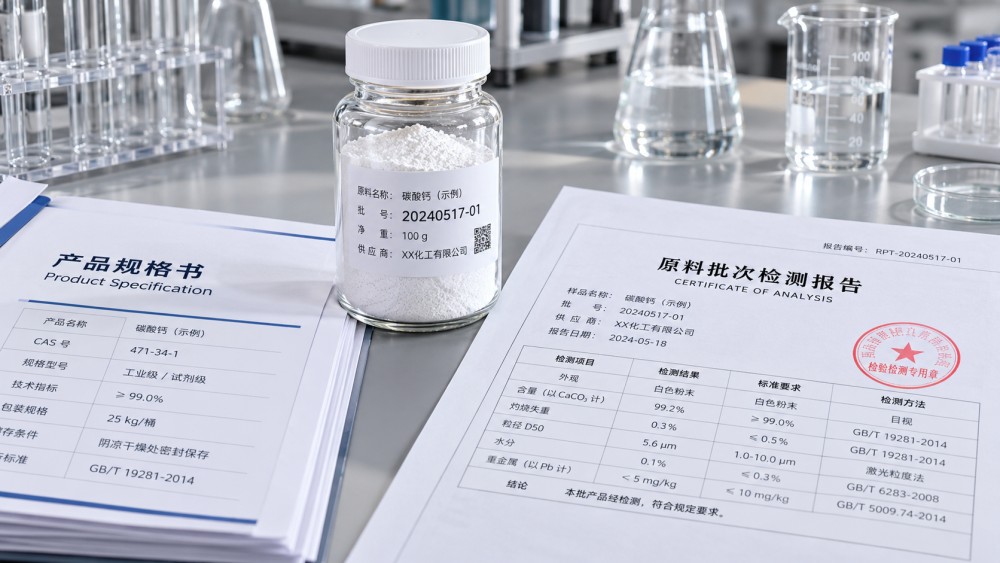
Send shortlisted suppliers the same document request so responses can be compared fairly. The documents should connect the offered product to its manufacturer, production site, specification, and traceable batches. Generic brochures and unrelated certificates do not establish that connection.
Verify significant certifications through the issuing body or its available verification service rather than trusting a logo. Certification supports supplier evaluation, but it does not establish that every ingredient meets every destination-market requirement.
Read analytical results beyond the “pass” column. A limit result can be appropriate for some tests; other attributes need numerical results to assess consistency. Ask whether testing is performed on each batch, periodically, or inferred from process controls. Where contamination risk or authenticity matters, quality staff should assess whether the methods and detection limits are suitable.
Resolve ingredient-specific compliance questions
A supplier’s statement that an ingredient is “globally compliant” is too broad to support a purchase decision. Compliance depends on the substance, composition, intended use, use level, finished-product category, and destination. Ask the supplier to identify the basis for its claim and have your regulatory team review it against the purchasing brief.
Food preservatives, pigments, and thickeners
Confirm that the exact ingredient and proposed use are permitted in the target market. Food-grade status alone does not establish suitability for every food category or concentration. Review relevant purity criteria, allergen information, microbiological controls, and contaminant risks.
For a US food use supported by a GRAS conclusion, examine its scope and supporting basis rather than requesting a generic “FDA GRAS certificate.” An FDA facility registration, where applicable, is not product approval or proof that a particular use is lawful.
Fragrance extracts and cosmetic actives
For botanical extracts and essential oils, request botanical identity, plant part, extraction method, origin information, and an appropriate compositional profile. Review adulteration risks, relevant allergens, residual solvents, and storage sensitivity. A familiar trade name may conceal differences that affect odor, stability, or labeling.
For cosmetic actives, establish the active content, carrier system, impurities, preservation, and evidence relevant to the intended claims. An INCI name identifies an ingredient for labeling purposes; it does not prove safety, efficacy, or universal acceptability. EU CPNP notification concerns cosmetic products and should not be treated as raw-material approval or efficacy certification.
Surfactants require comparable precision: active matter, impurities, residual reactants, and intended-use suitability may matter more than a broad description such as “mild” or “naturally derived.” Escalate unresolved regulatory or toxicological questions before commercial approval, not after the purchase order.
Qualify the material under actual application conditions
A sample should represent the commercial grade you intend to buy. Record its lot number, production site, specification revision, and packaging. Ask whether it came from normal production, a laboratory preparation, or a specially selected batch. An excellent development sample does not establish routine supply capability.
Agree on the evaluation plan before testing. It should cover identity and critical quality attributes as well as performance in the intended formulation:
- Thickeners: evaluate hydration, viscosity under defined test conditions, and compatibility with salts, acids, and the actual mixing process.
- Preservatives: confirm stability and performance in the finished formulation; raw-material assay alone does not demonstrate preservation effectiveness.
- Fragrance materials: assess odor consistency, discoloration, and stability in the intended base and packaging.
- Cosmetic actives: check concentration, solubility, formulation compatibility, and stability through relevant processing and storage conditions.
Use independent laboratory testing when justified by ingredient risk, uncertain authenticity, or limited supplier evidence. Define methods and acceptance criteria in advance so disagreements are not resolved by choosing whichever method gives the preferred result.
A single passing sample supports initial qualification, not a conclusion about long-term consistency. For higher-risk materials, assess additional production lots and use a controlled initial order before expanding purchasing. Retain reference samples and records linking the evaluated material to the approved grade.
Check whether the supply promise survives routine purchasing
Commercial reliability requires more than a quoted lead time. Ask when that lead time starts: order acceptance, deposit receipt, production scheduling, or release from quality control. Determine whether quoted inventory is physically available, reserved, and supported by a current batch record.
Review minimum order quantity, production capacity relevant to your forecast, dispatch location, transport conditions, and remaining shelf life. A lower unit price can become more expensive if the minimum order creates expiry losses or the material requires unplanned temperature-controlled transport.
Trace the proposed logistics route. Repacking, consolidation warehouses, and extended storage can introduce risks absent from the factory’s certification scope. Establish who controls those steps and how temperature excursions, damaged seals, and lot identification are managed.
Discuss disruption arrangements without assuming they are proven. An alternative factory or source still needs qualification. Require notification before changes to manufacturing site, raw-material source, composition, process, specification, or test method where those changes could affect your approval.
Make the approval decision traceable
Keep a comparison record organized around evidence rather than sales impressions. Give each requirement a status such as verified, pending, failed, or not applicable, with the supporting document, reviewer, and review date. Record unresolved questions and who is responsible for closing them.
Apply exclusion gates before ranking commercial offers. Unverified identity, an unacceptable contaminant result, or missing evidence for a required regulatory condition should stop approval. Price, responsiveness, and flexible payment terms cannot offset those failures.
Not every missing document requires rejection. A supplier that protects proprietary information may provide a controlled disclosure, redacted record, or confidential review arrangement. Repeated contradictions, unverifiable certificates, unexplained site changes, or refusal to identify the manufacturer require stronger escalation. Depending on the risk, this may mean an audit or removal from consideration.
Document the approved scope precisely: legal supplier, manufacturing site, ingredient grade, specification revision, intended application, and any purchasing restrictions. Before routine orders begin, agree on lot-specific documentation, incoming inspection, nonconformance handling, complaint investigation, and change notification. Supplier approval should remain tied to those conditions; a new site, changed formulation, or unexplained batch drift should trigger reassessment rather than inherit the original approval.
Related News
- Wissen Research: Global Cosmetics Market to Reach $497.2 Billion by 2031Nov 13, 2026Prof. Elian Thorne
- China Records 543 New Cosmetic Ingredients, Including 167 in 2026Nov 12, 2026Prof. Elian Thorne
- Australia and New Zealand Weigh Wider Steviol Glycoside Use in Griddle ProductsNov 11, 2026Prof. Elian Thorne
- China Announces Risk-Based Cosmetic Change Reviews and Shorter TimelinesNov 10, 2026Prof. Elian Thorne
Related News
- 00
0000-00
Wissen Research: Global Cosmetics Market to Reach $497.2 Billion by 2031 - 00
0000-00
Can biomimetic peptides improve skin firmness? - 00
0000-00
China Records 543 New Cosmetic Ingredients, Including 167 in 2026 - 00
0000-00
How to check a fragrance raw material specification for IFRA compliance - 00
0000-00
Australia and New Zealand Weigh Wider Steviol Glycoside Use in Griddle Products
Prof. Elian Thorne
Weekly Insights
Stay ahead with our curated technology reports delivered every Monday.