





Why does natural food additives wholesale require more than a price comparison?
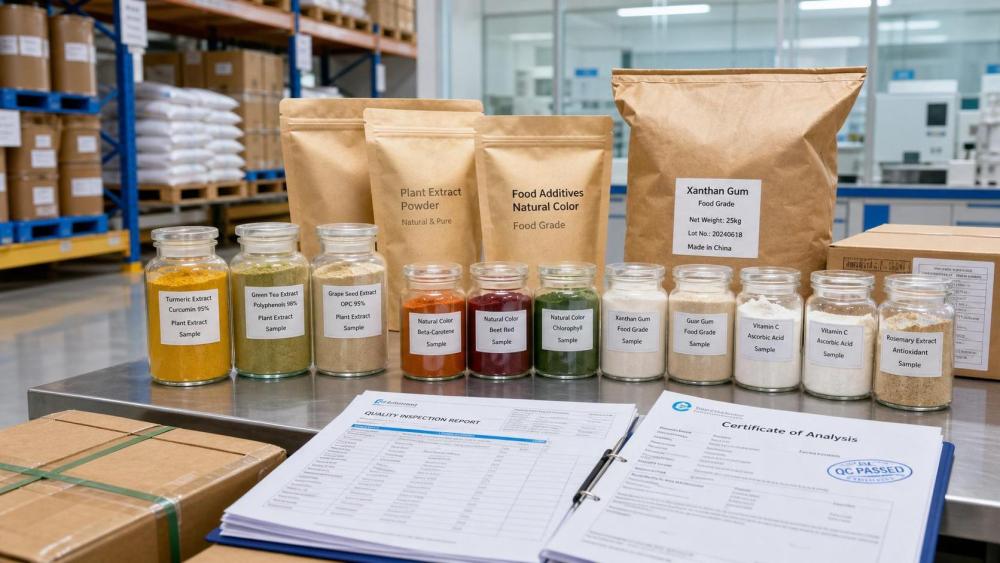
In natural food additives wholesale, the quoted price rarely tells the full sourcing story.
A lower offer can still lead to higher landed cost, unstable output, or reformulation work later.
That is especially true for antioxidants, preservatives, natural pigments, and thickeners used across food supply chains.
The practical question is not only what a kilogram costs today.
It is whether the ingredient performs consistently, clears compliance checks, and stays available when demand tightens.
FFAI follows these pressure points closely because food ingredients sit inside a broader FMCG logic.
Shelf life, mouthfeel, aroma stability, and clean-label claims all depend on precise material behavior.
A natural color that fades in heat, or a thickener that shifts viscosity between lots, can erode margin fast.
So when evaluating natural food additives wholesale, buyers usually look at four linked factors.
- True cost across price, freight, duties, testing, and waste.
- MOQ fit against production cadence and inventory risk.
- Quality consistency under real processing conditions.
- Supply resilience when crops, regulations, or logistics change.
That is the framework behind better contracts and fewer emergency substitutions.
What usually drives cost in natural food additives wholesale?
Raw material origin is often the first driver, but it is not the only one.
Natural inputs depend on harvest cycles, regional weather, extraction yield, and seasonal quality variation.
A botanical antioxidant from one region may cost more simply because active content is higher and purification losses are lower.
Processing also matters.
Spray drying, deodorization, microencapsulation, and tighter mesh control can add cost, yet improve handling and shelf stability.
For some natural pigments and hydrocolloids, that extra processing reduces batching errors and saves production time.
Compliance costs are another hidden layer in natural food additives wholesale.
GRAS status, allergen statements, residual solvent limits, heavy metal data, and microbiological controls all affect supplier cost structures.
Cross-border documentation is rarely free, especially when local market rules differ.
A simple comparison table helps separate low quote from low total cost.
In practice, natural food additives wholesale becomes cheaper when functional performance is measured, not just invoice price.
How should MOQ be judged without overbuying?
MOQ is often where a promising supplier stops looking economical.
Some factories offer attractive pricing only at pallet or container scale.
That works for stable, high-run ingredients.
It becomes risky for niche preservatives, sensitive extracts, or trial-stage color systems.
A useful way to judge MOQ is to connect it with monthly usage, shelf life, and replenishment lead time.
If a three-month MOQ sits inside a twelve-month shelf-life window, inventory pressure may be manageable.
If the same MOQ covers nine months of demand, the discount can quickly disappear through expiry risk.
Natural food additives wholesale often rewards a staged approach.
- Start with a qualification batch tied to specification approval.
- Move to a mid-volume order after plant validation.
- Negotiate annual pricing with split deliveries when demand becomes visible.
Suppliers that understand long-cycle partnerships are often open to this structure.
That is also where market intelligence helps.
FFAI’s coverage of preservatives, thickeners, flavors, and formulation economics reflects a simple reality.
MOQ should match the application rhythm, not only the supplier’s production preference.
When does a cheap offer become a quality risk?
Usually when the specification looks acceptable on paper but fails under process stress.
Natural food additives wholesale involves materials that react differently to pH, heat, light, shear, and storage humidity.
A supplier may meet color index targets, yet the pigment still collapses after baking or retort exposure.
The same pattern appears in hydrocolloids.
Two xanthan gum lots can pass a basic viscosity spec while behaving differently in a sugar-acid beverage.
That is why qualification should include application testing, not only document review.
More reliable suppliers can usually provide retention samples, wider historical data, and clearer process guidance.
For heat-sensitive antioxidants and preservation systems, thermal survival data can be more valuable than a small unit-price reduction.
A few warning signals tend to repeat across natural food additives wholesale:
- Very broad specification ranges with no typical values.
- Frequent crop-origin changes without updated validation data.
- Reluctance to share impurity, micro, or heavy metal details.
- No explanation for unusual price gaps versus market average.
A cheap lot is expensive the moment it disrupts release schedules or forces reformulation.
Where do supply risks usually come from, and how can they be reduced?
Supply risk in natural food additives wholesale rarely comes from one source alone.
Agricultural volatility, extraction bottlenecks, export controls, freight delays, and changing compliance requirements can overlap.
Natural ingredients are especially exposed because crop quality and yield can swing sharply across seasons.
Risk is also higher when a material depends on a single region or a narrow processing base.
One overlooked issue is substitution difficulty.
If a preservative or color is tied to a label claim, a backup source may not be plug-and-play.
This is why sourcing teams increasingly track both commercial and technical fallback options.
A practical risk screen can look like this:
This is where FFAI’s cross-category view becomes useful.
The same discipline used to assess flavor stability or cosmetic active compliance also sharpens food ingredient sourcing decisions.
What should be confirmed before signing a natural food additives wholesale contract?
By the time commercial terms are discussed, most technical ambiguity should already be gone.
The strongest contracts in natural food additives wholesale are precise about performance, documentation, and failure handling.
That means more than naming product grade and payment terms.
It means fixing the acceptable assay range, microbiological limits, packaging format, lead time, and change-notice obligations.
It is also worth defining what happens when crop origin, carrier system, or process method changes.
Without that language, a supplier can remain compliant to its own spec while still creating downstream instability.
Before final approval, most experienced sourcing teams confirm these points:
- Commercial price linked to a clear specification version.
- MOQ, split shipment options, and forecast windows.
- Shelf life under stated storage conditions.
- Required certificates for each shipment lot.
- Deviation process, claim handling, and replacement timing.
That level of detail supports continuity far better than a broad master agreement alone.
How can buyers move from reactive purchasing to better sourcing decisions?
A better natural food additives wholesale strategy usually starts with clearer internal ranking.
Not every ingredient deserves the same risk tolerance or stocking model.
Critical preservatives, high-impact thickeners, and label-sensitive colors deserve deeper qualification and closer market monitoring.
Lower-impact inputs can stay on a simpler buying cycle.
That is also where intelligence matters more than noise.
FFAI tracks food preservation, rheology, flavors, compliance, and pricing logic because these variables move together in the real market.
The result is a more informed view of cost drivers, technical fit, and likely disruption points.
To improve outcomes in natural food additives wholesale, the next step is straightforward.
Map each ingredient by usage rate, substitution difficulty, compliance burden, and lead-time sensitivity.
Then compare suppliers on total cost, realistic MOQ, and evidence of consistent performance.
That approach reduces rushed decisions and builds supply security before the market gets tight.
Related News
- What drives fragrance ingredients price changes in bulk orders?Oct 12, 2026Prof. Elian Thorne
- How minimum order quantities shape private label ingredient sourcing costsOct 10, 2026Prof. Elian Thorne
- What drives personal care ingredient price volatility in sourcingOct 08, 2026Prof. Elian Thorne
- What drives micelles price differences in cosmetic formulations?Oct 07, 2026Prof. Elian Thorne
Related News
- 00
0000-00
What drives fragrance ingredients price changes in bulk orders? - 00
0000-00
How to assess a food antioxidants distributor’s traceability practices - 00
0000-00
How minimum order quantities shape private label ingredient sourcing costs - 00
0000-00
What drives personal care ingredient price volatility in sourcing - 00
0000-00
What drives micelles price differences in cosmetic formulations?
Prof. Elian Thorne
Weekly Insights
Stay ahead with our curated technology reports delivered every Monday.