





Why does a private label sourcing cost breakdown matter more than the quoted unit price?
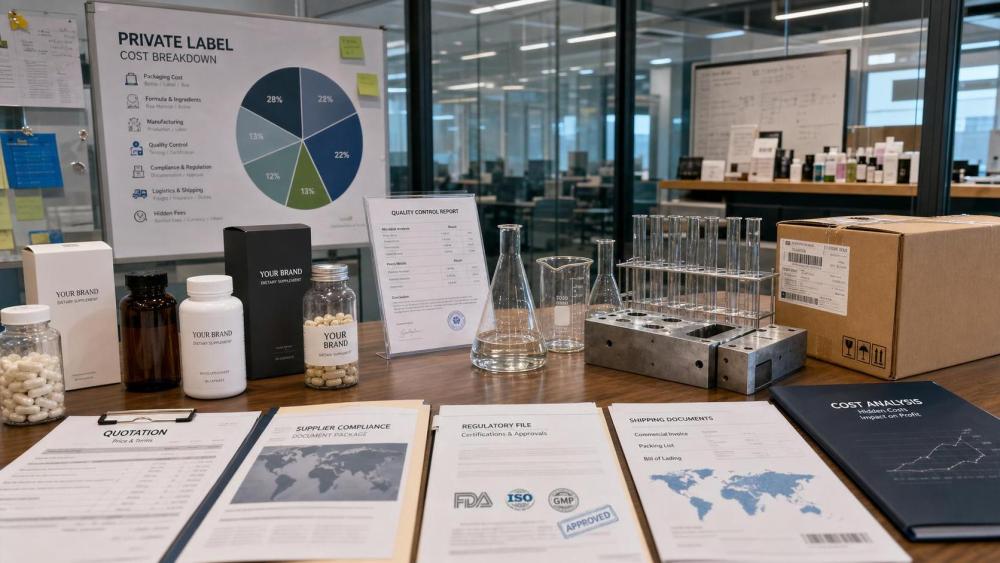
A private label sourcing cost breakdown is not just a purchasing worksheet. It is a margin protection tool.
Quoted price per kilogram, bottle, or unit often looks precise. In practice, it hides the expenses that move gross profit.
That risk is sharper in FMCG categories linked to food preservation, flavors, fragrances, surfactants, thickeners, and cosmetic actives.
These products depend on formulation stability, sensory consistency, safety files, and packaging compatibility. Each layer adds cost exposure.
A supplier may present an attractive opening price, then add mold fees, lab testing, artwork revisions, or minimum order penalties later.
Simple items rarely stay simple once export compliance, shelf life, and production variation enter the conversation.
This is why a useful private label sourcing cost breakdown must connect commercial numbers with technical reality.
In sectors tracked by FFAI, the cost of a preservative system, fragrance base, peptide active, or xanthan gum texture profile is rarely standalone.
It is tied to claims, dosage, process tolerance, regulatory evidence, and shipping conditions.
A better question is not, “What is the unit price?”
It is, “What fully loaded cost reaches the warehouse without causing reformulation, rejection, or delayed launch?”
Which hidden fees usually distort margins first?
The first margin leak usually appears before production begins, not after the goods ship.
Formulation adjustment is a common example. A supplier may quote based on a standard base formula, then bill extra for customization.
That matters when the formula needs stronger antioxidants, cleaner-label pigments, premium essential oils, or more stable anti-aging actives.
Packaging is another frequent source of cost drift.
A carton may seem low-cost until barrier upgrades, special pumps, UV protection, or fragrance-safe linings become mandatory.
Testing fees often arrive as separate line items. These can include microbial challenge tests, stability studies, compatibility checks, heavy metal screens, or preservative validation.
For food and beauty products, compliance paperwork also changes the math.
GRAS support, allergen declarations, SDS files, IFRA alignment, CPNP preparation, and batch traceability all create real administrative cost.
Freight is the fee buyers expect. Rework is the fee many overlook.
If fragrance intensity shifts, emulsion separates, or viscosity changes in transit, the correction cost can exceed the original savings.
A disciplined private label sourcing cost breakdown should capture both direct and delayed charges.
A quick cost check table helps surface the real exposure
How should you compare two supplier quotes that look similar?
Two quotes can appear nearly identical and still carry very different financial risk.
The more useful comparison starts with scope clarity. Ask what is included, excluded, conditional, and volume-dependent.
One supplier may include three pilot batches. Another may charge every adjustment after the first sample.
This is especially relevant in sensory-driven categories. Fragrance calibration, flavor matching, texture tuning, and active loading often need iteration.
A true private label sourcing cost breakdown also compares assumptions behind the quote.
Is the supplier using standard raw materials, or premium-grade inputs with stronger stability, cleaner labeling, or better penetration performance?
FFAI’s market lens is useful here because ingredient economics are rarely isolated from technical behavior.
An antioxidant that survives heat processing, or a peptide system that supports efficacy claims, may cost more but reduce later reformulation.
A lower quote can therefore be more expensive once spoilage risk, scent drift, poor foam behavior, or product separation appears.
When comparing suppliers, review these points together:
- Included development rounds and sample policy
- Raw material grade, origin, and substitution rights
- Testing package and document support
- Minimum order quantity by SKU, not just by project
- Lead time stability during seasonal demand swings
- Credit terms, defect handling, and remake responsibility
A quote is only comparable when these conditions are normalized.
Where do compliance and testing costs become impossible to ignore?
They become impossible to ignore when products cross borders, make claims, or use sensitive ingredients.
That threshold is common across food, personal care, home care, and beauty categories.
For preserved foods, shelf life data and microbial control are not optional if distribution is long or climate exposure is uneven.
For fragrances and essential oils, allergen disclosure, IFRA limits, and packaging interaction can affect both legal use and product integrity.
For high-end cosmetic actives, efficacy support and safety substantiation often determine whether a premium price can be defended.
A private label sourcing cost breakdown should therefore separate routine quality checks from market-entry costs.
That distinction improves approval decisions because some expenses repeat each batch, while others are one-time or region-specific.
In practical terms, these are the cost signals worth checking early:
- Need for third-party validation instead of internal supplier reports
- Different documentation standards between the US, EU, and other markets
- Retesting required after formula or packaging changes
- Claim language that triggers additional evidence needs
This is where scientific and regulatory intelligence become cost controls, not just technical support.
That alignment is central to FFAI’s perspective across preservation systems, sensory ingredients, and advanced actives.
Is freight the last line item, or does logistics reshape the whole private label sourcing cost breakdown?
Freight is not the end of the calculation. It often changes the structure of the entire sourcing decision.
Some ingredients and finished goods are sensitive to heat, oxidation, humidity, or pressure variation.
That sensitivity is easy to underestimate in antioxidants, aroma compounds, natural colors, surfactant blends, and peptide-rich formulas.
If cold-chain handling, desiccant use, drum lining, or special customs coding is required, landed cost shifts quickly.
More importantly, logistics affects working capital.
Longer transit times increase safety stock, forecasting error, and expiry risk. Those are financial costs, even when they do not appear in the quote.
A balanced private label sourcing cost breakdown should include:
- Inbound freight, duties, and customs brokerage
- Inventory carrying cost over actual lead time
- Loss risk from transit damage or temperature excursion
- Expedite cost when launch dates slip
A low-cost factory far from the destination market may still produce weaker margins than a higher-cost supplier with stable logistics.
What is the most practical way to approve sourcing proposals without margin surprises?
The most practical approach is to turn every quote into a decision sheet built around exceptions.
Do not approve based on average cost alone. Approve based on cost certainty, technical fit, and failure exposure.
In real sourcing reviews, the strongest proposals are not always the cheapest. They are the ones with the fewest unknowns.
For products shaped by preservation, rheology, fragrance performance, active delivery, or surfactant behavior, uncertainty is rarely cheap.
A working review checklist can stay simple:
- Map the full private label sourcing cost breakdown from development to landed inventory
- Flag one-time costs separately from recurring costs
- Test whether margin still holds under lower yield or delayed lead time
- Check who pays for defects, reformulation, relabeling, and replacement freight
- Confirm which claims, documents, and quality standards are contractually included
That process makes hidden fees visible before they become approved losses.
The clearest sourcing decisions come from combining commercial review with scientific, regulatory, and logistics judgment.
If the proposal involves sensitive flavors, preservatives, thickeners, surfactants, or cosmetic actives, build those checks in early.
A strong private label sourcing cost breakdown does not just explain spend. It protects margin before the contract is signed.
The next step is straightforward: normalize supplier assumptions, price the hidden fees, and stress-test the numbers against launch reality.
Related News
- What drives fragrance ingredients price changes in bulk orders?Oct 12, 2026Prof. Elian Thorne
- How minimum order quantities shape private label ingredient sourcing costsOct 10, 2026Prof. Elian Thorne
- What drives personal care ingredient price volatility in sourcingOct 08, 2026Prof. Elian Thorne
- What drives micelles price differences in cosmetic formulations?Oct 07, 2026Prof. Elian Thorne
Related News
- 00
0000-00
What drives fragrance ingredients price changes in bulk orders? - 00
0000-00
How to assess a food antioxidants distributor’s traceability practices - 00
0000-00
How minimum order quantities shape private label ingredient sourcing costs - 00
0000-00
What drives personal care ingredient price volatility in sourcing - 00
0000-00
What drives micelles price differences in cosmetic formulations?
Prof. Elian Thorne
Weekly Insights
Stay ahead with our curated technology reports delivered every Monday.