





Why does the quoted price rarely show the real cost of recombinant protein ingredients?
The first number on a quotation sheet is usually the easiest one to compare.
It is also the number most likely to mislead when recombinant protein ingredients are involved.
In food, fragrance-adjacent actives, cosmetics, and personal care, these materials often look efficient on a per-kilogram basis.
But the total financial exposure sits in performance stability, regulatory fit, handling requirements, and batch-to-batch consistency.
That is why recombinant protein ingredients need a wider review than ordinary commodity additives.
A lower unit price can quickly lose its appeal if the protein degrades in transit, fails a formulation test, or forces a packaging redesign.
In practical terms, the real question is not “What does this ingredient cost today?”
A better question is “What will this ingredient cost after qualification, launch risk, storage, and compliance are counted?”
This broader view matters across FMCG categories that FFAI tracks closely, especially where efficacy claims, sensory quality, and safety standards meet margin pressure.
Where do hidden cost risks usually appear first?
They usually appear before full commercialization, not after invoice approval.
Scale-up is a common weak point for recombinant protein ingredients.
A supplier may deliver strong pilot data, yet commercial fermentation yields can drift under larger production conditions.
That drift affects purity, active content, and final dosing economics.
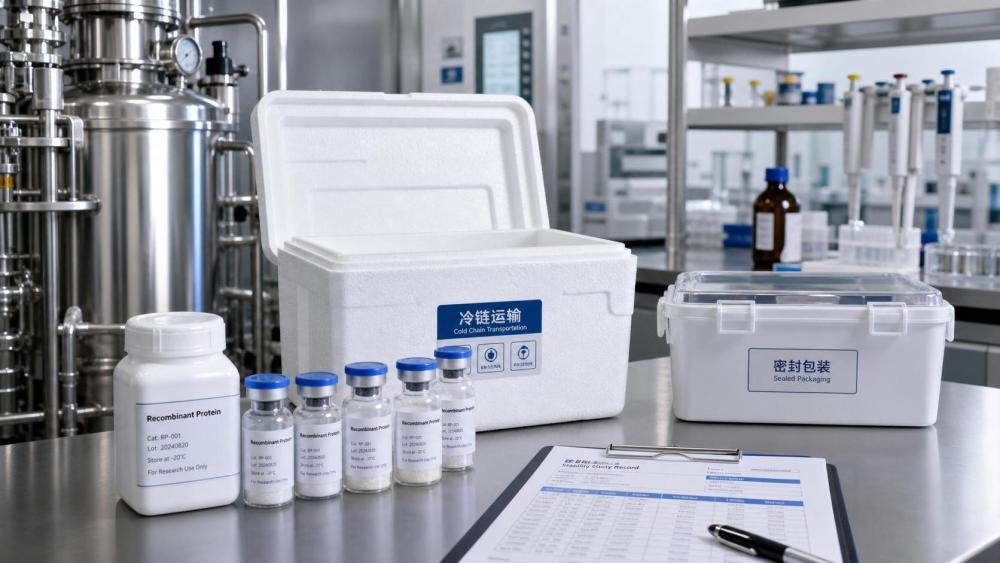
Cold-chain logistics are another frequent blind spot.
Some recombinant protein ingredients tolerate short transport events well, while others lose activity through repeated temperature swings.
If the material needs strict thermal control, freight, warehousing, and customs delays all become cost variables.
Formulation compatibility also deserves close attention.
Proteins can react poorly with preservatives, surfactants, salts, fragrances, or acidic systems.
One failed compatibility run may seem minor, yet repeated reformulation work can consume far more value than the ingredient discount ever saved.
FFAI often frames this as an intelligence problem, not only a sourcing problem.
The financial risk emerges where molecular behavior meets operational reality.
A quick risk screen before deeper evaluation
This kind of table is useful because it ties technical questions to cash consequences early.
How should recombinant protein ingredients be judged across food, beauty, and related FMCG applications?
The answer changes by application, even when the ingredient name stays the same.
In high-end cosmetic actives, recombinant protein ingredients are often evaluated through efficacy, penetration logic, claim credibility, and sensory impact.
A material that supports anti-aging positioning may justify a premium, but only if stability survives the finished formula.
In food-related systems, the emphasis shifts toward safety pathway, thermal endurance, oxidation response, and shelf-life behavior.
If a protein breaks down during processing, the theoretical benefit becomes financially irrelevant.
Personal care and cleansing formulas add another layer.
Here, recombinant protein ingredients may interact with surfactants, fragrance systems, and preservation packages in unpredictable ways.
More common than dramatic failure is gradual underperformance.
That can dilute the intended premium while leaving the full cost burden in place.
This is why cross-functional intelligence matters.
FFAI’s coverage of preservatives, thickeners, flavors, actives, and surfactants reflects a simple reality.
Recombinant protein ingredients do not operate alone inside a formula or a supply chain.
Useful signals during application review
- Check whether the active dose in the final formula matches the dose used in supporting data.
- Confirm if preservatives or fragrance oils reduce biological activity over time.
- Review whether packaging protects against light, oxygen, and moisture shifts.
- Ask whether the ingredient needs special mixing order or shear control.
When does a higher-priced option actually create lower total cost?
This happens more often than expected.
A more expensive lot of recombinant protein ingredients may still lower total cost if it offers tighter specification control.
Better consistency reduces retesting, reformulation, and dosage padding.
That matters when finished products carry premium claims and narrow tolerance bands.
A higher initial price can also be justified by stronger regulatory documentation.
If technical files are clean, export pathways are clearer, and labeling risk is lower.
That can save time in markets with demanding food or cosmetic review standards.
Another overlooked factor is claim durability.
Some recombinant protein ingredients support a stronger product story because purity, origin control, and bioactivity are easier to defend.
If that supports price architecture at the finished-product level, the ingredient cost should be viewed against margin contribution, not only against purchase price.
This is close to the capital logic often seen in advanced actives and specialty sensory ingredients.
The cheapest input is not always the cheapest decision.
What mistakes most often distort cost forecasts for recombinant protein ingredients?
One mistake is treating technical success and commercial success as the same thing.
A protein can work beautifully in a bench test and still fail under real shelf-life, transit, or production conditions.
Another mistake is ignoring failure cost.
If recombinant protein ingredients sit inside premium beauty, nutrition, or wellness positioning, a late-stage substitution can damage launch timing and brand credibility.
There is also a habit of underestimating documentation costs.
Certificates, impurity reviews, traceability records, and market-specific declarations all consume time.
That work becomes more expensive when it starts after the sourcing decision.
A final distortion comes from using one benchmark across unrelated categories.
Recombinant protein ingredients for a functional skincare serum should not be judged the same way as proteins intended for food preservation support or texture-linked systems.
The cost model has to reflect the intended claim, processing stress, and compliance environment.
A more reliable review pattern
- Compare cost per effective dose, not only cost per kilogram.
- Model a failure scenario with delay, rework, and replacement freight.
- Separate pilot evidence from long-run commercial supply evidence.
- Score documentation quality before final commercial approval.
What should be confirmed before approving a sourcing decision?
A disciplined approval process usually starts with four confirmations.
First, verify whether the supplier can maintain consistent output at the required commercial scale.
Second, confirm the full landed cost, including thermal protection, packaging format, testing burden, and waste allowance.
Third, review whether the intended market claims rely on data that actually match the finished formula context.
Fourth, ask how easily the ingredient can be replaced if supply tightens or regulation shifts.
These questions sound basic, yet they often reveal the difference between an acceptable price and a resilient decision.
For recombinant protein ingredients, financial discipline usually improves when technical, regulatory, and commercialization evidence are reviewed together.
That approach is especially relevant in sectors where FFAI follows molecule-level performance closely, from clean-label food systems to anti-aging actives and advanced personal care formulas.
The next sensible step is to build a comparison sheet that combines unit price, effective dose, stability window, compliance route, and failure replacement cost.
That single document often clarifies whether recombinant protein ingredients truly support margin, or only appear attractive at quotation stage.
Related News
- How to interpret active matter on a surfactant specification sheetOct 14, 2026Prof. Elian Thorne
- What Quality Checks Should You Run on Fragrance Ingredient Suppliers?Oct 14, 2026Prof. Elian Thorne
- How to assess a flavor chemistry manufacturer's batch consistencyOct 13, 2026Prof. Elian Thorne
- What drives fragrance ingredients price changes in bulk orders?Oct 12, 2026Prof. Elian Thorne
Related News
- 00
0000-00
Can biomimetic peptides in cosmetics reduce the look of wrinkles? - 00
0000-00
How to assess a bio-based thickener manufacturer's batch consistency - 00
0000-00
Verifying halal status of hydrocolloid ingredients in the Middle East - 00
0000-00
How to interpret active matter on a surfactant specification sheet - 00
0000-00
How Do You Test Hydrocolloid Viscosity After Changing a Thickener?
Prof. Elian Thorne
Weekly Insights
Stay ahead with our curated technology reports delivered every Monday.