





Transdermal Delivery Systems for Patches: Key Factors That Affect Drug Release
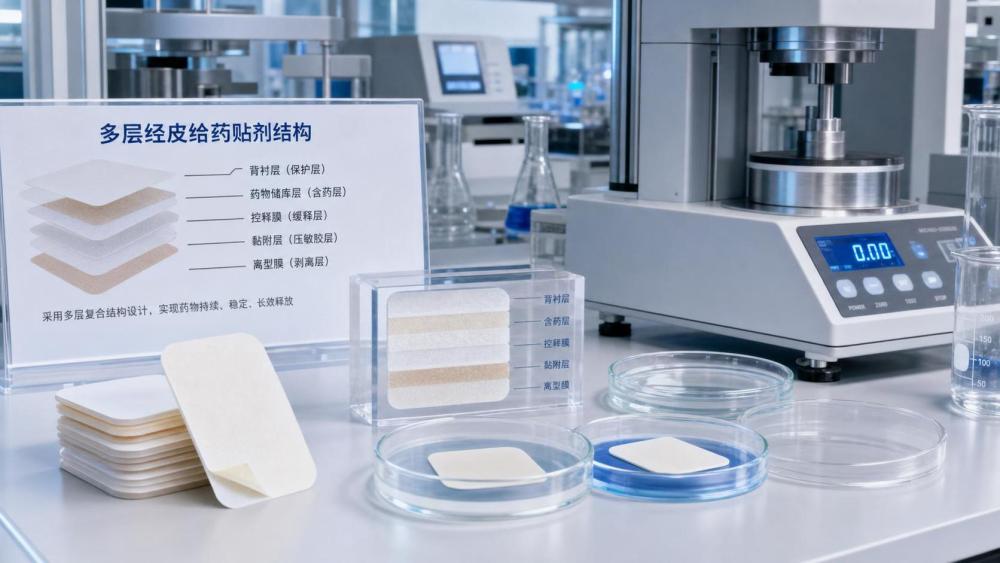
Transdermal delivery systems for patches work only when several variables stay in balance.
Drug solubility, skin permeability, adhesive behavior, and storage stability all shape release performance.
That balance is not theoretical.
It directly affects dose consistency, onset time, wear comfort, and safety during daily use.
In practice, the best transdermal delivery systems for patches are designed around controlled release, predictable skin contact, and resistance to real-world stress.
This matters across pharmaceuticals, cosmetic actives, and specialty ingredient applications where diffusion through the skin barrier must remain stable.
Why Drug Release Starts With the Patch Architecture
Patch structure defines the first release conditions.
Most transdermal delivery systems for patches use matrix, reservoir, or drug-in-adhesive designs.
Each design creates a different diffusion pathway.
Matrix patches disperse the drug inside a polymer network.
Reservoir patches hold the active in a separate compartment, often behind a rate-controlling membrane.
Drug-in-adhesive systems simplify construction, but they demand careful compatibility between adhesive and active ingredient.
A small design shift can change lag time, peak flux, and total dose delivered.
This is why transdermal delivery systems for patches are often evaluated as complete systems, not just as formulations.
Main structural elements that influence release
- Backing film permeability and flexibility
- Drug reservoir or matrix thickness
- Membrane selectivity in rate-controlled systems
- Adhesive contact area and cohesion
- Release liner compatibility during storage
Formulation Variables That Change Release Kinetics
Formulation is usually the strongest driver of release kinetics.
For transdermal delivery systems for patches, the active must stay stable, sufficiently soluble, and available for partitioning into skin.
If the drug crystallizes, release often drops sharply.
If it binds too strongly to the polymer, it may remain trapped inside the patch.
Molecular weight, lipophilicity, ionization state, and dose loading all matter.
A drug with moderate lipophilicity usually performs better because it can leave the patch and still cross the stratum corneum.
Penetration enhancers may increase flux, but they can also raise irritation risk or destabilize the adhesive layer.
Plasticizers, solvents, and tackifiers also influence diffusion by changing polymer mobility.
In technical reviews, this is often where promising transdermal delivery systems for patches either prove robust or show hidden variability.
Practical formulation checkpoints
- Confirm the active stays dissolved across shelf life.
- Measure crystallization risk under heat and humidity.
- Check polymer-drug interactions with stability studies.
- Balance enhancer efficiency against irritation potential.
- Validate release with in vitro diffusion testing.
Skin Barrier Behavior Is Never a Minor Variable
Even a well-built patch cannot ignore skin biology.
The outer skin layer is the main barrier controlling drug penetration.
Hydration, temperature, thickness, and local blood flow all influence absorption.
That means transdermal delivery systems for patches may behave differently on the arm, back, abdomen, or thigh.
Damaged or inflamed skin can increase uptake, sometimes beyond the intended release profile.
On the other hand, very dry skin may reduce contact quality and lower flux.
This is one reason application instructions are part of performance control, not just labeling.
For technical operators, site rotation and skin condition checks reduce avoidable variation in transdermal delivery systems for patches.
Common skin-related release risks
- Application to broken or irritated skin
- Excessive sweating under occlusion
- Heat exposure from exercise or external sources
- Uneven pressure from movement or clothing
- Residual creams, oils, or cleansers on the site
Why Adhesive Performance Directly Affects Drug Release
Adhesion is not only a wear issue.
For transdermal delivery systems for patches, poor adhesion reduces skin contact and changes the effective delivery area.
Even slight lifting at the edges can alter moisture retention and diffusion conditions.
The adhesive must hold firmly, yet release cleanly without skin trauma.
Acrylic, silicone, and polyisobutylene systems each have tradeoffs in tack, cohesion, drug compatibility, and irritation profile.
Drug loading can also weaken cohesion and cause adhesive residue or patch slippage.
This becomes more visible under humid conditions or long wear times.
Well-designed transdermal delivery systems for patches treat adhesion testing as part of release validation, not a separate quality box.
What to monitor during adhesive evaluation
Environmental Conditions Can Shift Release Faster Than Expected
Environmental stress often exposes weak points quickly.
Heat can increase drug mobility, soften adhesives, and raise skin permeability at the same time.
Humidity may change backing properties or encourage edge lift.
Cold conditions can reduce tack and slow diffusion.
For transdermal delivery systems for patches, these effects are especially important during transport, warehousing, and on-body wear.
A patch that performs well in controlled testing can still fail under real seasonal conditions.
That is why accelerated stability and in-use simulation are now standard in many development programs.
Recent market expectations also favor transdermal delivery systems for patches that remain stable across global distribution environments.
Testing Standards and Quality Controls That Matter Most
Reliable performance depends on disciplined testing.
For transdermal delivery systems for patches, release studies should connect formulation data, adhesion results, and skin permeation outcomes.
In vitro release testing can show how quickly the active leaves the system.
In vitro permeation testing adds another layer by measuring movement across a membrane or skin model.
Adhesion studies, stability protocols, and residual drug analysis complete the picture.
Residual drug matters because it reveals delivery efficiency and waste.
For regulated applications, data consistency is just as important as peak performance.
Strong transdermal delivery systems for patches are supported by repeatable methods, not single successful batches.
A focused control checklist
- Verify drug content uniformity across the patch area.
- Track release profile drift after storage.
- Compare permeation across relevant skin models.
- Record adhesion after sweat, motion, and temperature exposure.
- Measure residual drug to confirm delivery efficiency.
How to Improve Real-World Performance
Improving release is rarely about one fix.
The better approach is to optimize the whole system around use conditions.
For transdermal delivery systems for patches, that means choosing compatible excipients, matching adhesive behavior to wear time, and validating performance under realistic environmental stress.
It also means paying attention to packaging, because moisture and solvent loss can change release before the patch is even opened.
In daily operations, the most useful improvements are often simple and measurable.
- Standardize application site preparation
- Limit exposure to external heat sources
- Use packaging with strong barrier properties
- Recheck adhesion after formulation adjustments
- Monitor stability in target distribution climates
When these steps are handled well, transdermal delivery systems for patches become more predictable, safer, and easier to scale.
That is the real goal behind release optimization.
A patch should deliver the intended dose with minimal surprises, from storage to skin contact to final removal.
Related News
- What drives fragrance ingredients price changes in bulk orders?Oct 12, 2026Prof. Elian Thorne
- How minimum order quantities shape private label ingredient sourcing costsOct 10, 2026Prof. Elian Thorne
- What drives personal care ingredient price volatility in sourcingOct 08, 2026Prof. Elian Thorne
- What drives micelles price differences in cosmetic formulations?Oct 07, 2026Prof. Elian Thorne
Related News
- 00
0000-00
What drives fragrance ingredients price changes in bulk orders? - 00
0000-00
How to assess a food antioxidants distributor’s traceability practices - 00
0000-00
How minimum order quantities shape private label ingredient sourcing costs - 00
0000-00
What drives personal care ingredient price volatility in sourcing - 00
0000-00
What drives micelles price differences in cosmetic formulations?
Prof. Elian Thorne
Weekly Insights
Stay ahead with our curated technology reports delivered every Monday.