





For procurement teams negotiating bulk contracts, aroma chemical solutions price is shaped by far more than volume alone. Feedstock volatility, purity standards, formulation complexity, regulatory compliance, and supplier reliability all influence the final quote. Understanding these cost drivers helps buyers compare offers more accurately, control sourcing risk, and secure consistent quality in fragrance, flavor, and FMCG applications.
That matters because aroma chemicals are rarely bought as isolated commodities in practice. Even when a purchase order lists a single molecule or a defined blend, the commercial reality behind the price often includes upstream petrochemical or botanical exposure, manufacturing route constraints, batch-to-batch consistency requirements, documentation load, packaging choices, and the supplier’s ability to support downstream audits. A low headline offer can easily become the highest total-cost option once reformulation risk, delayed shipments, or compliance gaps appear.
Bulk price starts with feedstock exposure, not with the quote sheet
One of the most common procurement mistakes is treating aroma chemical solutions as if they follow a simple “more volume, lower price” logic. In reality, the supplier’s cost base begins much earlier: with the raw materials and the route used to make the aroma ingredient.
Many widely used aroma chemicals are linked to petrochemical chains, terpene derivatives, natural isolates, or hybrid synthetic-natural production routes. Each route carries different pricing behavior. If a material depends heavily on crude-linked intermediates, contract prices can move with energy costs, solvent availability, and regional chemical plant operating rates. If it depends on citrus, clove, mint, pine, or other agricultural or forestry-derived inputs, weather events, crop disease, harvest yields, and origin-country logistics become part of the pricing story.
For buyers, this means two suppliers offering “the same aroma profile” may not be exposed to the same raw material risks at all. One may have backward integration into key intermediates; another may be buying from the spot market. One may rely on a natural fraction with seasonal constraints; another may use a synthetic substitute with more stable output. The commercial implication is clear: identical specifications on paper do not guarantee identical price resilience over a 12-month or 24-month contract.
When reviewing aroma chemical solutions price, buyers should ask which part of the formulation is structurally volatile and which part is operationally volatile. Structural volatility comes from feedstock dependence. Operational volatility comes from energy, labor, environmental controls, transport, and regional capacity utilization. Both affect contract stability, but they need different mitigation strategies.
Purity, traceability, and sensory consistency can change the economics sharply
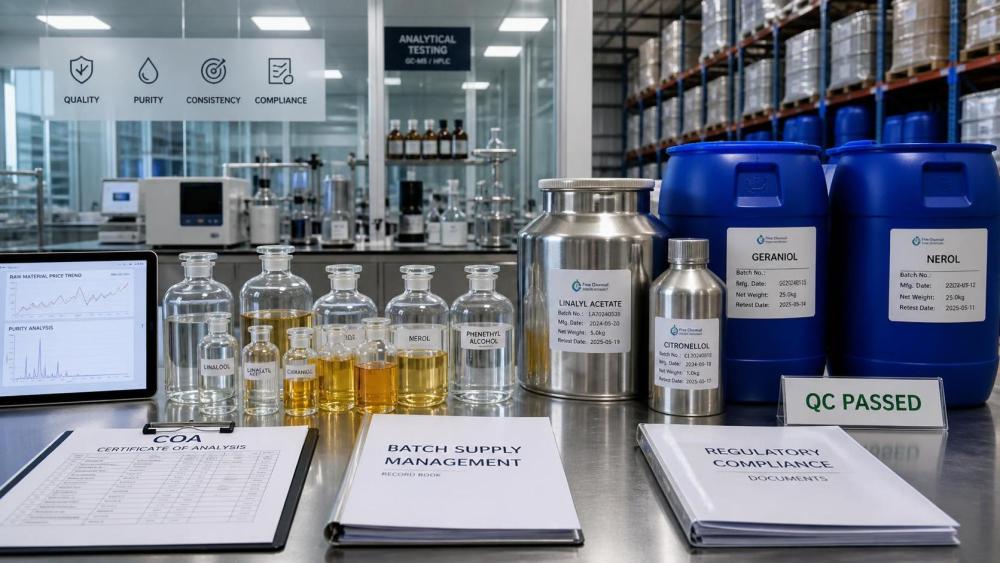
In procurement discussions, suppliers often present purity as a simple technical attribute. In cost terms, it is a major pricing lever. Higher purity grades usually mean additional distillation, refinement, tighter impurity control, lower yields, more quality testing, and stricter release procedures. The price delta can be significant, especially for ingredients used in premium fine fragrance, sensitive flavor systems, or personal care applications where off-notes become commercially unacceptable.
Procurement teams also need to separate “chemical purity” from “application suitability.” A lower-cost offer may meet assay targets but still perform poorly because of residual solvent profile, color drift, oxidation behavior, allergen traces, or instability in the customer’s final matrix. This is especially relevant when the aroma chemical is supplied as a solution rather than neat material, since solvent system choice affects both handling and end-use performance.
Sensory consistency adds another layer. In many FMCG applications, especially fragrance and flavor compounding, minor analytical variation may still translate into noticeable olfactory differences. Suppliers that maintain strong retention samples, batch mapping, panel validation, and process controls usually price those systems into the contract. Buyers who focus only on assay and miss sensory reproducibility often discover the cost later through customer complaints, internal adjustments, and production holds.
Traceability requirements can also raise price. If a buyer needs lot-level raw material tracking, origin declarations, change notification commitments, or documentation to support downstream brand claims, the supplier’s administrative and quality burden rises. That is not wasted cost; it is often what separates a dependable industrial contract from a transactional spot purchase.
Solutions are priced differently from single molecules
The phrase “aroma chemical solutions” can refer to several procurement realities: a single aroma molecule diluted in a carrier, a stabilized intermediate for fragrance compounding, or a multi-component solution prepared for easier dosing and safer plant handling. These are not priced the same way as neat commodity aroma chemicals.
Once a product is supplied as a solution, the buyer is no longer paying only for the active aromatic component. Price also reflects solvent or carrier quality, dilution accuracy, blending labor, stability testing, packaging compatibility, and in some cases hazardous goods handling advantages. A 10% or 20% active solution may appear expensive on a per-kilogram basis until normalized to active content, filling efficiency, and reduced process loss.
This is where procurement comparisons often go wrong. One quote may look lower because it is based on lower active concentration, less expensive carrier material, or wider specification tolerance. Another may look higher because it includes antioxidant stabilization, lower color limits, or a solvent system accepted in more export markets. Without recalculating on an active-content and use-cost basis, quote comparison is incomplete.
For buyers running fragrance, home care, food-adjacent, or personal care production, the more useful question is not “Which supplier has the lowest unit price?” but “Which supply format lowers total delivered cost per qualified batch?” In many plants, easier metering, lower residue, and fewer deviations can justify a higher invoice price.
Compliance is a direct cost driver, not a paperwork afterthought
Regulatory and customer compliance requirements influence price more than many non-technical buyers expect. The effect is especially strong in cross-border sourcing, where the same aroma ingredient may need different documentation sets depending on final market and application.
Relevant documentation may include safety data sheets, allergen statements, IFRA-related information for fragrance use, food-contact or flavor-related declarations where applicable, REACH-related supply chain obligations in Europe, TSCA status in the United States, transport classification, residual solvent information, and non-animal testing or other customer-specific declarations. The exact regulatory framework depends on the application and destination market, and buyers should avoid assuming one universal compliance package exists for all aroma materials.
Where compliance expectations are higher, price usually follows. Suppliers maintaining multilingual technical dossiers, updated regulatory review, controlled change management, and fast response to customer audits incur ongoing overhead. In regulated or brand-sensitive sectors, that overhead is often worth paying. A cheaper supplier that cannot support customs clearance, brand documentation, or audit questionnaires creates hidden procurement exposure.
Certain claims also increase cost indirectly. “Natural,” “nature-identical,” “clean label compatible,” or sustainability-linked positioning can narrow available raw material routes and approved processing aids. Buyers should verify how such claims are defined in their target market rather than purchasing on marketing language alone. The same wording may carry different commercial value and different compliance risk depending on region and end use.
Supplier reliability often explains why the lowest quote is not repeatable
In stable markets, buyers can be tempted to benchmark too heavily against spot offers. But bulk supply contracts are judged over time, not on the day the RFQ is issued. The supplier’s operating discipline often determines whether the quoted price is sustainable.
Several reliability factors typically sit behind a higher but more defensible quote: multiple production lines, secured intermediate sourcing, inventory buffers, validated alternate raw materials, stronger QC release systems, and export documentation competence. These are easy to overlook until a disruption occurs.
Single-site dependence is a notable risk in aroma chemicals. If the supplier relies on one plant for a key ingredient and that site experiences shutdowns, environmental inspections, utility outages, or local logistics restrictions, the buyer may face force majeure, delayed deliveries, or emergency substitution. A supplier with a modestly higher contract price but better continuity planning can lower business risk materially.
Lead time consistency should be priced into procurement decisions as well. A shorter and more stable lead time reduces safety stock requirements, working capital pressure, and the need for expedited shipping. Those savings do not always show up in the raw material line item, but they affect the true economics of the contract.
Geography, logistics, and packaging can move landed cost more than buyers expect
Aroma chemical solutions are sensitive not only to production cost but also to logistics configuration. Material origin, freight mode, warehouse location, drum or IBC format, temperature sensitivity, and hazardous classification can all alter the landed cost significantly.
Some solutions are easier and cheaper to move because dilution reduces hazard profile or improves handling. Others become more expensive because they ship more inactive carrier weight or require specialized packaging to maintain stability. Buyers comparing offshore and regional suppliers should not stop at FOB or ex-works pricing. Ocean freight volatility, port congestion, inland haulage, insurance, and customs handling can quickly erase an apparent source advantage.
Packaging is another underestimated lever. High-spec lined drums, nitrogen-blanketed containers, tamper-evident seals, and smaller batch packaging for contamination control all increase direct cost. Yet in certain categories they reduce oxidation, odor contamination, or warehouse loss. Procurement should evaluate packaging as part of product fitness, not merely as a surcharge.
Currency exposure also matters. If the supplier’s feedstocks are purchased in one currency but the contract is written in another, exchange swings may show up in renewal negotiations or price adjustment clauses. Buyers with multi-region spend should ask whether pricing is fixed, indexed, or reviewable against agreed triggers.
Volume discounts are real, but only under the right contract conditions
Yes, scale can improve price. But suppliers usually grant meaningful volume discounts only when demand visibility is credible. A buyer requesting annual contract pricing without forecast discipline, call-off commitment, or minimum take volumes should not expect the same economics as a customer offering stable releases and production planning transparency.
From the supplier’s perspective, lower prices become possible when capacity can be planned, procurement of intermediates can be hedged or contracted, batch sizes can be optimized, and packaging runs can be standardized. If the buyer’s actual lifting pattern is irregular, rush-driven, or fragmented across multiple SKUs, the supplier’s cost to serve rises even when total annual tonnage looks attractive.
This is why well-structured contracts often outperform aggressive spot buying. A contract that includes forecast windows, tolerance bands, indexed adjustment logic, and defined quality-change procedures can produce a more durable price than repeated quarterly re-bidding. For procurement teams measured on continuity as well as savings, that distinction matters.
How buyers should evaluate an aroma chemical offer beyond the unit price
A sound procurement review of aroma chemical solutions price should include at least five commercial tests.
The first is normalization. Compare offers on active content, delivered basis, packaging basis, and usable yield in production—not just quoted kilograms.
The second is specification relevance. Identify which parameters truly matter to your application: purity, odor profile, color, stability, flash point, carrier acceptability, or documentation completeness. Avoid paying for premium attributes that your process does not need, but do not underbuy on parameters that drive customer acceptance.
The third is supply resilience. Ask how many manufacturing sites are involved, whether alternate feedstocks are qualified, how long average lead times have been in recent quarters, and what disruption history exists. Even partial answers are informative.
The fourth is compliance readiness. Confirm whether the supplier can provide the exact declarations your export markets and customers require. If documents are promised “after order,” factor that uncertainty into supplier scoring.
The fifth is price mechanism design. Fixed pricing may look attractive in volatile markets, but only if the supplier can realistically honor it. In some cases, a transparent formula linked to agreed raw material or energy triggers produces fewer disputes and better continuity.
Where procurement teams most often misread price signals
Three errors appear repeatedly in bulk aroma sourcing.
One is assuming that a lower quote indicates manufacturing efficiency. Sometimes it does. Just as often it reflects lower purity, weaker documentation, narrower quality systems, old inventory, or temporary distress selling.
Another is overvaluing short-term savings in categories tied to brand sensory consistency. In fragrance and flavor systems, a minor supply change can create disproportionate reformulation and approval costs. The cheaper source may remain cheaper only until the first deviation.
The third is treating all supplier risk as negotiable through contract language. Contracts help, but they do not create plant redundancy, raw material access, or regulatory competence where none exists. Due diligence still matters.
What to watch in the next negotiation cycle
Procurement teams should expect aroma chemical pricing discussions to remain influenced by a mix of feedstock volatility, environmental compliance costs, regional manufacturing shifts, and customer demand for tighter documentation. Clean-label preferences, sustainability scrutiny, and traceability expectations are unlikely to reduce sourcing complexity. In many cases they will increase the gap between a basic commodity offer and a contract-ready industrial supply offer.
The practical takeaway is straightforward: buying better in this category requires moving beyond quote comparison. The most useful pricing questions are about exposure, consistency, compliance, and continuity. When those variables are visible, buyers can judge whether a premium is justified, where negotiation is realistic, and where the apparent savings are simply risk transferred downstream.
In bulk supply contracts, aroma chemical solutions price is not just a number attached to a material. It is a compressed signal of how the supplier manages chemistry, operations, compliance, and risk. Procurement teams that unpack that signal usually make better decisions—and spend less over the full life of the contract, even when the opening quote is not the lowest on the table.
Related News
- How rheological thickeners for shampoo affect suspension stabilityOct 03, 2026Prof. Elian Thorne
- When does OEM ingredient sourcing support make custom formulations viable?Sep 29, 2026Prof. Elian Thorne
- What to check in a transdermal penetration supplier for skincareSep 26, 2026Prof. Elian Thorne
- How farnesene market pricing affects renewable ingredient sourcingSep 26, 2026Prof. Elian Thorne
Related News
- 00
0000-00
How to assess color stability from a natural food colors manufacturer - 00
0000-00
When does amino acid surfactant powder improve cleanser mildness? - 00
0000-00
How to verify a cosmetic nanotechnology supplier's safety documentation - 00
0000-00
How rheological thickeners for shampoo affect suspension stability - 00
0000-00
How to assess recombinant collagen ingredients for cream stability
Prof. Elian Thorne
Weekly Insights
Stay ahead with our curated technology reports delivered every Monday.