





A fragrance ingredient supplier should be approved only when its material passes three separate tests: it is chemically what the supplier claims, it performs consistently in the intended formulation, and its documentation supports lawful use in the destination market. A specification sheet alone cannot establish any of these. Even a material that meets a purity limit can carry a trace impurity that changes the scent or creates a safety concern.
Effective fragrance ingredient supplier quality checks combine document review, analytical testing, controlled odor evaluation, and an assessment of manufacturing and traceability controls. The depth of testing should reflect the material: a defined synthetic aroma chemical, a variable botanical extract, and a proprietary fragrance blend require different evidence.
Define what “acceptable” means before requesting samples
Supplier qualification starts with a purchasing specification tied to the intended use. “Perfume grade” or “cosmetic grade” is not a sufficiently precise acceptance criterion. Establish the required chemical identity, composition or assay range, odor profile, physical properties, storage conditions, and relevant impurity limits.
For a synthetic aroma chemical, identity may include the chemical name, CAS number, isomer composition, and any declared stabilizer or carrier. A shared CAS number does not necessarily establish equivalent odor performance when isomer ratios or impurity profiles differ.
For an essential oil or botanical extract, specify the botanical species, plant part, extraction method, and any processing such as rectification or fractionation. Geographic origin matters where it supports an agreed composition or origin claim, but origin alone is not proof of quality.
For a fragrance blend, require a unique formula identifier and revision number. The full formula may remain confidential, but the supplier must provide sufficient information for safety assessment, restricted-substance review, allergen disclosure, and traceability.
Acceptance criteria should distinguish safety or legal limits from functional tolerances. A minor color difference might be acceptable in an opaque detergent but unacceptable in a clear perfume. A restricted constituent exceeding the agreed limit cannot be treated as an aesthetic deviation.
Check whether the documents describe the material actually supplied
Request a current specification, safety data sheet, representative certificates of analysis, storage and shelf-life information, and application-relevant regulatory declarations. Each document should identify the same material, grade, and responsible supplier. Conflicting names, obsolete revisions, or unexplained differences in composition warrant clarification before approval.
A useful certificate of analysis connects test results to an identifiable batch. It should state the specification limits, methods or method references, and numerical results where appropriate. “Pass” may be suitable for an odor description; it is less informative for assay, water content, or a controlled impurity.
Ask whether each result was measured on the supplied batch, calculated, or drawn from periodic testing. Periodic testing can be defensible for a well-controlled parameter, but it should not be mistaken for a batch-specific measurement. Review certificates from several production lots to assess whether the supplier records meaningful variation rather than merely repeating nominal values.
Regulatory documents require equally careful interpretation:
- IFRA documentation: For a fragrance mixture, check the supplier-issued Certificate of Conformity against the applicable IFRA Standards, intended product category, maximum use level, and relevant amendment. IFRA does not issue supplier certificates. For an individual raw material, request information on applicable restrictions and specifications rather than assuming a blend-style certificate is appropriate.
- Allergen information: Obtain composition data detailed enough to calculate finished-product concentrations under the applicable market rules. A generic “allergen compliant” statement cannot replace those calculations.
- Market-specific declarations: Confirm relevant restrictions, chemical-inventory obligations, and supporting safety information for the destination and intended application. REACH-related documentation, where applicable, does not by itself demonstrate finished-product cosmetic compliance.
An SDS addresses hazard communication and handling. It is not proof of fragrance purity, authenticity, or suitability for a particular finished product. Likewise, IFRA conformity does not replace a finished-product safety assessment or other legal obligations.
Verify identity and purity with methods suited to the ingredient
Independent testing adds the most value during initial qualification, after significant changes, and where substitution, adulteration, or hazardous impurities present a credible risk. Select a laboratory with relevant methods and, where appropriate, ISO/IEC 17025 accreditation covering the actual tests—not simply a general accreditation claim.
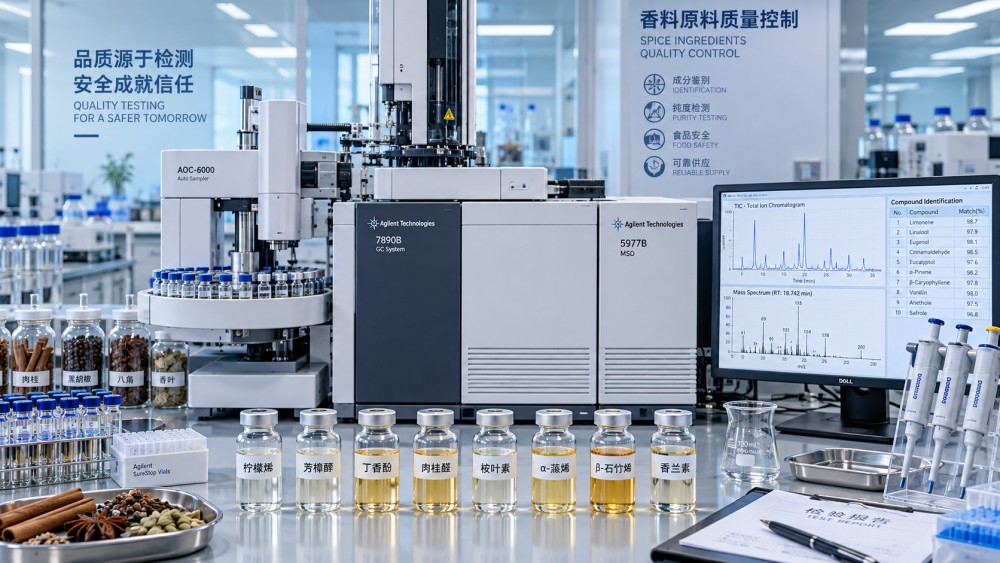
Require clarity on how the supplier calculates “purity.” GC area normalization expresses a component’s share of the detected chromatographic response; it is not necessarily equivalent to mass percentage. Different response factors, undetected water, or nonvolatile residues can affect the interpretation. A quantitative assay with appropriate calibration may be needed when concentration directly determines dosing or compliance.
Compare results using aligned methods. Differences in column selection, sample preparation, calibration, or integration can produce apparent disagreements between laboratories. Resolve method comparability before interpreting a discrepancy as evidence of supplier failure.
Treat odor evaluation as a controlled quality test
Analytical conformity does not guarantee olfactory equivalence. Trace components can contribute disproportionately to odor, while two batches with similar headline assays may differ in freshness, harshness, or dry-down.
Evaluate samples against an approved reference under standardized conditions. Define dilution, solvent, blotter type, evaluation timing, and sample coding. Avoid assessing unfamiliar concentrated materials directly from the container; follow appropriate handling and exposure controls.
For initial approval, assess several production lots rather than relying only on a specially prepared sample. Compare opening character, evaporation behavior, dry-down, and unwanted notes. The reference itself needs controlled storage and periodic review because oxidation or evaporation can make an aging standard misleading.
Then test the ingredient in the intended formulation at the proposed dose. An acceptable blotter result can still become unsuitable in a surfactant system, high-pH cleaner, or emulsion. Check relevant changes in odor, color, clarity, precipitation, and product stability under realistic conditions.
Accelerated testing can reveal vulnerabilities, but it does not establish shelf life by itself. Heat, light, and packaging-contact studies should be interpreted alongside ambient storage evidence, especially where elevated temperature creates degradation pathways unlike normal storage.
Select contaminant checks from the process—not a generic checklist
Testing every ingredient for every conceivable contaminant is expensive and may still miss the most relevant hazard. Ask which substances could enter through cultivation, extraction, synthesis, purification, storage, or shared equipment, then select tests and limits accordingly.
Botanical materials may justify pesticide screening based on agricultural inputs and sourcing controls. Solvent-extracted ingredients may need residual-solvent testing. Synthetic materials may require targeted checks for residual reagents, catalysts, reaction by-products, or purification residues.
Metal testing should reflect a credible source, such as catalyst use or processing equipment, rather than an unsupported claim that all fragrance ingredients carry the same metal risk. Microbiological controls are particularly relevant to water-containing preparations and susceptible carriers; neat essential oils and dry aroma chemicals should not automatically receive the same test panel as aqueous botanical extracts.
Oxidation deserves specific attention for susceptible ingredients. It can alter both odor and the safety profile. Review oxygen exposure, antioxidant use where applicable, container headspace, opening practices, and temperature control. Any oxidation test must have a method and acceptance limit suitable for the particular material.
A contaminant declaration is useful only when its basis is clear. Establish whether it rests on process knowledge, raw-material controls, analytical testing, or a combination. “Not intentionally added” does not mean “analytically absent.”
Audit the controls that keep approved quality repeatable
A strong initial sample proves little if the supplier cannot reproduce it. Assess the actual manufacturing site and any distributor or repacker in the supply chain. A distributor’s quality certificate does not automatically establish control over the original producer.
Focus an audit on evidence that connects production to release:
- Traceability: Can the supplied lot be linked to manufacturing records, input materials, processing, and any repacking or blending?
- Laboratory control: Are instruments calibrated, methods controlled, and results reviewed before release?
- Deviation handling: Are out-of-specification results investigated rather than repeatedly retested until an acceptable result appears?
- Contamination prevention: Are cleaning and segregation controls suitable for potent odorants, shared equipment, and sensitive materials?
- Retention and complaints: Are representative samples retained, and can complaints be traced to affected batches with documented corrective action?
ISO 9001 certification can support confidence in a quality-management system, but it does not certify the purity or sensory performance of an individual ingredient. Review the certificate’s scope and site coverage, then verify the controls relevant to the material.
Include change notification in a written quality agreement. Changes to manufacturing site, synthesis route, botanical source, extraction conditions, carrier, stabilizer, specification, or test method can invalidate an earlier approval. Define which changes require notice and which require requalification before shipment.
Confirm that shipping and receipt preserve the approved material
Quality approval should cover commercial packaging and distribution conditions, not just laboratory samples. Check container compatibility, closure integrity, light protection, fill conditions, and temperature requirements where relevant. A clean analytical result at manufacture cannot exclude deterioration or contamination during transit.
At receipt, verify the supplier lot against the certificate, inspect seals and container condition, and record evidence of leakage, unusual color, or improper storage. Sampling should avoid contaminating the lot or introducing excessive air into oxidation-sensitive material.
A small sample from one container may not represent an entire consignment. Set a documented sampling plan based on lot size, container count, material homogeneity, and supplier history. Keep incoming material under quarantine until required release checks are complete.
Make approval conditional on evidence—and keep checking
Approve a supplier-material-site combination, not merely a company name. A supplier qualified for one synthetic ingredient is not automatically qualified for a botanical extract or a different production location.
Use initial commercial deliveries to confirm that routine supply matches qualification samples. Early lots may warrant independent identity testing, targeted impurity analysis, and formulation comparison. Once consistency is demonstrated, some testing can move to a justified periodic schedule, while receipt verification and essential release controls remain in place.
Trend results rather than reviewing every certificate in isolation. Movement within specification can reveal changing feedstock, purification performance, or storage conditions before a formal failure occurs. Repeated odor drift, unexplained documentation changes, or unresolved deviations should trigger tighter testing or suspended approval.
The release decision should have an unambiguous outcome: accepted, quarantined pending investigation, or rejected. Any concession must remain within legal and safety requirements and be supported by a documented functional assessment. When identity, traceability, or a critical restriction cannot be established, a lower price or urgent delivery need is not an adequate basis for acceptance.
Related News
- China Records 543 New Cosmetic Ingredients, Including 167 in 2026Nov 12, 2026Prof. Elian Thorne
- Australia and New Zealand Weigh Wider Steviol Glycoside Use in Griddle ProductsNov 11, 2026Prof. Elian Thorne
- China Announces Risk-Based Cosmetic Change Reviews and Shorter TimelinesNov 10, 2026Prof. Elian Thorne
- How to assess product database coverage in an ingredient intelligence platformNov 08, 2026Prof. Elian Thorne
Related News
- 00
0000-00
Can biomimetic peptides improve skin firmness? - 00
0000-00
China Records 543 New Cosmetic Ingredients, Including 167 in 2026 - 00
0000-00
How to check a fragrance raw material specification for IFRA compliance - 00
0000-00
Australia and New Zealand Weigh Wider Steviol Glycoside Use in Griddle Products - 00
0000-00
How does pH affect plant-based color ingredients in beverages?
Prof. Elian Thorne
Weekly Insights
Stay ahead with our curated technology reports delivered every Monday.