





Micelles price differences in cosmetic formulations often begin with a misleading comparison: two clear liquids may appear similar, carry the same broad claim, and use the same headline surfactant family, yet their usable cost in a finished product can differ sharply. The reason is that a micellar system is a controlled assembly, not a single commodity ingredient. Its price reflects the purity and selection of surfactants, the way those surfactants organize in water, the solubilization burden placed on the system, the quality controls needed to keep it stable, and the documentation required to support its intended markets.
A low unit price can therefore conceal a higher formulation cost when it requires additional solubilizers, preservative adjustments, fragrance restrictions, repeated stability work, or a larger dose to reach acceptable cleansing performance. Conversely, a higher-priced micellar base may reduce formula complexity, improve sensory character, or hold oils and actives more reliably through storage. A meaningful comparison starts with the delivered, formulation-ready system rather than the price per kilogram of one raw material.
Surfactant architecture sets the baseline
Micelles form when amphiphilic molecules arrange their water-compatible heads toward the surrounding phase and their oil-affinitive tails toward an internal core. The chemistry of those molecules determines much of the initial cost. Commodity nonionic surfactants can support economical cleansing and solubilization, while mild amphoteric, amino-acid-derived, sugar-derived, or highly refined surfactants may command more because their feedstocks, synthesis routes, purification demands, and supply volumes differ.
The surfactant name alone is insufficient. Grade, molecular distribution, residual starting materials, odor profile, color, active content, and impurities all alter the commercial value of an ingredient. A surfactant with a broad distribution of ethoxylation or chain lengths may work acceptably in a rinse-off cleanser but create inconsistent clarity, odor, or cloud point behavior in a transparent micellar water. Tighter compositional control adds manufacturing and analytical cost, but it also reduces formulation variability.
Active matter must be normalized before comparing offers. One material may arrive as a concentrated paste, another as a dilute aqueous solution, and a third as a pre-blended liquid containing humectant or solvent. Comparing drum price without calculating the actual surfactant solids, the use level needed in the final formula, and the contribution of auxiliary components produces a distorted micelles price comparison.
Micelle quality is not visible from a clear bottle
Clarity is useful, but it is not proof of robust micelle formation. A system can look perfectly transparent at room temperature and still lose performance when exposed to cold storage, elevated temperature, repeated temperature cycling, salt introduced by another ingredient, or a small pH shift. Price differences often reflect how much development work and process control are embedded in achieving a useful operating window.
Micelle size and size distribution matter especially when the product is expected to remain water-clear and deliver a consistent skin feel. Smaller or more narrowly distributed assemblies may help maintain optical clarity, but the desired particle profile depends on the formula rather than on a universal “smaller is better” rule. A micellar cleanser carrying a light fragrance oil, a botanical extract, or a lipophilic skin-conditioning material faces a different solubilization challenge from a minimalist makeup-removal water.
Dynamic light scattering, turbidity measurement, centrifugation, and temperature cycling can reveal different weaknesses. Particle-size data collected from a freshly prepared sample may look stable while a preserved, fragranced batch turns hazy after a freeze-thaw cycle. Equally, a system that becomes slightly opalescent after storage may retain cleansing capacity and remain acceptable if the product brief allows it. The required appearance standard should be agreed before a premium is assigned to a highly transparent system.
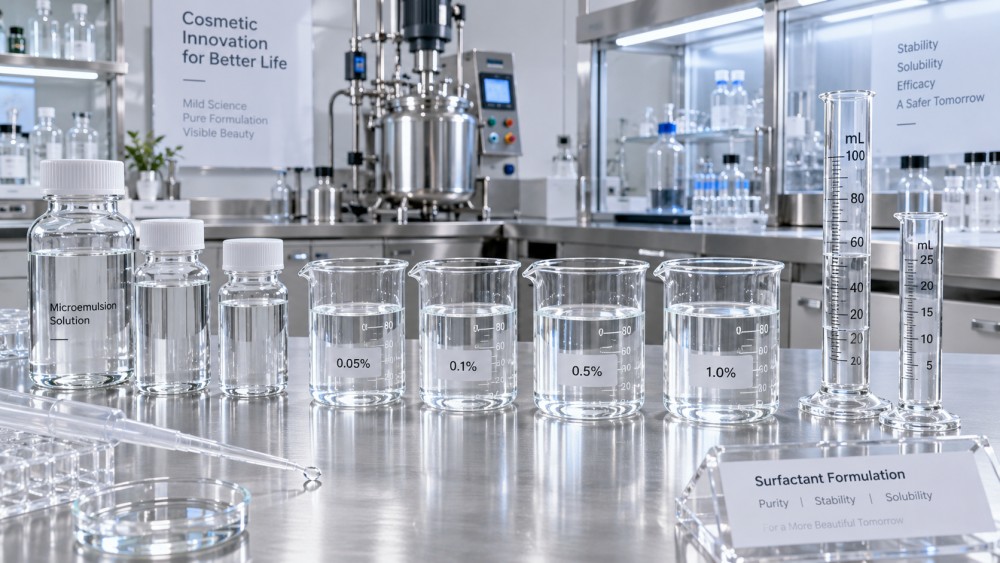
The ratio between surfactants is frequently more important than the presence of any one surfactant. A co-surfactant can lower interfacial tension, alter micelle curvature, improve tolerance for oils, and soften the cleansing feel. It can also introduce a new odor, affect foam behavior, narrow the pH range, or interfere with preservation. A lower-cost blend built around a high-loading primary surfactant may need several corrective ingredients. A more balanced, higher-priced blend may enter the production tank with fewer adjustments.
Purity affects sensory performance and formulation risk
For leave-on-adjacent products such as micellar waters, residue after wiping is often commercially important. Trace odor, stickiness, irritation potential, or a lingering surfactant film can be noticeable because the product is commonly left on skin or only lightly rinsed. Raw-material refinement, low-odor processing, and closer impurity specifications can therefore influence price even when the detergent action seems comparable on paper.
Impurities are also a technical issue. Residual solvents, free fatty alcohols, unreacted feedstocks, salts, oxidized fractions, and trace color bodies can change clarity or stability over time. Some contaminants interact with fragrance components, chelating agents, polymers, or preservatives. The resulting problem may appear late in product development, after packaging compatibility or extended storage samples have already been prepared. The cost of replacing a material at that stage is usually much larger than the apparent saving from an incomplete specification review.
Water quality should not be overlooked. In a simple micellar formula, water represents most of the composition and can carry dissolved minerals or microbial burden that complicate a sensitive surfactant system. The cost difference between a concentrate designed for controlled purified water and one intended to tolerate moderate ionic content can be justified only when it aligns with the actual production environment. Paying for electrolyte tolerance that is never needed is wasteful; assuming tolerance without evidence is a common source of haze and batch variation.
Solubilization capacity changes the true formula cost
A micellar system is often asked to carry ingredients that do not naturally dissolve in water: perfume oils, essential-oil fractions, oil-soluble antioxidants, certain botanical components, and lipophilic cosmetic actives. The question is not merely whether a clear solution can be made on the day of mixing. The relevant question is how much of the intended oil phase the system can retain without separation, crystal formation, scent loss, or a change in cleansing behavior during the stated shelf life.
High solubilization capacity does not automatically signal a better system. More surfactant or solubilizer may leave a stronger residue, increase eye sting potential, weaken the desired sensory profile, or make preservative selection harder. The appropriate target is the lowest effective surfactant burden that holds the required payload and performance. When a formula includes no oil-soluble materials, a costly high-capacity solubilizer package offers little value. When fragrance is central to the product identity, insufficient capacity can lead to persistent rework.
Actives can turn a basic micellar water into a delivery problem
Many formulas use micelles primarily for gentle cleansing. Others also seek deposition or improved apparent delivery of a lipophilic active. These are distinct design objectives. A system optimized to remove sebum and makeup may readily carry an active in the bottle yet remove it during wiping. A system intended to leave conditioning materials on skin needs assessment of residue, deposition, and compatibility with the product’s cleansing claim.
Claims about active delivery deserve particular scrutiny. Encapsulation, solubilization, and increased dispersion are not interchangeable with demonstrated skin delivery. A supplier may provide a micellar dispersion with a defined particle profile, but the profile can change after dilution into a full formula or after contact with salts, polymers, preservatives, and fragrance. The cost attached to a specialized active carrier should be evaluated against evidence from the actual final composition, not from a model system with different ingredients.
pH is a frequent source of false equivalence. A micellar base may be stable across a broad pH range by itself, while a chosen active, preservative system, or fragrance component narrows the acceptable range. Adjusting pH after the surfactant package has been selected can alter viscosity, cloud point, charge state, and microbiological protection. A lower-cost base that only works at a narrow pH point can become expensive when the remainder of the formula needs flexibility.
Documentation, change control, and regulatory fit have a real cost
Cosmetic ingredients require records that support safe, traceable formulation and market access. The appropriate documentation varies by destination, product category, and claim strategy, but the underlying commercial issue is consistent: documentation that is incomplete, outdated, or disconnected from the exact supplied grade creates delay. A low price is less meaningful when composition statements, allergen information, impurity limits, microbiological controls, origin information, or change-notification terms cannot be confirmed.
Change control deserves attention because micellar products can be sensitive to modest raw-material variation. A shift in fatty-chain feedstock, preservative grade, production site, or dilution water can change odor, clarity, foam, and particle behavior. Written notification periods and batch-to-batch specification limits are often more useful than broad marketing descriptions of consistency. These provisions can influence price because they require the supplier to maintain controls rather than simply meet a loose assay target.
Sustainability attributes also affect cost when they are supported by segregated feedstocks, documented origin, mass-balance accounting, biodegradability testing, or additional audit requirements. Such attributes should be tied to the product’s actual positioning and substantiation needs. Paying for a claim-related attribute that cannot be carried through the finished product documentation adds cost without creating a usable commercial advantage.
Scale, packaging, and plant behavior are part of the comparison
Large-volume, widely used surfactants benefit from established production assets and efficient logistics. Specialty micellar blends may have smaller batch sizes, more complex blending sequences, stricter filtration, or limited regional availability. These realities affect lead time, minimum order quantity, shipping format, and price volatility. They also influence how much buffer inventory is needed to avoid an interrupted manufacturing schedule.
Physical handling can expose hidden differences. A concentrate that becomes viscous in a cool warehouse may require warming, slower transfer, or dedicated pumping equipment. A low-viscosity liquid may be easier to dose but less concentrated, increasing freight and storage requirements. Some surfactant systems foam aggressively when added too quickly or circulated through high-shear equipment, trapping air and complicating filling. Processing instructions should be assessed alongside laboratory performance because a stable bench sample does not guarantee a straightforward production batch.
Packaging compatibility is equally practical. Micellar waters are commonly filled into clear or translucent packs, where slight color shift, cloudiness, sediment, or fragrance separation is immediately visible. Plastic packaging can also interact with fragrance or low-level solvents over time. Stability work should use the intended closure, headspace, fill temperature, and transport orientation where feasible. A supplier’s sample in a glass vial is useful for screening but cannot answer every packaged-product question.
Compare offers through an equivalent formula, not a single line item
A disciplined comparison places each candidate into the same formula brief: identical cleansing target, pH, water quality, fragrance or active load, preservative approach, packaging, and storage conditions. The relevant calculations include raw-material use level, added solubilizer or humectant, processing time, quality-control testing, expected yield, freight, and the cost of safety stock. This approach often reveals that apparently expensive materials reduce the number of supporting ingredients or lower the probability of an avoidable reformulation cycle.
- Separate the surfactant active content from water and carrier components before calculating use cost.
- Set acceptance criteria for clarity, odor, residue, and removal performance before reviewing samples, so the lowest initial quote does not define the technical target.
- Test with the real fragrance, active, preservative, and package rather than a stripped-down laboratory version.
- Record the permitted range for pH, temperature exposure, mixing order, and shear; a material that works only under tightly controlled conditions carries an operational cost.
Micelles price differences become understandable when the comparison is moved from raw surfactant cost to controlled performance in the final formula. The least expensive option is appropriate when the product is simple, the specification is broad, and the production environment is well matched to the material. A higher-priced system earns its place only when its purity, stability margin, solubilization behavior, sensory profile, documentation, or handling characteristics remove a genuine cost or risk elsewhere in the formulation.
Related News
- China Records 543 New Cosmetic Ingredients, Including 167 in 2026Nov 12, 2026Prof. Elian Thorne
- Australia and New Zealand Weigh Wider Steviol Glycoside Use in Griddle ProductsNov 11, 2026Prof. Elian Thorne
- China Announces Risk-Based Cosmetic Change Reviews and Shorter TimelinesNov 10, 2026Prof. Elian Thorne
- How to assess product database coverage in an ingredient intelligence platformNov 08, 2026Prof. Elian Thorne
Related News
- 00
0000-00
Can biomimetic peptides improve skin firmness? - 00
0000-00
China Records 543 New Cosmetic Ingredients, Including 167 in 2026 - 00
0000-00
How to check a fragrance raw material specification for IFRA compliance - 00
0000-00
Australia and New Zealand Weigh Wider Steviol Glycoside Use in Griddle Products - 00
0000-00
How does pH affect plant-based color ingredients in beverages?
Prof. Elian Thorne
Weekly Insights
Stay ahead with our curated technology reports delivered every Monday.