





When Does OEM Ingredient Sourcing Support Make Custom Formulations Viable?
Custom formulation is often treated as a branding decision: a new flavor profile, a cleaner preservative system, a richer serum texture, or a sulfate-free cleansing base that feels less stripping on the scalp. In practice, it is a sourcing decision first. A concept becomes commercially viable only when the required ingredients can be supplied with the right documentation, consistent performance, realistic lead times, and a cost structure that survives scale-up.
That is where OEM ingredient sourcing support matters. It is not simply a purchasing service or a supplier referral. The useful version of sourcing support connects formulation chemistry with regulatory readiness, manufacturing constraints, packaging interaction, market claims, and procurement reality. For food, fragrance, cosmetics, and household-care businesses, that connection can determine whether a promising prototype reaches the shelf—or remains an expensive laboratory sample.
The question for decision-makers is not “Can we make this formula?” Almost any experienced lab can make a bench sample. The better question is: Can we make it repeatedly, compliantly, and at the target quality level after the first production run?
Custom Formulations Become Viable When Sourcing Solves More Than Availability
An ingredient being available somewhere in the market is not the same as being sourceable for an OEM project. A specialty peptide may be listed by several traders, for example, but the brand still needs to know its grade, stability profile, recommended use conditions, batch-to-batch specifications, traceability, and the documents needed for the intended market. The same applies to essential oils, natural colors, antioxidants, hydrocolloids, and amino-acid surfactants.
OEM ingredient sourcing support custom formulations become practical when the sourcing partner can answer operational questions early rather than after the packaging has been approved. Can the selected antioxidant tolerate the product’s processing temperature? Will the fragrance remain recognizable after being introduced into a surfactant base? Does a botanical pigment drift in shade under light exposure? Does the thickener still deliver the expected viscosity after the formula is adjusted for pH, salt, or active loading?
Those are not minor technical details. They are the points at which many “differentiated” formulas lose their differentiation. A yogurt-style beverage may look excellent in a pilot cup but become thin after transport conditions change. A premium facial serum may contain an appealing active at a marketing-friendly level but fail to maintain clarity or sensory elegance over time. A laundry liquid can achieve cleaning power yet lose consumer acceptance because the fragrance collapses too quickly on fabric.
Good sourcing support narrows these risks before the project is locked into a costly development path.
The Four Conditions That Usually Determine Feasibility
A custom formulation is generally worth pursuing when four conditions can be met at the same time: the ingredient has a defensible role in the formula, the documentation matches the sales geography, the material performs under actual processing conditions, and the supply plan works at the expected order volume.
1. The ingredient must change the product in a meaningful way
Not every novel raw material deserves a custom program. The ingredient should solve a formulation problem or create a benefit the finished product can genuinely express. In food applications, that may mean preserving freshness without undermining flavor, creating a cleaner-looking label strategy, or improving mouthfeel with a carefully selected hydrocolloid system. In personal care, it may mean a more credible active story, a less harsh cleansing profile, or a texture that supports a premium positioning.
A useful discipline is to ask what happens if the proposed ingredient is removed. If the answer is “the formula is almost the same,” the material may be adding cost and complexity without creating a durable reason to customize. This is common with fashionable actives used at low levels without a clear formulation rationale, or with fragrance changes that do not translate through the finished base.
2. Documentation must arrive before commercial promises
Regulatory work is frequently underestimated because it does not look like product innovation. Yet it can decide the launch timetable. Food ingredients may require review against local food-use rules, specifications, labeling requirements, and the intended category of use. Cosmetic ingredients demand a different documentation trail, and the finished product’s safety assessment, ingredient listing, notification obligations, and claims must be considered in the destination market. Household-care ingredients can raise questions around classification, biodegradability expectations, impurity controls, and downstream communication obligations.
A responsible sourcing process does not casually label an ingredient “FDA approved,” “GRAS,” or “EU compliant.” These terms have specific meanings and do not automatically apply to every use, dose, product category, or geography. The practical requirement is simpler: obtain current supplier documents, verify the intended application, and have qualified regulatory personnel assess the finished-product route. FFAI’s intelligence approach is particularly relevant here because the commercial value of an ingredient is inseparable from the documentation needed to use it safely and credibly.
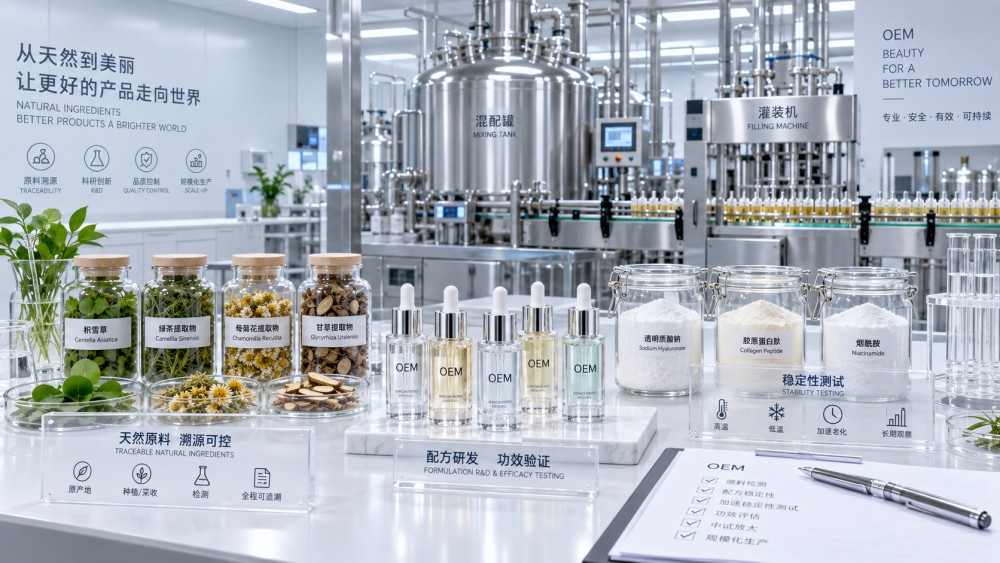
3. The formula must survive real manufacturing, not just a laboratory trial
The most overlooked gap in custom development is the difference between a small beaker and a production vessel. Heat history, mixing energy, order of addition, shear exposure, deaeration, filling temperature, and holding time can all alter the behavior of sensitive materials.
Consider the ingredients that shape the FFAI landscape. A preservative system may be effective only within a certain pH environment. Xanthan gum or another rheological thickener can deliver a desirable body in one formula while producing stringiness, poor dispersion, or inconsistent viscosity in another. Natural pigments can be especially sensitive to light, oxidation, and matrix interactions. Fragrance and essential-oil compositions may require solubilization work and careful compatibility checks to avoid haze, separation, or unexpected odor changes. High-end cosmetic actives may be vulnerable to heat, oxidation, or incompatibility with the broader base.
OEM support earns its value when it brings the ingredient supplier, formulator, and production team into the same conversation early. The objective is not to make the formula technically elaborate. It is to make it repeatable.
4. The commercial model must work beyond the first purchase order
A custom formula can fail commercially even when the chemistry is sound. Specialty materials often have higher minimum order quantities, longer replenishment cycles, narrower supplier pools, or greater price volatility than commodity inputs. That does not rule them out. It means the business case must be built around the right product architecture.
For a prestige serum, a costly active may be commercially sensible if it supports a clear formulation story, acceptable gross margin, and a price point the market can bear. For a high-volume shampoo or beverage, a similar material may be difficult to justify unless its use level is low, its supply is stable, or it replaces several other components. The decision cannot be made by looking at ingredient price per kilogram alone. Use level, yield, process loss, warehousing, testing, freight, and the cost of a substitute during disruption all matter.
Where OEM Sourcing Support Is Most Valuable
Not every project needs deep sourcing involvement. A straightforward line extension using an established base formula and familiar raw materials may only require routine procurement. Support becomes more valuable when the formulation contains one or more of the following conditions:
- an active, flavor, fragrance, pigment, or extract that materially defines the product concept;
- a clean-label, natural-origin, biodegradable, or high-purity target that limits material choices;
- multiple export markets with different documentation and labeling considerations;
- a formula that depends on tight sensory control, such as creaminess, slip, foam, fragrance evolution, or after-feel;
- an ingredient with limited approved suppliers, variable natural feedstock, or uncertain lead time;
- a need to move from concept to pilot production without repeated reformulation loops.
The strongest value is often created in the middle of the project, not at the beginning or end. By then, the brand knows what it wants to make, but has not yet committed to artwork, claims, large-scale packaging, or launch inventory. That is the point at which a sourcing review can still prevent a costly detour.
A Practical Evaluation Framework for Decision-Makers
Before approving a custom formulation, require the team to review the project through a cross-functional lens. The table below is not a substitute for technical validation, but it exposes the questions that often stay hidden in separate departments.
Do Not Confuse “Custom” With “Over-Engineered”
There is a tendency in premium FMCG development to add more ingredients in pursuit of a stronger story. That can work, but only when each component earns its place. A formula with several fragile actives, multiple natural extracts, a demanding fragrance, and a narrow preservation window may look attractive on paper while becoming difficult to manufacture consistently. Every additional dependency adds testing, documentation, and supply exposure.
The smarter route is often selective customization: make one or two elements genuinely distinctive and keep the rest of the system robust. A food brand may focus on an improved flavor-release profile while retaining a proven texture system. A skin-care launch may choose one well-supported active and build a stable, elegant vehicle around it rather than assembling a crowded active list. A detergent brand may prioritize a biodegradable surfactant direction and validate fragrance retention instead of changing every component at once.
This is also where molecular understanding and market intelligence need to meet. Sensory performance, transdermal delivery considerations, preservation, rheology, and cost are not separate workstreams in a finished product. They interact. FFAI’s focus on connecting ingredient science with commercial formulation decisions reflects the practical reality that a great molecule is not automatically a viable product solution.
The Decision Point: Is the Partner Reducing Uncertainty?
The right OEM sourcing partner does not merely say yes to every requested ingredient. A credible partner may recommend changing the grade, adjusting the target use level, selecting a more stable delivery form, simplifying the fragrance system, or delaying a claim until supporting information is in place. That kind of pushback is useful. It means the conversation has moved beyond catalog access.
Custom formulations are viable when sourcing support reduces uncertainty across the full chain: what the ingredient is, how it behaves, what can be documented, how it will be supplied, and whether the final product still makes economic sense. If those questions are answered before the project becomes expensive, customization can be a disciplined route to a better product—not a gamble dressed up as innovation.
Related News
- How to interpret active matter on a surfactant specification sheetOct 14, 2026Prof. Elian Thorne
- What Quality Checks Should You Run on Fragrance Ingredient Suppliers?Oct 14, 2026Prof. Elian Thorne
- How to assess a flavor chemistry manufacturer's batch consistencyOct 13, 2026Prof. Elian Thorne
- What drives fragrance ingredients price changes in bulk orders?Oct 12, 2026Prof. Elian Thorne
Related News
- 00
0000-00
Verifying halal status of hydrocolloid ingredients in the Middle East - 00
0000-00
How to interpret active matter on a surfactant specification sheet - 00
0000-00
What Quality Checks Should You Run on Fragrance Ingredient Suppliers? - 00
0000-00
How to assess a flavor chemistry manufacturer's batch consistency - 00
0000-00
What drives fragrance ingredients price changes in bulk orders?
Prof. Elian Thorne
Weekly Insights
Stay ahead with our curated technology reports delivered every Monday.