





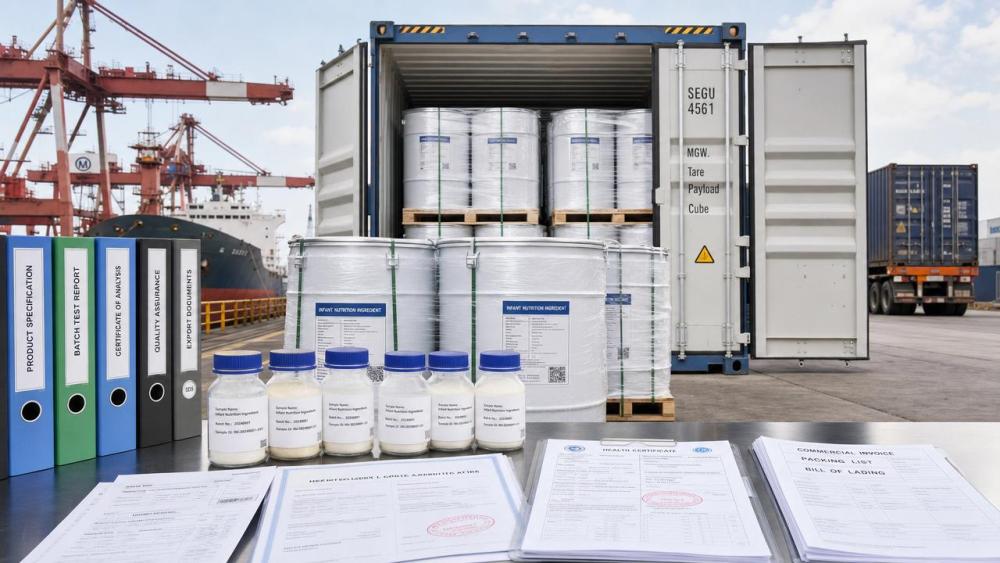
Starting on June 1, 2026, the General Administration of Customs will launch annual spot inspections for certain import and export goods outside the scope of statutory inspection. Although food ingredients are not explicitly listed, exporters of sensitive ingredients used in infant and young child nutrition should pay close attention, as customs practice has already placed some of these products into priority screening. For exporters, ingredient suppliers, quality teams, and logistics planners, the immediate issue is not only compliance itself but also whether customs clearance timing and delivery stability may come under new pressure.
What the June 1 measure confirms
The confirmed information is limited but important. According to the provided summary, the customs authority will begin annual spot inspections from June 1, 2026 for selected import and export goods that are not otherwise subject to statutory inspection. Infant and child products and low-voltage electrical products are identified as key categories in the announcement.
The same summary notes that food ingredients are not expressly named. However, in actual practice, several highly sensitive product types used in infant complementary foods have already been included in priority spot checks, including natural colors, water-soluble flavors, and high-purity hyaluronic acid. The provided information also states that exporters are advised to prepare IFRA and FDA GRAS documentation packages together with batch testing reports in advance to help maintain delivery stability.
Where the pressure may appear first in the supply chain
Exporters handling sensitive infant-use ingredients
Analysis shows this group is the most directly exposed to timing risk. Even where a product is not formally listed as a food ingredient priority category, actual inspection practice around sensitive infant-use applications may affect customs clearance steps, document review, and shipment release timing. What deserves closer attention is whether internal export files can support quick verification when a shipment is selected.
Ingredient buyers and sourcing teams
From an industry perspective, procurement teams may feel the impact through lead-time uncertainty rather than a confirmed change in product eligibility. If customs handling becomes less predictable for priority-screened lots, buyers may need to watch shipment scheduling, specification consistency, and supplier readiness for supporting documents more closely.
Processors and end-use manufacturers
For manufacturers using these inputs in infant and young child nutrition applications, the main exposure is continuity of supply. Observably, even a limited increase in inspection attention can affect production planning when ingredients are highly specified or difficult to substitute quickly. The key business link here is coordination between production schedules and import or export release timing.
Logistics and supply chain service providers
Service providers involved in customs clearance and shipment planning may need to pay closer attention to product sensitivity, documentation completeness, and batch-level traceability. The practical impact is likely to appear in pre-clearance preparation and exception handling rather than in ordinary transport execution alone.
What companies should review now
Separate the written scope from inspection practice
The announcement, based on the provided information, highlights key categories such as infant and child products, but does not explicitly name food ingredients. Analysis shows companies should not rely only on category wording; they should also assess whether their products fall into the sensitive groups that customs practice has already treated as priority screening targets.
Prepare document packages before shipment
The clearest operational message in the provided information is document readiness. Exporters should review whether IFRA files, FDA GRAS materials, and batch testing reports can be assembled in a complete and shipment-ready format before customs submission, rather than after a spot check is triggered.
Check batch-level consistency and traceability
Because the summary specifically mentions batch testing reports, companies should focus on whether product batches, specifications, and testing records align cleanly across internal quality, regulatory, and shipping documents. This is especially relevant where one ingredient may be sold into infant-use applications that receive greater scrutiny.
Reset delivery communication with customers
Observably, the most immediate business issue may be delivery stability. Companies serving overseas buyers should review how they communicate possible customs inspection timing, what buffer they build into shipment commitments, and how they escalate document requests if a lot is selected for priority review.
Why this matters beyond a single notice
Analysis shows this update is best read as a practical compliance signal rather than proof of a broad rule change for all food ingredients. The announcement itself does not confirm that all infant food ingredients will face the same treatment, but it does indicate that customs attention may extend into adjacent sensitive materials where infant-use risk is higher. That makes this a development worth continued monitoring, especially for businesses whose products sit near the boundary between general ingredients and high-scrutiny infant-use inputs.
It is more appropriate to understand this as a short-term operational risk with possible longer-term compliance implications. The short-term question is whether spot inspections affect clearance efficiency for sensitive shipments. The longer-term question is whether inspection practice becomes more standardized or more clearly articulated for these ingredient categories.
How the market should interpret the update
At this stage, the most balanced reading is that the June 1 measure does not by itself establish a confirmed broad restriction on infant food ingredient exports, but it does raise the importance of shipment readiness for sensitive categories. For the industry, the significance lies in customs execution risk: products not expressly named in policy language may still face closer review in practice.
That is why the current focus should remain on documentation, batch testing support, and delivery planning rather than on overstating market impact. From an industry perspective, this is a development that requires attention, operational adjustment, and continued observation rather than a conclusion that trade conditions have already fundamentally changed.
Basis of this article and what still needs verification
This article is generated based on the user-provided news title, event date, and event summary. The information available for this piece includes the June 1, 2026 timing, the annual spot inspection arrangement for certain non-statutory inspection goods, the identification of infant and child products and low-voltage electrical products as key categories, the practical inclusion of some sensitive infant-use ingredients in priority screening, and the recommendation to prepare IFRA, FDA GRAS, and batch testing materials in advance.
Typical source types relevant to this kind of industry update may include official customs announcements, company disclosures, industry association notices, authoritative media reporting, and standard-setting documents. However, a specific official source link was not provided in the input, so the precise source document still needs ongoing verification. What should be monitored next is whether later official wording, implementation guidance, or market practice provides clearer confirmation on category scope, inspection frequency, and execution standards for sensitive infant-use ingredients.
Related News
- How to assess color stability from a natural food colors manufacturerOct 06, 2026Food Rheology Expert
- How natural food pigments for bakery hold color during bakingSep 20, 2026Food Rheology Expert
- EFSA Tightens MRLs for Natural Food ColorsAug 10, 2026Food Rheology Expert
- EFSA Updates Residue Limits for Natural Colorants, Drawing Attention to China’s Export Compliance PathwaysAug 08, 2026Food Rheology Expert
Related News
- 00
0000-00
What drives fragrance ingredients price changes in bulk orders? - 00
0000-00
How to assess a food antioxidants distributor’s traceability practices - 00
0000-00
How minimum order quantities shape private label ingredient sourcing costs - 00
0000-00
What drives personal care ingredient price volatility in sourcing - 00
0000-00
What drives micelles price differences in cosmetic formulations?
Food Rheology Expert
Weekly Insights
Stay ahead with our curated technology reports delivered every Monday.