





China’s updated GB 7718-2025 standard for prepackaged food labeling took effect on June 1, 2026, turning recent attention toward how natural ingredient claims are documented and presented in the market. For ingredient exporters, food manufacturers, procurement teams, and international buyers sourcing from China, the development is notable because it links product positioning more closely with label compliance, especially where claims such as natural origin, non-synthetic, and non-hydrogenated are involved.
What the new labeling standard now requires
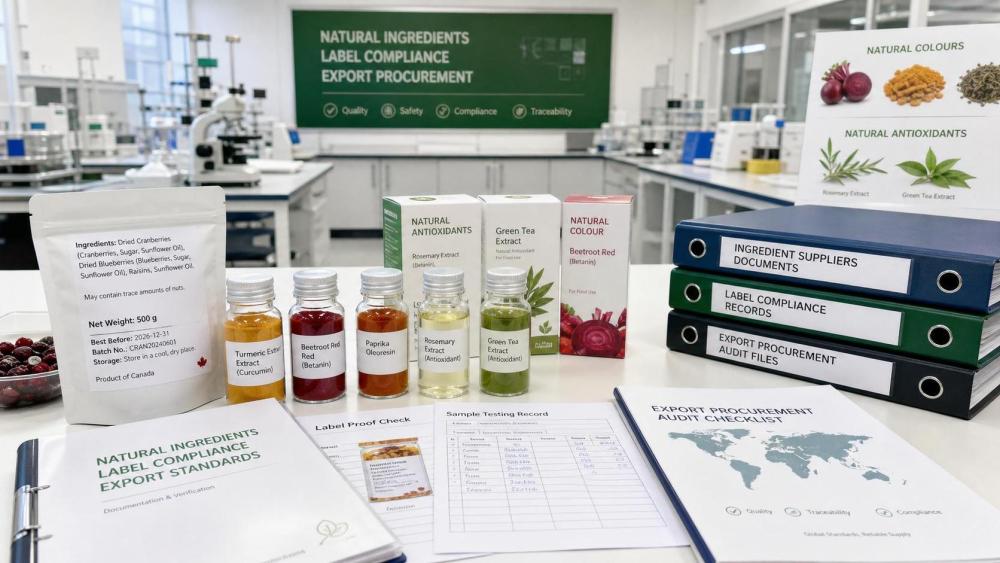
According to the information provided, the General Standard for the Labeling of Prepackaged Foods, GB 7718-2025, was issued on March 27, 2025 and officially came into force on June 1, 2026. The updated standard adds evidence-chain requirements for claims including natural origin, non-synthetic, and non-hydrogenated. It also standardizes how Natural Food Colorants and Natural Antioxidants are labeled.
The same information indicates that global buyers purchasing natural ingredients from China now need to review not only the ingredients themselves, but also the supplier’s supporting labeling compliance capability.
Where the practical impact is likely to appear
Procurement decisions may now extend beyond ingredient specifications
From an industry perspective, buyers of natural ingredients may be affected because supplier selection is no longer only about product quality or supply availability. The information provided suggests that supporting documentation for label claims becomes part of the review process, which may influence sourcing assessment, supplier onboarding, and contract communication.
Manufacturers may face closer coordination between formulation and labeling
Analysis shows that food manufacturers using natural ingredients are likely to pay closer attention to how product claims are supported before labels are finalized. The impact may be most visible in internal review steps tied to claim wording, document preparation, and label approval for products that emphasize natural positioning.
Export and trading participants may need stronger compliance alignment
For trading companies and export-facing suppliers, the development may affect customer communication and delivery preparation. What deserves closer attention is whether overseas buyers begin to request clearer proof packages related to claim language and labeling treatment, especially for products marketed with natural component narratives.
What companies should be reviewing now
Check whether claim language can be backed by documents
Analysis shows that businesses should focus on whether claims such as natural origin, non-synthetic, and non-hydrogenated are supported by a complete evidence chain, rather than treating label wording as a standalone marketing matter.
Review naming and presentation of relevant ingredient categories
Companies dealing with Natural Food Colorants and Natural Antioxidants should closely examine how these categories are described in labels and related materials, since the provided information points to more standardized labeling treatment under the new rule.
Reassess supplier files used in cross-border sourcing
For global buyers sourcing from China, a practical priority is to verify whether suppliers can provide the documentation and compliance support needed for downstream labeling use. This matters not only at purchase stage, but also in audit preparation, customer communication, and shipment-related document checks.
Separate policy wording from business execution
Observably, one of the key operational issues is the gap between a rule taking effect and a company being ready to implement it smoothly. Businesses may need to align procurement, regulatory review, labeling, and customer-facing teams so that claim use, supporting materials, and product delivery stay consistent.
Why this matters beyond a single label update
Observation: this development is better understood as more than a narrow wording adjustment. It points to a stricter connection between natural-claim language and verifiable support in the prepackaged food labeling process. That does not by itself confirm how every market participant will respond, but it does suggest that compliance capability is becoming more visible in commercial discussions around natural ingredients.
Observation also shows that this is not merely a short-term transition issue. The standard is already in force, yet the fuller industry response may still depend on how companies interpret claim risk, organize internal evidence, and answer buyer due diligence in practice.
How to read the signal at this stage
At this stage, it is more appropriate to understand the implementation of GB 7718-2025 as a clear compliance signal with direct operational relevance, rather than as a finished market outcome. The confirmed change is the enforcement of stricter requirements around certain natural-related claims and the standardized treatment of some ingredient descriptions. The broader commercial effect still deserves continued observation through procurement reviews, supplier coordination, and label compliance practice.
Basis of this article
This article is generated based on the user-provided news title, event date, and event summary. The factual basis available here includes the stated implementation date, the reference to GB 7718-2025, the added evidence-chain requirements for specific claims, the standardized labeling treatment for Natural Food Colorants and Natural Antioxidants, and the need for global buyers to review related labeling compliance capability.
For this type of industry update, common source types may include official notices, standard documents, company disclosures, industry association materials, and reporting by authoritative media. A specific official source link was not provided in the input, so further verification remains necessary. Continued attention should focus on any later clarifications, implementation interpretations, and practical compliance expectations affecting sourcing and labeling workflows.
Related News
- How to assess color stability from a natural food colors manufacturerOct 06, 2026Food Rheology Expert
- How natural food pigments for bakery hold color during bakingSep 20, 2026Food Rheology Expert
- EFSA Tightens MRLs for Natural Food ColorsAug 10, 2026Food Rheology Expert
- EFSA Updates Residue Limits for Natural Colorants, Drawing Attention to China’s Export Compliance PathwaysAug 08, 2026Food Rheology Expert
Related News
- 00
0000-00
How to assess color stability from a natural food colors manufacturer - 00
0000-00
When does amino acid surfactant powder improve cleanser mildness? - 00
0000-00
How to verify a cosmetic nanotechnology supplier's safety documentation - 00
0000-00
How rheological thickeners for shampoo affect suspension stability - 00
0000-00
How to assess recombinant collagen ingredients for cream stability
Food Rheology Expert
Weekly Insights
Stay ahead with our curated technology reports delivered every Monday.