





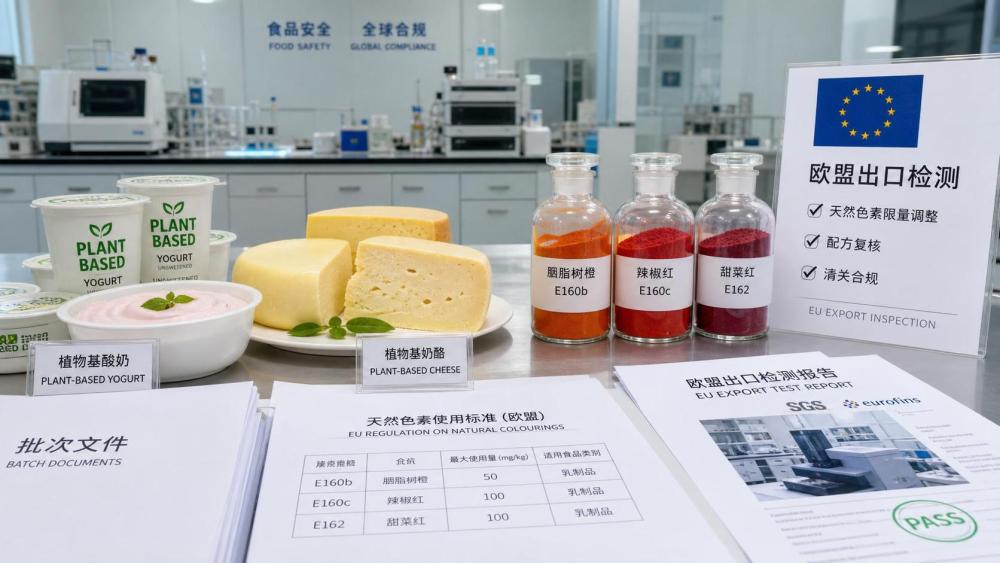
On 9 July 2026, the European Food Safety Authority (EFSA) released updated safety assessments that lower acceptable intake limits for annatto (E160b), paprika extract (E160c), and beetroot red (E162) when used in plant-based yogurts and cheeses. The development matters not only to natural food colorant exporters serving EU-formulated dairy alternatives, but also to manufacturers, procurement teams, and customs-facing compliance functions, because it links product formulation decisions directly to market access and shipment clearance.
What EFSA changed on 9 July
According to the information provided, EFSA updated its safety assessments on 9 July 2026 for three natural food colorants: annatto (E160b), paprika extract (E160c), and beetroot red (E162). The updated assessments reduce ADI values specifically for their use in plant-based yogurts and cheeses.
The stated basis for this update is new data related to metabolic stability and cumulative exposure. The information provided also indicates a direct trade consequence: exporters supplying these colorants into EU-formulated dairy alternatives may now need either reformulation or batch-specific compliance documentation before customs clearance.
Where the pressure is likely to appear first
Export supply into EU dairy-alternative production
From an industry perspective, exporters of natural food colorants are the first group likely to feel the change because the update directly affects products moving into EU-formulated plant-based yogurt and cheese applications. The main pressure point is no longer only product availability, but whether a shipment can be supported by documentation that matches the updated safety position.
What deserves closer attention is the link between regulatory interpretation and customs execution. Even where supply contracts are already in place, exporters may need to align product files, batch documentation, and customer-facing declarations with the revised limits.
Formulation and procurement inside plant-based dairy
Manufacturers and ingredient buyers in plant-based dairy alternatives may be affected at the formulation stage. If the previous use levels of annatto, paprika extract, or beetroot red are no longer suitable under the updated ADI framework for plant-based yogurts and cheeses, procurement and R&D teams may need to reassess current ingredient selections and usage levels.
Analysis shows that the practical issue is not limited to ingredient substitution. It may also affect specification management, supplier approval, and coordination between purchasing and technical teams where EU-bound products are involved.
Compliance, logistics, and border-facing operations
Supply chain service providers, customs documentation teams, and other compliance-related functions may also see a more immediate workload impact. The information provided specifically mentions batch-specific compliance documentation before customs clearance, which means administrative readiness can become a gating factor for shipment movement.
Observably, this makes documentation quality part of commercial execution. Delays or mismatches in batch records, declarations, or application-specific compliance materials could become a business issue even before any wider market response develops.
What companies should review now
Check affected applications rather than treating this as a broad ban
Analysis shows that the update described in the input is specific to plant-based yogurts and cheeses. Companies should therefore focus first on where these three colorants are being used in those applications, rather than assuming the same impact automatically applies across all food categories.
Separate formulation questions from documentation questions
What deserves closer attention is the difference between two practical tracks: reformulation and proof of compliance. Some businesses may need to revisit recipe or use-level decisions, while others may first need to ensure that batch-specific compliance documents are complete and ready for customs-related review.
Review supplier files and customer communication timing
For exporters and downstream users, supplier qualification and customer communication are likely to become more important in the near term. Analysis shows that where shipments support EU-formulated dairy alternatives, companies should be prepared to confirm how affected batches align with the updated assessments and to communicate any resulting adjustments in lead time or documentation requirements.
Monitor whether official wording leads to additional operational interpretation
Observably, one of the practical risks in this kind of update is the gap between a published safety assessment and how market participants implement it in contracts, border procedures, and technical reviews. Companies should therefore keep tracking how the updated position is referenced in actual compliance workflows tied to EU market entry.
Why this reads as more than a one-day update
Analysis shows that this development is not just a narrow ingredient notice. It signals that even natural colorants used in plant-based dairy alternatives can face tighter scrutiny when new evidence on metabolic stability and cumulative exposure is introduced. That matters because the immediate consequence described in the input is operational: reformulation or batch-level compliance proof may be required before goods clear customs.
At the same time, it is more appropriate to understand this as a targeted regulatory signal rather than a complete market conclusion. The confirmed information is specific in scope, and the broader commercial effect will depend on how companies adapt formulations, documents, and customer delivery plans in response.
How the market should frame this development
At this stage, the update is best understood as a concrete compliance change with immediate relevance for EU-facing plant-based yogurt and cheese supply chains, especially where annatto, paprika extract, and beetroot red are involved. It does not support broader conclusions beyond the applications and requirements described in the input, but it clearly raises the importance of formulation review and batch-level documentation discipline.
From an industry perspective, this is both a short-term operational issue and a longer-term signal that evidence-based reassessment of natural ingredients can translate quickly into trade and execution consequences.
Basis of this article and points for continued verification
This article is based on the user-provided news title, event date, and event summary. For developments of this type, relevant source categories typically include official notices, regulatory or safety authority publications, company statements, industry association updates, authoritative media reporting, and standards-related documents.
A specific official source link was not provided in the input, so the exact underlying publication and any subsequent implementing references still require continued verification. Areas that remain worth monitoring include any further official wording, follow-on compliance interpretation, and how documentation expectations are applied in actual customs and commercial processes.
Related News
- How to assess color stability from a natural food colors manufacturerOct 06, 2026Food Rheology Expert
- How natural food pigments for bakery hold color during bakingSep 20, 2026Food Rheology Expert
- EFSA Tightens MRLs for Natural Food ColorsAug 10, 2026Food Rheology Expert
- EFSA Updates Residue Limits for Natural Colorants, Drawing Attention to China’s Export Compliance PathwaysAug 08, 2026Food Rheology Expert
Related News
- 00
0000-00
Can biomimetic peptides in cosmetics reduce the look of wrinkles? - 00
0000-00
How to assess a bio-based thickener manufacturer's batch consistency - 00
0000-00
Verifying halal status of hydrocolloid ingredients in the Middle East - 00
0000-00
How to interpret active matter on a surfactant specification sheet - 00
0000-00
How Do You Test Hydrocolloid Viscosity After Changing a Thickener?
Food Rheology Expert
Weekly Insights
Stay ahead with our curated technology reports delivered every Monday.